

Hollow-type or pigment-type? Spot the cause first, then choose filler or laser.
Published
Updated

Author
Wi Young-jin · Chief director
Seoul National University College of Medicine · Seoul National University Hospital Specialist
→
When searching for ways to get rid of dark circles, it is easy to get confused: "Should I get dermal fillers, or should I get a laser treatment?" Since they are all called dark circles, but some people are recommended fillers while others are recommended lasers, it can be hard to tell which path is right for you.
The short answer is that dark circles have many different causes. Therefore, the correct approach is to first diagnose which contributing factors are present before choosing a treatment. The most effective method changes depending on whether the darkness is due to structural shading, pigmentation, or visible blood vessels.
This content compiles treatment insights from Beautystone in Hapjeong.
In this article, you will discover:
Why dark circles form and the different types of causes
Why dermal fillers are suitable for structural (sunken) dark circles
How laser treatments are used for pigmented and vascular dark circles
How we identify the root cause together at Beautystone in Hapjeong
Why do dark circles form?
While they might just look like a single dark patch, the underlying causes are much more diverse than you might think. According to research classifying the causes of dark circles, they are categorized into pigmented types (brown), vascular types (blue/purple) where blood vessels show through, structural types caused by shadows from sunken under-eye areas, and mixed types combining these factors.
The same study highlights that mixed types are actually more common than single-cause types. This means that rather than having just one cause, most people have a combination of two or three. That is why, instead of choosing a treatment simply because the color is dark, it is crucial to first understand which specific type of dark circle you have.
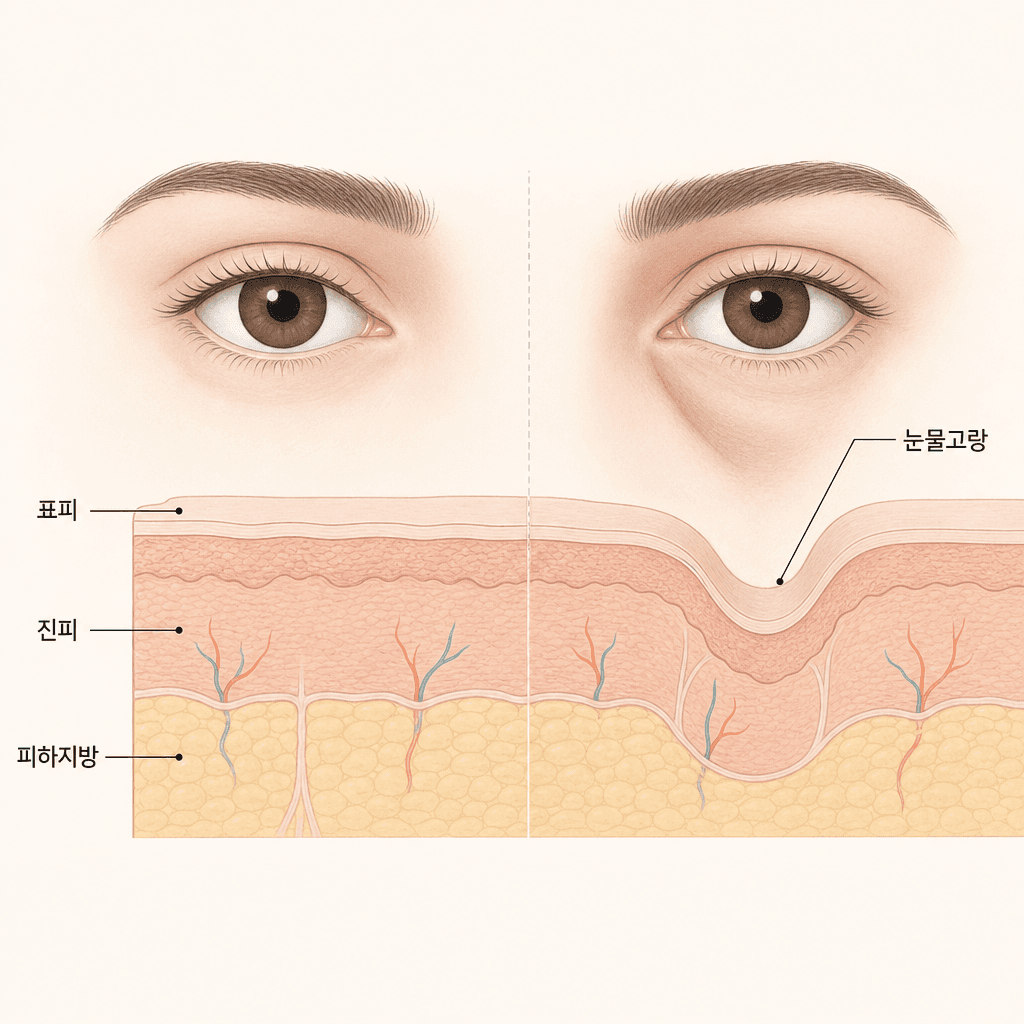

Which type of dark circles are fillers best for?
We often hear this during consultations: "My under-eyes look fine under bright indoor lighting, but they look exceptionally dark under natural light." In these cases, the cause is often structural rather than pigment-related.
Fillers are primarily used for structural (sunken) dark circles. If the under-eye area is hollowed or if a deep tear trough* creates a shadow, this approach fills in that valley to minimize the shadow. Rather than removing pigment or shrinking blood vessels, it physically restores the structure. Looking at clinical literature on dark circle diagnosis and treatment, identifying the root cause first before selecting a therapy is highly recommended. If the issue is structural, treatments targeting pigment alone will have very limited results, making a cause-specific approach essential.
Tear trough*: The groove that runs between the under-eye area and the cheek. When volume decreases or the structure hollows out, it casts a shadow that makes the area look dark, mimicking dark circles.

Which type of dark circles are lasers best for?
Laser devices are used for pigmented* or vascular* dark circles. For pigmented areas, we use wavelengths that target melanin, and for visible blood vessels, we consider modalities that target vascular structures. According to materials covering infraorbital hyperpigmentation and vascularity, because dark circles often have overlapping causes, determining the precise etiology is the key to treatment selection, often requiring a combination of different methods.
Pigmented type*: This is when melanin pigment deposits in the superficial layers of the skin, making the under-eye area look brown. Major causes include UV exposure, friction, and aging.
Vascular type*: This occurs when blood vessels show through the thin skin under the eyes. It appears blue or purple and can look more pronounced depending on fatigue or blood circulation.
If there is a structural hollow as well, lasers alone may show limited improvement. This is because even after clearing the pigment, the sunken structure will still cast a shadow. For mixed types, we typically design a targeted plan that addresses each aspect step-by-step or combines treatments.
Here is a quick summary of the primary approaches used for each type:

Why Beautystone in Hapjeong starts with the root cause
At Beautystone in Hapjeong, we carefully assess the pigment, blood vessels, and structure of the under-eye area for each individual case to customize the treatment plan. Because mixed types are so common, addressing only one cause often leads to only half-satisfactory results.
Rather than quickly declaring "this is the treatment for you" during your consultation, we prefer to first figure out which causes are present and in what proportions, mapping out your treatment journey together. As a cozy clinic located just a short walk from Hapjeong Station, you can easily discuss your diagnosis, treatment plan, and schedule all in one visit.

Things to check together before your treatment
The skin under the eyes is very thin and structurally complex, making a precise diagnosis essential before any procedure. Keeping these points in mind will make your consultation even more helpful:
If the color looks different under natural light versus indoor lighting, there is a high chance a structural (sunken) component is involved.
If the color is brownish, it is likely a pigmented type. If it is blue or purple, it is likely a vascular type.
Because mixed types are common, some cases may not be completely resolved with just a single type of treatment.
If you are currently using Retinol, AHA, or undergoing other laser treatments, please let our medical team know beforehand for your safety.
Your individual skin condition is always best assessed in person in our consultation room.

Frequently Asked Questions
Q. Which is better for dark circles, fillers or lasers?
A. It depends on the root cause. If the darkness is due to a shadowed structure, fillers are helpful; if it is due to pigment or blood vessels, laser treatments are more suitable. Since mixed cases are very common, identifying the cause first is the most important step.
Q. My under-eyes look sunken. Will fillers make them look brighter?
A. If shadows are created by a hollow structure, filling the groove with dermal fillers to minimize the shadow is a great approach. However, it is always best to check if there are accompanying pigment or vascular causes first to plan the optimal treatment sequence.
Q. Can dark circle lasers remove them in a single session?
A. For pigmented and vascular types, the number of sessions and overall results vary depending on your skin condition and the depth of the target. If you have a mixed type, lasers alone may have limited efficacy, so it is safest to determine your approach after a detailed consultation with a medical professional.
Q. The skin under my eyes is brown. Is a laser the right choice?
A. For brownish dark circles caused by pigment deposition, laser treatments targeting pigment are highly considered. However, it is ideal to check for any combined structural or vascular issues, and the wavelength and intensity must be carefully tailored to your skin's pigment levels for a safe treatment.



Contouring & Volume
Hip Dip Filler Before and After: 4 Checks

Body
Potenza Treatment Interval: Why 4 Weeks?

Lifting
Ultherapy Before and After: Why Wait 90 Days?

Contouring & Volume
Belotero Revive Cost: 2cc Price vs. 3 Sessions

skin
Lip Hyperpigmentation Laser: Does It Work?

Contouring & Volume
Men's Forehead Filler: Hollow or Just Lines?