

Do fat-dissolving injections for a double chin last? What returns, what doesn't, and why.
Published
Updated

Author
Wi Young-jin · Chief director
Seoul National University College of Medicine · Seoul National University Hospital Specialist
→
One of the most common questions we hear about double-chin injections is the one you're here for: if the fat melts away now, won't it come back the next time your weight goes up?
Here's the honest, two-part answer. Deoxycholic acid injections break down the membranes of fat cells in the treated pocket, so those cells are destroyed and cleared by your body over the following weeks. Because the number of fat cells you carry stays relatively stable in adulthood, the cells that are cleared don't regenerate. That's the reassuring half. The other half matters just as much: the fat cells that remain under your chin can still enlarge if you gain a significant amount of weight later. Fewer cells means less capacity to store fat there, but fewer isn't none. Individual results vary.
In this article, we'll cover what deoxycholic acid is, how it works under your chin, what the sessions and recovery really look like, the side effects and red flags worth knowing, how it compares with tightening and liposuction, and who's a good candidate. This is general information from Beautystone, a dermatology clinic in Seoul's Hapjeong area.
Why Dieting and Fat-Dissolving Injections Aren't the Same Thing
The short answer: dieting shrinks fat cells, while deoxycholic acid destroys them. That difference is the whole reason this question has a hopeful answer.
When you lose weight, the fat cells under your chin don't leave. They empty out. Each one gives up the lipid stored inside it and gets smaller, but the cell stays right where it was, intact and capable of refilling. That's why a double chin so often reappears after a few relaxed months. Nothing was removed; the storage containers just got emptier.
Deoxycholic acid works one level down. It's a synthetic form of a bile acid your body already makes to break down dietary fat. Injected into a fat pocket, it disrupts the membrane of the fat cell itself. The cell can't survive that, so it breaks apart and its contents are cleared. Once a fat cell is destroyed, it doesn't rebuild itself.
That's where the adult fat-cell count comes in. In adulthood, the number of fat cells you carry stays relatively stable. When your weight rises or falls, what's mainly changing is the size of those cells, not how many there are. So when a portion of the cells under your chin is destroyed, your body isn't standing by to make replacements.
The caveat you shouldn't skip: the cells that remain are still fully functional storage cells. Gain a significant amount of weight and they can enlarge, and the area can look fuller again. It won't necessarily look the way it did before, since there's less storage capacity there, but it isn't weight-proof. Individual results vary.
What Is Deoxycholic Acid, and Is It Regulated?
Deoxycholic acid is a drug, not a device, and that shapes how it's regulated. The injectable form used here is FDA-approved for moderate to severe submental fat, the clinical term for the pocket under the chin. That approval is specific to the submental area; use anywhere else on the body falls outside it, and a provider offering it elsewhere should say so plainly.
A few practical points follow from it being a drug:
It's prescription territory: this isn't a spa add-on. It should be planned and injected by a qualified medical provider who has examined your neck in person.
Anatomy dictates placement: the under-chin area sits close to nerves, so mapping where the product goes, and where it doesn't, is the core skill.
Products differ: not every fat-dissolving injectable is deoxycholic acid based, so ask what's going in.
It only treats fat: it isn't a skin-tightening treatment, and it won't help a jawline whose main issue is laxity.
How Does It Work Under Your Chin?
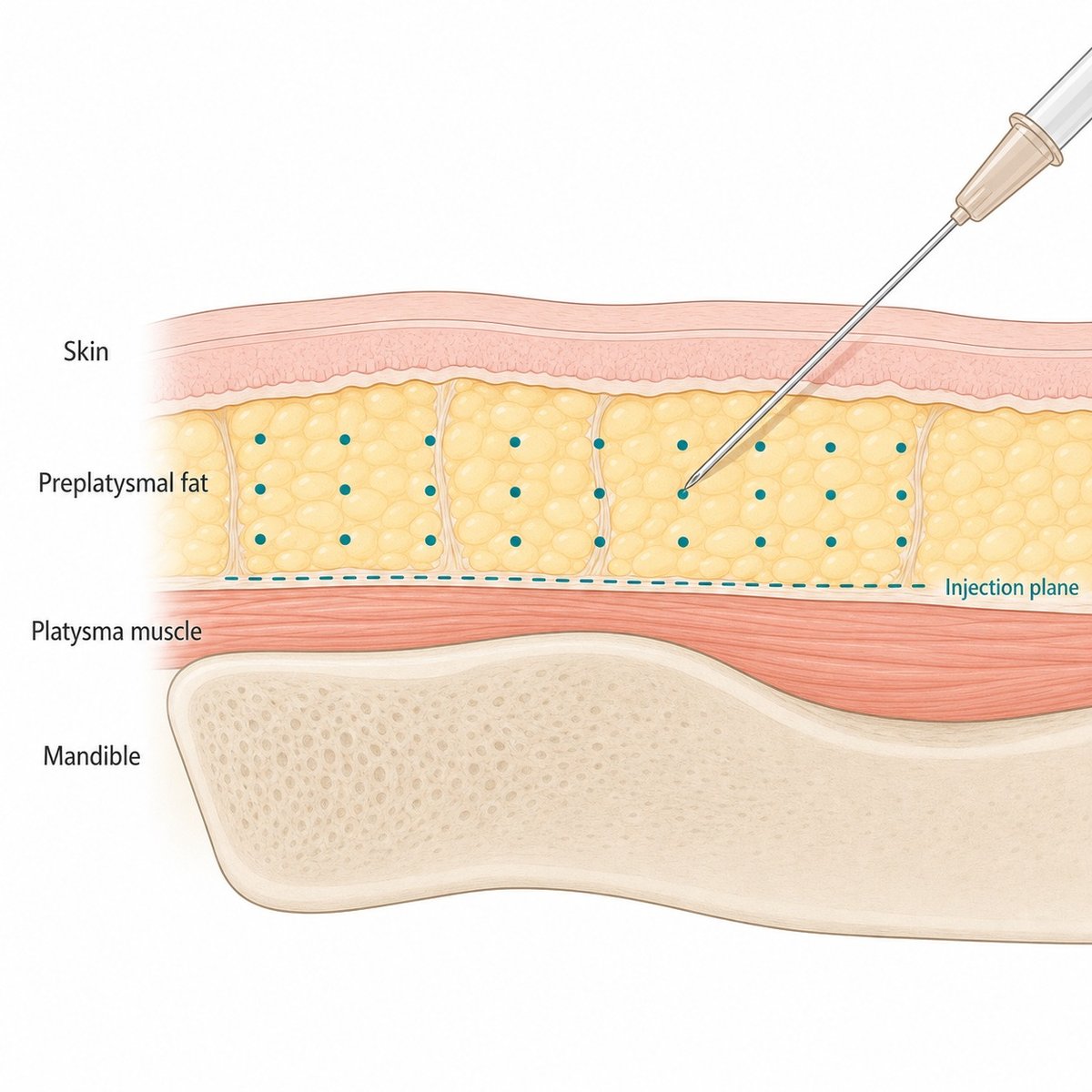
It works by being placed into the fat compartment itself, not the skin above or the muscle below. Under your chin, the fat that creates the visible bulge sits in the preplatysmal compartment, a layer of subcutaneous fat resting on the platysma, the thin sheet of muscle across the front of the neck.
During a session, your provider marks the treatment area and injects small amounts across it in a grid pattern rather than one concentrated deposit. Spreading the injections out gives an even reduction instead of a patchy result, and it keeps product away from structures that shouldn't be touched. A session usually runs twenty to thirty minutes, in a treatment chair with topical numbing.
You'll typically feel warmth, stinging, or a tight, burning sensation during and shortly after. That's expected: it's the product beginning to act on the fat. What comes next takes patience, because clearing the broken-down cells is gradual.
Since the effect builds up, most people don't get their full result from one appointment. Providers typically plan two to three sessions, spaced roughly four to eight weeks apart, and reassess between rounds rather than committing to a fixed package on day one. How many you need depends on how much fat you're starting with and how you respond.
What to Expect: Swelling and the Recovery Timeline
Expect swelling, and expect it to be pronounced. This is the biggest surprise for most people: the area under your chin will usually swell after a session, sometimes quite a lot, and for a few days you may look fuller rather than slimmer. That isn't a sign something went wrong. The treatment deliberately triggers fat breakdown, and swelling is part of that.
A rough map of the days after a session:
The first few days: swelling and tenderness are usually at their peak. The area can feel firm, sore, or numb, and a scarf earns its keep.
The first week or so: swelling gradually settles for most people, though it lingers longer in some cases.
Bruising and firmness: both are common and typically fade over a couple of weeks.
Weeks four to eight: visible slimming tends to emerge here, as your body finishes clearing the treated cells. Individual results vary.
So don't book a session the week before a wedding, and be patient with the mirror: judging your result at day three is judging swelling, not fat reduction.
Side Effects, Risks, and Downtime
Every injectable carries risk, and this one has a distinctive side effect profile you should understand before consenting to it.
Common and expected. Swelling, tenderness, bruising, redness, firmness, numbness, and small lumps in the treated area are the usual cast. They're temporary in most cases and settle as the area recovers. Numbness can last longer than people expect and still resolve on its own.
Less common but important. The under-chin area sits near the marginal mandibular nerve, which controls part of your lower lip movement. Injections placed incorrectly can cause temporary weakness there, and the visible sign is an asymmetric smile. That's why injector skill and anatomical mapping matter here, and why this isn't a treatment to shop for on price alone.
Rare and serious. Tissue injury, injection-site ulceration, and infection are uncommon but documented possibilities.
Seek medical care right away if you experience any of the following: difficulty swallowing; difficulty breathing; weakness on one side of your mouth or an asymmetric smile; fever; spreading redness or warmth; skin that turns pale, dusky, or breaks down at an injection site; or pain that keeps worsening instead of easing. Don't wait for your scheduled follow-up. For milder concerns that aren't improving on the expected timeline, contact your clinic promptly.
Who shouldn't have it. This treatment is contraindicated during pregnancy and while breastfeeding. Beyond that, infection at the treatment site, prior surgery in the submental area, trouble swallowing, and bleeding disorders or blood-thinning medication all need to be disclosed at consultation. Tell your provider everything, supplements included.
Injections vs. Tightening vs. Liposuction
The right answer depends on what's actually creating your double chin, and it isn't always fat. Sometimes it's a fat pocket, sometimes skin that's lost firmness, sometimes both, and sometimes neither.
Fat-dissolving injections | Ultherapy / Thermage | Liposuction | |
|---|---|---|---|
What it addresses | A pocket of fat under the chin | Firmness and laxity | Larger volumes of fat |
How it works | Injected drug destroys fat cells, which are then cleared | Ultrasound or radiofrequency heat tightens tissue | Surgical suction through a small incision |
Incision | None, needle only | None | Yes |
Sessions | Typically two to three, four to eight weeks apart | Varies by device | Usually a single surgery |
Downtime | Days of pronounced swelling | Generally minimal | Surgical recovery |
Do treated fat cells return? | Destroyed cells don't regenerate, but remaining cells can enlarge | Not applicable, no fat removed | Same: removed cells don't regenerate, remaining ones can enlarge |
If your concern is a fat pocket, injections address it without an incision, at the cost of a slower timeline and multiple visits. If your concern is laxity, tightening treatments like Ultherapy or Thermage aim at a different problem, and a fat treatment will disappoint you. If you have a large volume of fat, liposuction moves faster but brings surgical downtime. When fat and laxity are both in play, a provider may discuss sequencing more than one approach.
Who's a Good Candidate?
The best candidates have a modest, pinchable pocket of fat under the chin, reasonably firm skin, a stable weight, and realistic expectations.
Localized fat that diet hasn't touched: a submental pocket that stays put no matter what the scale says.
Skin with decent snap: reducing the fat underneath works best when the skin above can redrape over the smaller contour.
A reasonably stable weight: since remaining fat cells can still enlarge, results hold up best when your body composition isn't in flux.
Room for downtime: a few visibly swollen days per session, more than once, is a real ask.
It's a poorer fit if your main issue is loose skin, if the heaviness in your lower face comes from muscle or gland volume, if you're pregnant or breastfeeding, or if you want one appointment and a finished result.
The Bottom Line
Treated fat cells don't come back: the injections destroy the fat cells they reach, and since adult fat-cell number stays relatively stable, those cells aren't replaced.
Your chin isn't weight-proof, though: the cells left behind can still enlarge with significant weight gain, so a stable weight is what protects your result.
Plan for two to three sessions: roughly four to eight weeks apart, with slimming building over weeks rather than days.
Swelling is the real downtime: it's expected, it can be pronounced, and it needs scheduling around.
Fat is the only thing it treats: laxity, muscle, and gland volume are different problems.
Like any procedure, this one comes with trade-offs, and individual results vary. The half of the answer people love to quote, that treated fat cells are destroyed and don't regenerate, is true. The half they skip, that remaining cells can still enlarge, is just as true.
Ultimately, the choice depends on what's causing your double chin, your goals, and your tolerance for downtime. If you're considering fat-dissolving injections, a consultation is the best way to get a straight answer about whether it fits you. Beautystone is a dermatology clinic in Seoul's Hapjeong area; see current offers at /en/promotion.
Frequently asked questions
Q. If the fat cells are destroyed, is my double chin gone for good?
A. Partly, and it's worth understanding both halves. The fat cells that are destroyed by the injections are cleared by your body and don't regenerate, because adult fat-cell number stays relatively stable. But the fat cells that remain in the area are still working storage cells, and they can enlarge if you gain a significant amount of weight later. Think of it as reducing the capacity to store fat there rather than eliminating it. A stable weight is what protects the result, and individual results vary.
Q. How many sessions will I need, and how far apart?
A. Most people are planned for two to three sessions, spaced roughly four to eight weeks apart, because the effect builds up rather than arriving all at once. Your provider will usually reassess between rounds instead of committing to a fixed number on day one. How many you actually need depends on how much fat you're starting with and how your body responds, which is something only an in-person assessment can judge.
Q. How bad is the swelling, honestly?
A. Swelling is the main event of recovery, and it can be pronounced. Because the treatment deliberately triggers fat breakdown, the area under your chin usually swells afterward and may look fuller before it looks slimmer. It's typically at its worst in the first few days and settles over the following week or so, though it lingers longer for some people. Bruising, firmness, and numbness are also common. Plan sessions with a few low-stakes days afterward.
Q. Can it tighten loose skin under my chin?
A. No. It targets fat cells, and it doesn't tighten skin or lift a neck. If loose skin is your main concern, heat- and ultrasound-based options such as Ultherapy or Thermage are aimed at firmness instead. If your lower face feels heavy because of muscle or salivary gland volume rather than fat, that's a different problem again. This is why an in-person assessment matters before you pick a treatment.



Contouring & Volume
Glabella Botox Side Effects: Droopy Eyelids

Contouring & Volume
Juvelook Volume Not Working After 3 Sessions?

Contouring & Volume
Hip Dip Filler Before and After: 4 Checks

Body
Potenza Treatment Interval: Why 4 Weeks?

Lifting
Ultherapy Before and After: Why Wait 90 Days?

Contouring & Volume
Belotero Revive Cost: 2cc Price vs. 3 Sessions