

Juvelook: 3/4 of early volume is just swelling.
Juvelook: 3/4 of early volume is just swelling.
Juvelook: 3/4 of early volume is just swelling.
Juvelook: only 1/4 of early volume is real Collagen—rest is swelling. Session timeline explained.
Published -
Updated -

Author
Wi Young-jin · Chief director
Seoul National University College of Medicine · Seoul National University Hospital Specialist
→

Juvelook effect,
Three-quarters of the volume right after the procedure are
actually swelling
Please check this before reading
Q. When you look in the mirror after Juvelook, the volume
you see—is that the real effect?
A. No.
Only about one-quarter of that volume remains as collagen,
and the rest is swelling and water.
It's like the soil puffing up right after sowing seeds.
Q. Then when does the real effect appear?
A. Usually from weeks 6–8,
collagen starts to build up,
and the 3-month mark is the real result.
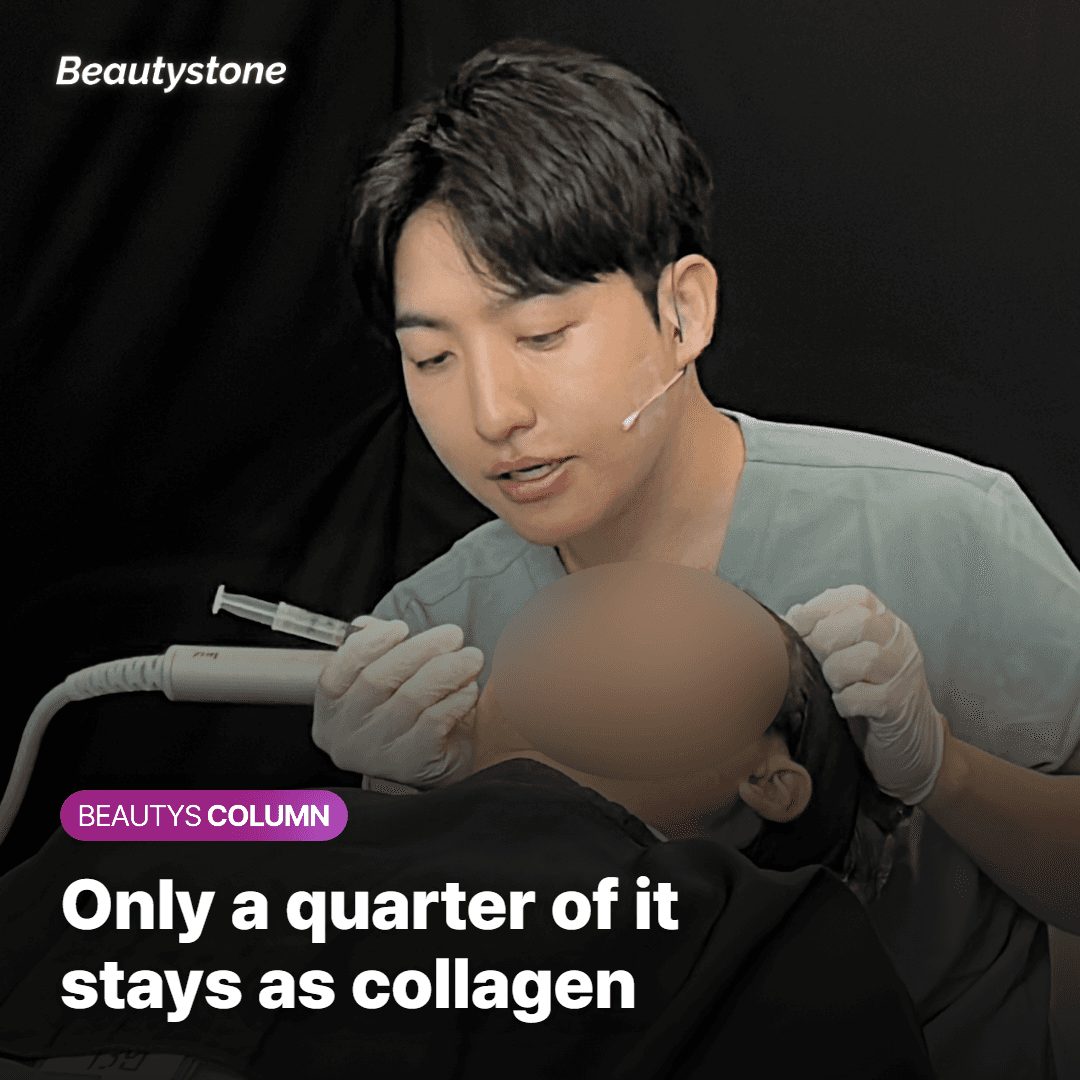
Juvelook looks like a filler, but
it's actually going in a different direction
Juvelook is made by putting PDLLA (poly-D,L-lactic acid)
biodegradable particles into the skin,
and it is a collagen booster that induces collagen production.
Unlike fillers, Juvelook is not a case where
the "material inserted" becomes the volume,
but rather the "collagen your body makes" becomes the volume.
So the appearance right after treatment and
the appearance three months later are completely different.
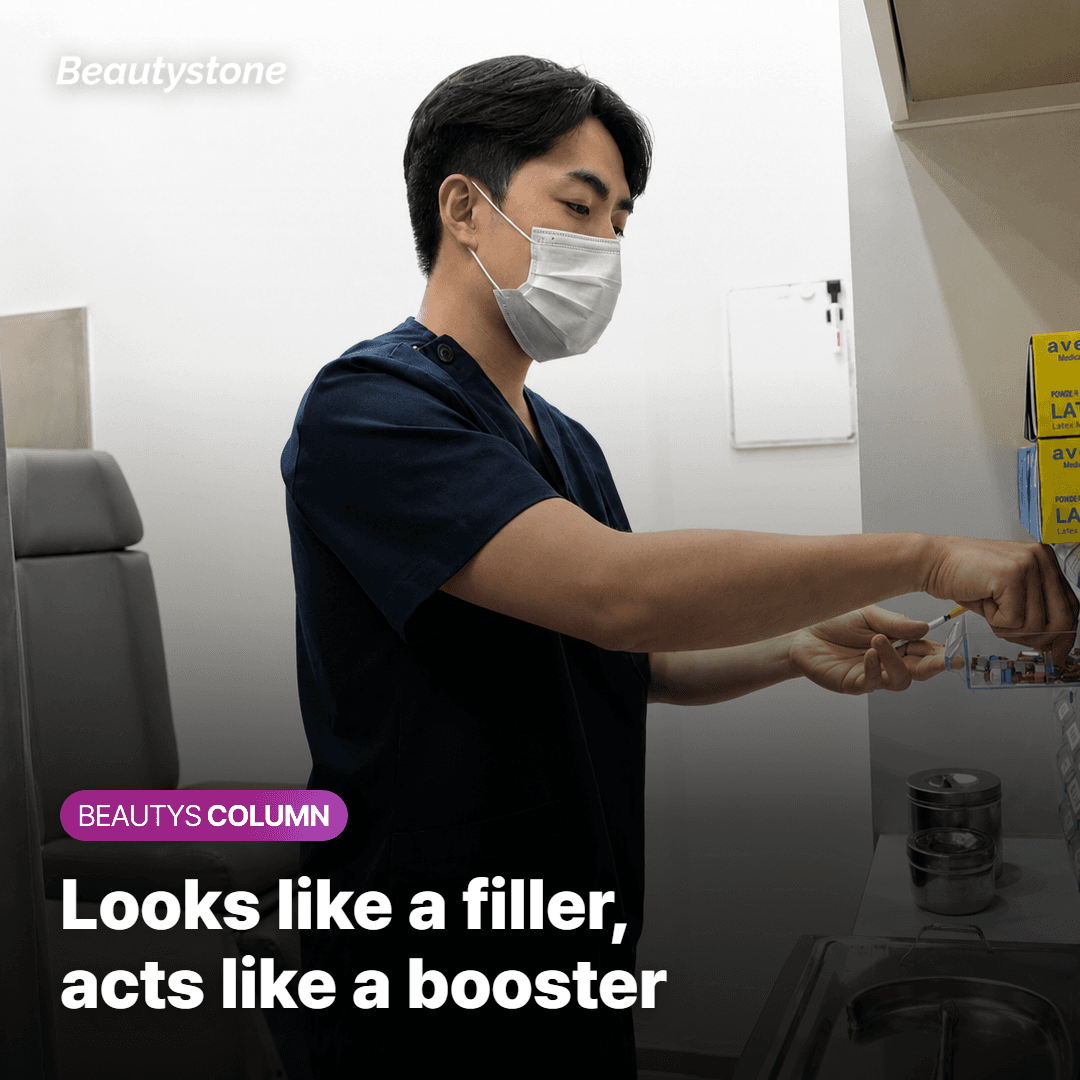
Why Juvelook's effect is
less than half visible right after treatment
Key point of this article
Is the volume visible right after Juvelook treatment
the real effect?
No,
only one-quarter of that volume remains as real collagen,
and the rest is swelling.
It's like the soil puffing up right after sowing seeds.
You've heard that getting Juvelook often makes it work faster,
right? In fact, it's the opposite.
The shorter the interval, the higher the risk of nodules,
and because you don't give collagen time to build up,
the cumulative effect actually drops.
This is the point I explain
most often in the clinic.
Let me explain it again with the seed analogy.
Juvelook particles are a kind of "seed".
Right after injection, PDLLA particles
+ solvent (water) + tissue swelling caused by the injection,
these three things combine to make the face look puffed up.
But after 1–2 weeks, as the solvent and swelling subside,
the stage comes when you think, "Huh? It looks like everything's gone?"
In fact, at week 2 after the procedure,
quite a few people contact us saying
"I think the effect is gone."
This may not fully come across in text,
but when you see actual cases, it's clear.
A 29-year-old client came back two weeks after
the first session last month, and
they were almost in tears, saying, "Doctor, I really think it all went away."
But when I saw them again around week 8, they said first
"Oh, now I can see it starting to build up."
At the 3-month mark, they compared it with the before photo
and were very satisfied.
In a similar pattern, a 42-year-old person was lukewarm for a month after
the first session,
and in the consultation right before the second session,
they said, "Honestly, I regretted it during the first month,
but now I can feel the texture has changed."
There's a saying that time is medicine,
and with Juvelook, it really applies as is.
If you organize the effect timeline by session,
right after the first session there is swelling volume,
about 70% goes down at week 2,
from weeks 6–8 you start feeling collagen build up,
the 3-month mark is the real result of the first session,
and that's how it goes.
And there are three major factors that determine the effect.
First, injection depth (subcutaneous layer or above the SMAS),
second, how evenly it is distributed,
third, your own collagen synthesis ability.
Because of the third factor, even with the same treatment,
the perceived result can be completely different.
If someone in their 20s and someone in their 50s get the same amount,
of course the results will be different.
Dr. Wi Young-jin's Key Summary
Juvelook is not a treatment that shows "what you put in," but
a treatment that shows "what your body makes."
Only one-quarter of the volume right after treatment is real,
and the real result should be evaluated at the 3-month mark.
If it goes down at week 2,
it does not mean the treatment is ineffective.
Juvelook repeat treatment interval, and
the decisive difference from Sculptra
I've made it into a table for easier viewing.
The recommended interval for Juvelook repeat treatment is
usually 4–6 weeks.
But that doesn't mean it's always better.
If you stack treatments too frequently, before the PDLLA particles clear,
they go in again and the risk of nodules rises.
Usually, after 3–4 sessions,
it's safer to leave an interval of at least 6 months.
And the comparison with Sculptra is what confuses people
most when they look into Juvelook.
Both are called collagen boosters,
but their ingredients and effect curves are quite different.
Category | Juvelook | Sculptra |
Main ingredient | PDLLA | PLLA |
Particle breakdown | Relatively fast | Slow (long-term maintenance) |
When effects are felt | From weeks 6–8 | After 2–3 months |
Duration | About 12–18 months | About 24 months |
Best for | Texture improvement and fine lines | Overall volume loss |
PDLLA breaking down faster than PLLA means
you feel the effect sooner,
but the duration is shorter.
So for people trying a collagen booster for the first time,
or those whose main goal is texture improvement, Juvelook is recommended,
and for people with significant volume loss,
Sculptra is the better choice.
Let me also point out the limits of cumulative effect.
If you get Juvelook four times,
the perceived increase drops sharply from the fifth session onward.
Collagen production also has an upper limit to your own capacity.
It doesn't accumulate endlessly.
Three things customers really ask about a lot,
I'll answer honestly
Q1. Do you see results even with just one Juvelook session?
A. Fewer than half of people are satisfied with just one session.
If you're in your late 20s to early 30s, when collagen synthesis ability is good,
and you only want some texture improvement,
you may notice a change even with one session.
But once you go into your 40s, after one session,
more people say, "Huh? It doesn't seem to have changed much."
Usually, 2–3 sessions are recommended.
Q2. Do I need to get it every year to maintain the effect?
A. You don't need to get the full set every year.
If you build a collagen base with an initial series of 3–4 sessions,
many people only need about one maintenance treatment a year after that.
However, if your aging progresses quickly, or
if the first series had a weak effect,
we may recommend intervals of 8–10 months.
Q3. How often do nodules or side effects occur?
A. Nodules usually occur when the injection depth is too shallow
or when it is concentrated in one area.
In terms of frequency,
if injected evenly at the proper depth,
it's under 1%,
but it varies a lot depending on the practitioner's skill.
And the 5-5-5 massage after treatment
must be followed,
and getting it too often is also a risk factor.
Swelling and bruising are normal reactions that last about
1–2 weeks for almost everyone.
If you can feel a nodule, do not self-massage,
and come in right away.
If you take away just one thing today,
— evaluate Juvelook results
at the 3-month mark, not right after the treatment.
In the next post,
'Juvelook after treatment, week 4 vs week 6,
I'll explain how to decide the timing for repeat treatment.'
I'll show with cases how even for the same client, a two-week difference
can change nodule risk and
perceived effect.
This has been Wi Young-jin.
Read also
Juvelook effect,
Three-quarters of the volume right after the procedure are
actually swelling
Please check this before reading
Q. When you look in the mirror after Juvelook, the volume
you see—is that the real effect?
A. No.
Only about one-quarter of that volume remains as collagen,
and the rest is swelling and water.
It's like the soil puffing up right after sowing seeds.
Q. Then when does the real effect appear?
A. Usually from weeks 6–8,
collagen starts to build up,
and the 3-month mark is the real result.
Juvelook looks like a filler, but
it's actually going in a different direction
Juvelook is made by putting PDLLA (poly-D,L-lactic acid)
biodegradable particles into the skin,
and it is a collagen booster that induces collagen production.
Unlike fillers, Juvelook is not a case where
the "material inserted" becomes the volume,
but rather the "collagen your body makes" becomes the volume.
So the appearance right after treatment and
the appearance three months later are completely different.
Why Juvelook's effect is
less than half visible right after treatment
Key point of this article
Is the volume visible right after Juvelook treatment
the real effect?
No,
only one-quarter of that volume remains as real collagen,
and the rest is swelling.
It's like the soil puffing up right after sowing seeds.
You've heard that getting Juvelook often makes it work faster,
right? In fact, it's the opposite.
The shorter the interval, the higher the risk of nodules,
and because you don't give collagen time to build up,
the cumulative effect actually drops.
This is the point I explain
most often in the clinic.
Let me explain it again with the seed analogy.
Juvelook particles are a kind of "seed".
Right after injection, PDLLA particles
+ solvent (water) + tissue swelling caused by the injection,
these three things combine to make the face look puffed up.
But after 1–2 weeks, as the solvent and swelling subside,
the stage comes when you think, "Huh? It looks like everything's gone?"
In fact, at week 2 after the procedure,
quite a few people contact us saying
"I think the effect is gone."
This may not fully come across in text,
but when you see actual cases, it's clear.
A 29-year-old client came back two weeks after
the first session last month, and
they were almost in tears, saying, "Doctor, I really think it all went away."
But when I saw them again around week 8, they said first
"Oh, now I can see it starting to build up."
At the 3-month mark, they compared it with the before photo
and were very satisfied.
In a similar pattern, a 42-year-old person was lukewarm for a month after
the first session,
and in the consultation right before the second session,
they said, "Honestly, I regretted it during the first month,
but now I can feel the texture has changed."
There's a saying that time is medicine,
and with Juvelook, it really applies as is.
If you organize the effect timeline by session,
right after the first session there is swelling volume,
about 70% goes down at week 2,
from weeks 6–8 you start feeling collagen build up,
the 3-month mark is the real result of the first session,
and that's how it goes.
And there are three major factors that determine the effect.
First, injection depth (subcutaneous layer or above the SMAS),
second, how evenly it is distributed,
third, your own collagen synthesis ability.
Because of the third factor, even with the same treatment,
the perceived result can be completely different.
If someone in their 20s and someone in their 50s get the same amount,
of course the results will be different.
Dr. Wi Young-jin's Key Summary
Juvelook is not a treatment that shows "what you put in," but
a treatment that shows "what your body makes."
Only one-quarter of the volume right after treatment is real,
and the real result should be evaluated at the 3-month mark.
If it goes down at week 2,
it does not mean the treatment is ineffective.
Juvelook repeat treatment interval, and
the decisive difference from Sculptra
I've made it into a table for easier viewing.
The recommended interval for Juvelook repeat treatment is
usually 4–6 weeks.
But that doesn't mean it's always better.
If you stack treatments too frequently, before the PDLLA particles clear,
they go in again and the risk of nodules rises.
Usually, after 3–4 sessions,
it's safer to leave an interval of at least 6 months.
And the comparison with Sculptra is what confuses people
most when they look into Juvelook.
Both are called collagen boosters,
but their ingredients and effect curves are quite different.
Category | Juvelook | Sculptra |
Main ingredient | PDLLA | PLLA |
Particle breakdown | Relatively fast | Slow (long-term maintenance) |
When effects are felt | From weeks 6–8 | After 2–3 months |
Duration | About 12–18 months | About 24 months |
Best for | Texture improvement and fine lines | Overall volume loss |
PDLLA breaking down faster than PLLA means
you feel the effect sooner,
but the duration is shorter.
So for people trying a collagen booster for the first time,
or those whose main goal is texture improvement, Juvelook is recommended,
and for people with significant volume loss,
Sculptra is the better choice.
Let me also point out the limits of cumulative effect.
If you get Juvelook four times,
the perceived increase drops sharply from the fifth session onward.
Collagen production also has an upper limit to your own capacity.
It doesn't accumulate endlessly.
Three things customers really ask about a lot,
I'll answer honestly
Q1. Do you see results even with just one Juvelook session?
A. Fewer than half of people are satisfied with just one session.
If you're in your late 20s to early 30s, when collagen synthesis ability is good,
and you only want some texture improvement,
you may notice a change even with one session.
But once you go into your 40s, after one session,
more people say, "Huh? It doesn't seem to have changed much."
Usually, 2–3 sessions are recommended.
Q2. Do I need to get it every year to maintain the effect?
A. You don't need to get the full set every year.
If you build a collagen base with an initial series of 3–4 sessions,
many people only need about one maintenance treatment a year after that.
However, if your aging progresses quickly, or
if the first series had a weak effect,
we may recommend intervals of 8–10 months.
Q3. How often do nodules or side effects occur?
A. Nodules usually occur when the injection depth is too shallow
or when it is concentrated in one area.
In terms of frequency,
if injected evenly at the proper depth,
it's under 1%,
but it varies a lot depending on the practitioner's skill.
And the 5-5-5 massage after treatment
must be followed,
and getting it too often is also a risk factor.
Swelling and bruising are normal reactions that last about
1–2 weeks for almost everyone.
If you can feel a nodule, do not self-massage,
and come in right away.
If you take away just one thing today,
— evaluate Juvelook results
at the 3-month mark, not right after the treatment.
In the next post,
'Juvelook after treatment, week 4 vs week 6,
I'll explain how to decide the timing for repeat treatment.'
I'll show with cases how even for the same client, a two-week difference
can change nodule risk and
perceived effect.
This has been Wi Young-jin.
Read also


Latest post
Latest post

Hair Removal
레이저 제모 1회에도 남는 몫이 있어요 — 밀도를 모자이크로 보는 법

Tattoo removal
Why Extremity Tattoos Are Slower to Remove

Tattoo removal
Tattoo Removal Cost: Why Quotes Vary by Area

Tattoo removal
Unused Tattoo Removal Sessions: What Happens?

Lifting
Forehead Thread Lifting: How Far Can It Go?

skin
Skin Booster Prices: What to Check in a Quote
1:1 Custom Approach
1:1 Consultation Whatsapp
🌸 Beautystone Clinic attends the Meditox Bangkok Cadaver Workshop 🌸
1:1 Custom Approach