

How many LDM ultrasound sessions until results? Who it helps, the cost, and what to expect.
Published -
Updated -

Author
Wi Young-jin · Chief director
Seoul National University College of Medicine · Seoul National University Hospital Specialist
→

Among the procedures we offer at our clinic,
LDM is the one that most often gets the reaction:
“I’ve heard the name, but I have no idea what it actually does.”
It doesn’t deliver the dramatic, instant change a laser does,
and the results aren’t obvious the moment you walk out,
so it’s honestly trickier to explain than you’d expect.
And yet I reach for it often, across a wide range of cases.
So if you’re hearing about LDM for the first time,
or quietly wondering, “Is this actually the right treatment for me?”
here’s the short answer first: LDM is a gentle, low-irritation option that supports skin condition—not a lifting device, and not a one-and-done fix.
Below I’ll share, honestly and without overpromising, what I’ve learned performing it across roughly 10 sessions per patient.
Let’s start with the three questions I get most often.
Q. What kind of skin does LDM
work well for?
A. It responds especially well in skin with a weakened barrier or high sensitivity to irritation.
More detail follows below.
Q. Can I go back to my normal day
right after treatment?
A. In most cases, you can wash your face and wear makeup right after.
There are exceptions depending on your skin, so be sure to read on.
Q. Will one or two sessions of LDM
be enough to feel a difference?
A. A dramatic change from a single session is unlikely.
Individual results may vary, and I’ll explain why below.
First, let’s clear up
what LDM actually is
LDM stands for Local Dynamic Micro-massage.
It focuses ultrasound just below the skin surface
to create fine, fast micro-vibrations within the tissue.
In plain terms:
instead of generating high heat or directly abrading the skin,
it nudges cellular-level vibration that helps activate the skin’s own regenerative signaling.
Compared with laser or radiofrequency (RF) treatments,
its defining trait is how little it irritates the skin.
For people with a compromised barrier,
or skin too reactive for other procedures,
that low-irritation profile is exactly why LDM keeps coming up.
Quick note on regulatory status: LDM-type low-intensity ultrasound micromassage isn’t a household-name, FDA-cleared device the way some lasers and RF systems are, so I won’t overstate it—ask any provider what specific device they use and how it’s regulated.
Low irritation, though, doesn’t mean all upside.
Where and how it’s used changes the results a lot.
Which skin types saw the best response?
In my experience, the cases that respond well to LDM fall into three buckets.
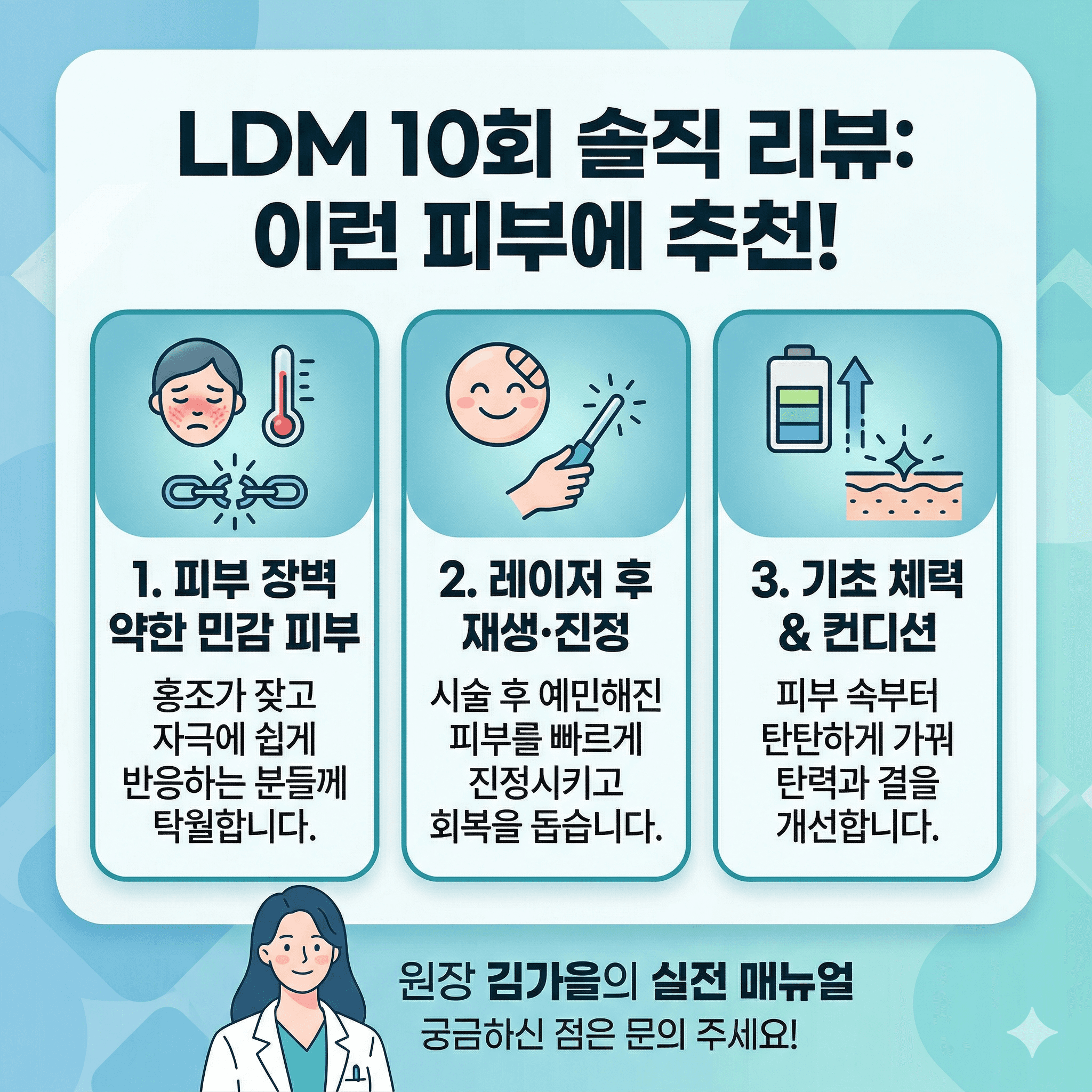
A weakened skin barrier
Long-term topical steroid use, or recurrent contact dermatitis.
The recovery phase after another procedure
When skin is sensitized after a laser or peel, to support calming and recovery.
Redness and facial flushing
In skin with high vascular reactivity, when you want a calming effect without added irritation.
Those three saw the best responses.
On the flip side, for patients with high expectations—
the ones who ask, “Can LDM alone lift my face instead of a laser?”—
I’m straight with them.
LDM is not a lifting procedure.
It’s closer to raising your skin’s baseline condition. Individual results may vary.
Enough people arrive with that mix-up that I always say it up front.
Dr. Kim’s practical note:
Satisfaction was much higher when LDM was paired with laser or RF treatments
to maintain skin condition—rather than run on its own for many sessions.
Done solo and on repeat, the most common reaction is,
“It seems a little better, but I can’t really tell.”
One thing I have to stress: the spacing and number of sessions should depend on your skin, not a script.
Rather than a fixed “once a week for 10 sessions” package,
I usually adjust as we go, reading how your skin responds each visit.
A few things to watch for
It’s true that LDM is low-irritation,
but that doesn’t mean it’s automatically safe for everyone.
A few situations call for caution.
Severe active acne
Inflammation can spread, so those areas should be avoided.
Pregnancy
The abdomen is off-limits.
For the face, clear it with your OB-GYN first.
An active skin infection
During an active herpes simplex (cold sore) outbreak, the procedure should wait.
None of this is unique to LDM—it applies to most skin procedures.
The real downside is cost.
Because of that gentle, low-irritation profile, LDM sits in a premium tier, so the price can sting.
Costs vary widely by country, clinic, and how many areas you treat; in the US, gentle no-downtime facials and device sessions like this commonly run roughly $150–$400 per session and are often sold in packages—treat any figure as a ballpark and confirm with your own provider.
Is it worth it? Honestly, for most people with normal, resilient skin, there are cheaper ways to get a glow. But for very reactive or barrier-damaged skin with few good options, the gentleness is the whole point—and that’s where it earns its keep.
Still, for very sensitive skin, the reality is there just aren’t many alternatives.
How many sessions
until you feel a difference?
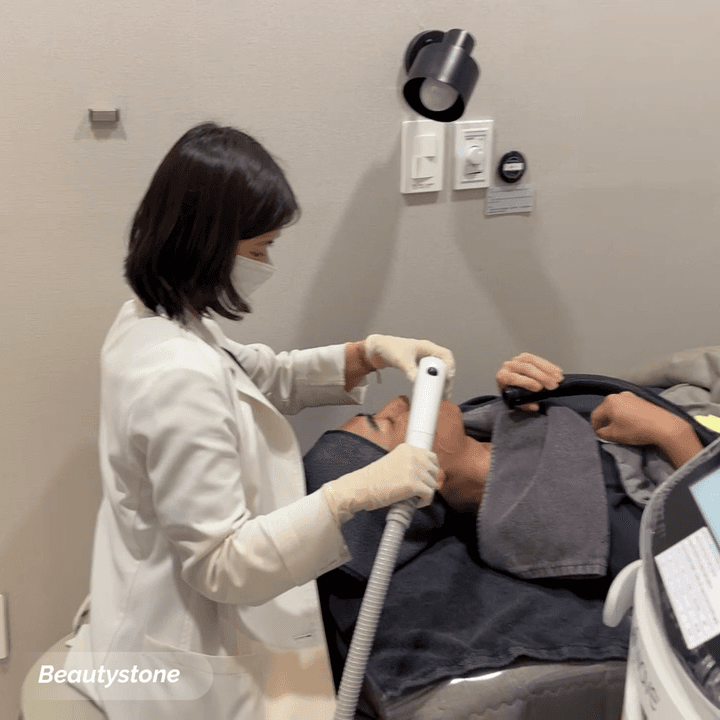
LDM isn’t a procedure where you feel a clear change after just one or two sessions.
Barrier recovery and that calming effect usually start to register around the 3rd to 5th session, when people say, “My skin feels a little different.” Individual results may vary.
Here’s the tricky part: the effect isn’t something you see at a glance,
it’s a gradual shift in firmness and texture.
So in many cases you only catch it when you compare before-and-after photos.
What I’ve learned over many cases is that your starting point changes how fast you respond.
The more depleted the barrier, the quicker the response in those first few sessions,
while skin that’s already in decent shape tends to feel the change later.
A quick timeline, with the usual caveat that everyone differs: sessions 1–2, little visible change; sessions 3–5, the first “my skin feels calmer/smoother” reactions; beyond that, gradual maintenance you’ll mostly notice in photos.
Frequently asked questions
Q1. Can I put on makeup
right after LDM?
A. In most cases, yes.
Because the treatment is so low-irritation, there’s usually no real limit on your day right afterward.
That said, if your skin is having a very reactive day, it’s better to stick to light moisturizer.
Your provider can read your skin on the day and advise.
Q2. Is LDM okay
for acne-prone skin?
A. It depends on the case.
If it’s mostly quiet acne scarring or redness, it can work,
but if you have active inflammatory acne, those spots should be avoided.
Putting ultrasound energy over oozing or badly swollen lesions can actually make things spread.
Q3. Can I combine it
with other laser procedures?
A. Yes—and combining often gives a better response.
The idea is to use the laser for its work, then LDM to support recovery afterward.
Which treatments to pair, and in what order, should depend on your skin, so it’s worth asking your provider before you book.
Q4. Does it hurt, and is there any downtime? Most people describe LDM as relaxing rather than painful—there’s no needle and no heat spike—and downtime is typically minimal. Mild, brief redness is the most you’d usually expect. If you notice spreading redness, swelling, oozing, or signs of infection afterward, that’s not normal for LDM—contact your provider or seek urgent care.
This information is general education from Beautystone, a skin clinic in Seoul, and isn’t a substitute for an in-person medical assessment. Last updated June 2026.
That’s it from me, Dr. Kim.
Book a consult
Not sure if LDM fits your skin? Have the doctor who would treat you take a look first.
Content


![[Beautystone] Rosacea can’t be completely cured? A doctor explains ‘smart ways to manage it’](https://framerusercontent.com/images/X0lrBoi1cM8Xlh7xuFyM2jtBD2c.jpg?width=1080&height=1080)


skin
Why Does Fractional CO2 Take Longer to Heal?

Contouring & Volume
How Many cc Does Forehead Filler Need?

skin
Why Is My Skin Oily but Tight in the Fall?

Hair Removal
Underarm Laser Hair Removal Cost: Do the Math

Tattoo removal
Laser Before a Cover-Up: How Many Sessions?

skin
큐어젯 다운타임, 다음 날 출근과 화장은 언제부터 될까요?