

When to Stop Retinol: It's Not About Summer
When to Stop Retinol: It's Not About Summer
When to Stop Retinol: It's Not About Summer
Why retinol timing depends on skin barrier damage, not the season—with clear criteria to stop.
Published -
Updated -

Author
Wi Young-jin · Chief director
Seoul National University College of Medicine · Seoul National University Hospital Specialist
→

When to Stop Retinol,
Stopping just because it’s summer is wrong
I’m Director Wi Young-jin of Beauty’s Doctor.
Check this before you read
Q. Do you have to stop retinol
unconditionally in the strong UV of summer?
A. The season is not the criterion.
Whether the skin barrier has collapsed or not is the real criterion.
Q. My skin peels when I use retinol,
does that mean it’s working?
A. Exfoliation itself can be a normal reaction, but
if it comes with inflammatory redness, you should stop.
"The medical basis for stopping retinol
while the skin is breaking out"
— Director Wi Young-jin (Beautystone Clinic, Hongdae)

What is retinol?
Retinol is a form of vitamin A,
and it promotes skin cell turnover
to help improve wrinkles, pigmentation, and pores.
It is a representative functional skincare ingredient.
Unlike tretinoin (a prescription drug), retinol
can also be included in cosmetics, but
because it has to convert within the skin,
irritation often appears later.

Why you should stop while
the skin is "breaking out"
When using retinol, if your skin peels,
during a retinoid reaction (retinoid dermatitis),
mild flaking can be normal, but
it must be distinguished from barrier breakdown.
Retinol temporarily reduces ceramide synthesis
in the stratum corneum,
and if you keep applying it in this state,
it leads to chronic inflammation instead of improvement.
Pigmentation can become even deeper,
and capillary dilation may become fixed as well.
To summarize:
A little dryness and fine flaking are normal,
but if you see the signs below, that is the time to stop.
[Comparison] Normal reaction vs. barrier damage
Category | Normal retinoid reaction | Barrier damage (stop needed) |
Flaking | Slight, stabilizes within 1–2 weeks | Peeling over a wide area, lasts more than 3 weeks |
Redness | Temporary redness after cleansing | Lasts all day, with heat sensation |
Dryness | Can be managed with moisturizer | Feels tight and stings even with moisturizer |
Pigment | Existing pigmentation is fading | New brown patches appear |
Moisture measurement | Slight drop (35–45%) | Drops sharply below 30% |
If it stings no matter how much you moisturize,
that is
the easiest self-diagnosis point for barrier breakdown.
Director Wi Young-jin’s key takeaway
The time to stop retinol is not "because it’s summer."
When the ceramides in the skin barrier are depleted
and inflammatory reactions begin,
that is the real stopping point.
The season is only a secondary factor,
the key criterion is your skin condition.
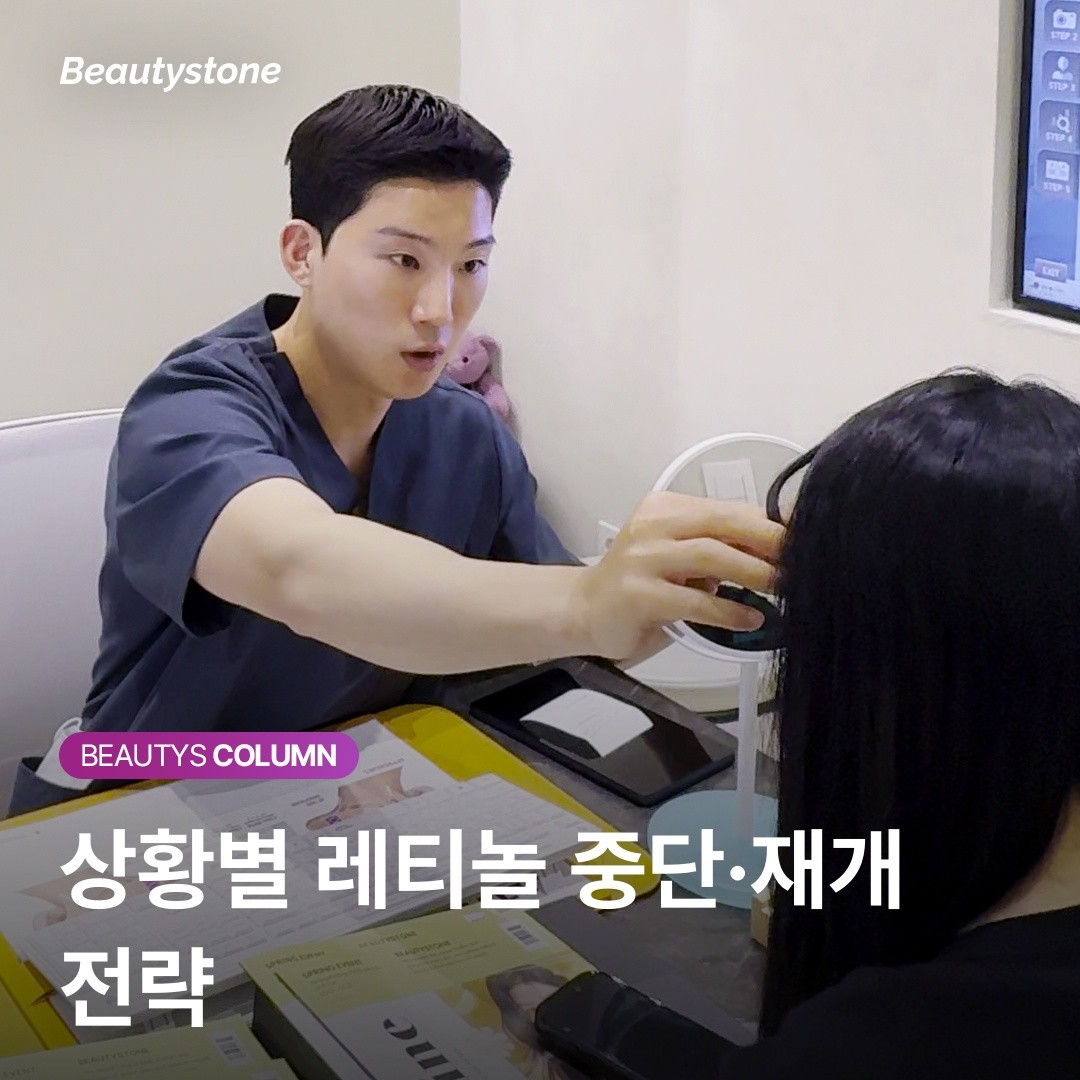
Retinol stop/restart strategy by situation
1. Before and after laser procedures
You should stop at least 5 to 7 days before the procedure.
If you undergo treatment with a weakened barrier,
the risk of post-inflammatory hyperpigmentation (PIH) rises sharply.
2. Seasonal change — transitional seasons
In fact, the time you need to be more careful is
the transitional seasons, not summer.
Because humidity drops and the barrier is stressed,
using retinol on top of that becomes a double hit.
3. During pregnancy and breastfeeding
Retinoid products may cause birth defects,
so if there is even a chance of pregnancy, it’s right to stop immediately.
4. When using peels or scrubs together
If used together with acidic peels such as AHA or BHA,
damage speeds up twice as fast.
Be sure to separate the days.

When restarting after stopping
— this is even more important
If the break is more than 2 weeks,
the tolerance your skin adapted to is reset.
So when you start again,
it’s safest to begin with a low concentration (0.025–0.05%)
about twice a week.
After the re-acclimation period, you can more stably
increase up to a higher concentration this time.
Because you’re starting from a recovered barrier.
Frequently asked questions
Q1. If I stop retinol,
will my skin get worse again?
It won’t go back overnight.
However, in the long term,
the turnover speed returns to normal,
so it’s best to rest sufficiently and restart safely.
Q2. Can I switch to
bakuchiol instead of retinol?
Bakuchiol is an excellent alternative with far less irritation.
However, if your goal is wrinkle improvement, learning
how to use retinol safely is even more effective.
Q3. If the problem gets worse,
should I go to a dermatologist?
If it doesn’t improve within 3 to 5 days or if oozing occurs,
you must get medical care.
If you try to endure it alone, pigmentation can become fixed.
This has been Wi Young-jin.
Also read
▶Five criteria for a Hongdae dermatology clinic recommendation, explained directly by a specialist
▶Cellredem vs Rejuran HB, which is better for me?
▶The secret of a 10-session package for flawless Brazilian hair removal
▶Rosacea dermatitis: how is it treated at a dermatology clinic?
▶Fat-dissolving injections: if it’s not DCA base (bile acid), don’t believe it,
When to Stop Retinol,
Stopping just because it’s summer is wrong
I’m Director Wi Young-jin of Beauty’s Doctor.
Check this before you read
Q. Do you have to stop retinol
unconditionally in the strong UV of summer?
A. The season is not the criterion.
Whether the skin barrier has collapsed or not is the real criterion.
Q. My skin peels when I use retinol,
does that mean it’s working?
A. Exfoliation itself can be a normal reaction, but
if it comes with inflammatory redness, you should stop.
"The medical basis for stopping retinol
while the skin is breaking out"
— Director Wi Young-jin (Beautystone Clinic, Hongdae)
What is retinol?
Retinol is a form of vitamin A,
and it promotes skin cell turnover
to help improve wrinkles, pigmentation, and pores.
It is a representative functional skincare ingredient.
Unlike tretinoin (a prescription drug), retinol
can also be included in cosmetics, but
because it has to convert within the skin,
irritation often appears later.
Why you should stop while
the skin is "breaking out"
When using retinol, if your skin peels,
during a retinoid reaction (retinoid dermatitis),
mild flaking can be normal, but
it must be distinguished from barrier breakdown.
Retinol temporarily reduces ceramide synthesis
in the stratum corneum,
and if you keep applying it in this state,
it leads to chronic inflammation instead of improvement.
Pigmentation can become even deeper,
and capillary dilation may become fixed as well.
To summarize:
A little dryness and fine flaking are normal,
but if you see the signs below, that is the time to stop.
[Comparison] Normal reaction vs. barrier damage
Category | Normal retinoid reaction | Barrier damage (stop needed) |
Flaking | Slight, stabilizes within 1–2 weeks | Peeling over a wide area, lasts more than 3 weeks |
Redness | Temporary redness after cleansing | Lasts all day, with heat sensation |
Dryness | Can be managed with moisturizer | Feels tight and stings even with moisturizer |
Pigment | Existing pigmentation is fading | New brown patches appear |
Moisture measurement | Slight drop (35–45%) | Drops sharply below 30% |
If it stings no matter how much you moisturize,
that is
the easiest self-diagnosis point for barrier breakdown.
Director Wi Young-jin’s key takeaway
The time to stop retinol is not "because it’s summer."
When the ceramides in the skin barrier are depleted
and inflammatory reactions begin,
that is the real stopping point.
The season is only a secondary factor,
the key criterion is your skin condition.
Retinol stop/restart strategy by situation
1. Before and after laser procedures
You should stop at least 5 to 7 days before the procedure.
If you undergo treatment with a weakened barrier,
the risk of post-inflammatory hyperpigmentation (PIH) rises sharply.
2. Seasonal change — transitional seasons
In fact, the time you need to be more careful is
the transitional seasons, not summer.
Because humidity drops and the barrier is stressed,
using retinol on top of that becomes a double hit.
3. During pregnancy and breastfeeding
Retinoid products may cause birth defects,
so if there is even a chance of pregnancy, it’s right to stop immediately.
4. When using peels or scrubs together
If used together with acidic peels such as AHA or BHA,
damage speeds up twice as fast.
Be sure to separate the days.
When restarting after stopping
— this is even more important
If the break is more than 2 weeks,
the tolerance your skin adapted to is reset.
So when you start again,
it’s safest to begin with a low concentration (0.025–0.05%)
about twice a week.
After the re-acclimation period, you can more stably
increase up to a higher concentration this time.
Because you’re starting from a recovered barrier.
Frequently asked questions
Q1. If I stop retinol,
will my skin get worse again?
It won’t go back overnight.
However, in the long term,
the turnover speed returns to normal,
so it’s best to rest sufficiently and restart safely.
Q2. Can I switch to
bakuchiol instead of retinol?
Bakuchiol is an excellent alternative with far less irritation.
However, if your goal is wrinkle improvement, learning
how to use retinol safely is even more effective.
Q3. If the problem gets worse,
should I go to a dermatologist?
If it doesn’t improve within 3 to 5 days or if oozing occurs,
you must get medical care.
If you try to endure it alone, pigmentation can become fixed.
This has been Wi Young-jin.
Also read
▶Five criteria for a Hongdae dermatology clinic recommendation, explained directly by a specialist
▶Cellredem vs Rejuran HB, which is better for me?
▶The secret of a 10-session package for flawless Brazilian hair removal
▶Rosacea dermatitis: how is it treated at a dermatology clinic?
▶Fat-dissolving injections: if it’s not DCA base (bile acid), don’t believe it,


Latest post
Latest post

Tattoo removal
손가락 문신은 작으니까 금방 지워질 거라 생각하셨나요?

Tattoo removal
문신제거 견적이 병원마다 다른 이유, 크기 기준부터 달라서예요

Tattoo removal
10회 결제했는데 그 전에 다 지워지면 돈이 아깝지 않을까요?

Lifting
Forehead Thread Lifting: How Far Can It Go?

skin
Skin Booster Prices: What to Check in a Quote

Contouring & Volume
InMode Cost: Why One Area, Three Line Items
1:1 Custom Approach
1:1 Consultation Whatsapp
🌸 Beautystone Clinic attends the Meditox Bangkok Cadaver Workshop 🌸
1:1 Custom Approach