

Can't get forehead Botox? Skin Botox micro-doses the dermis to refine pores, sebum, redness.
Published
Updated

Author
Wi Young-jin · Chief director
Seoul National University College of Medicine · Seoul National University Hospital Specialist
→
When you keep seeing the term 'Skin Botox,' the shared name 'Botox' might make you think of it as just a 'light version' of forehead Botox. In reality, though they use the exact same product, their targets are completely different. Forehead Botox targets the muscles, while Skin Botox targets the skin itself. This is why you don’t need to worry, 'If I can't get forehead Botox, does that mean I can't get this either?' when looking into Skin Botox for pore concerns.
They are 'the same product, but different treatments'
Both treatments use the same Botulinum Toxin Type A. The product can be any brand, whether it's Botox, Dysport, or Xeomin. The difference lies in 'where and how much' is injected.
Forehead Botox is injected into the muscle layer (5–6 mm deep) at about 2 to 4 U per point. On the other hand, Skin Botox is injected into the dermis (1–2 mm deep) using a highly diluted solution at about 0.5 to 1 U per point. Because the depth, dosage, and target areas are all different, they ultimately work in completely different ways.

The target is 'skin,' not 'muscle'
Skin Botox is delivered straight into the dermis*. The dermis* is home to sebaceous glands, hair follicles, microvessels, and tiny muscles like the arrector pili. The Botulinum Toxin partially reduces signaling in these areas to improve pores, sebum, and redness.
Since it barely touches the larger forehead muscle (frontalis) or glabella muscles, the treatment won't affect your facial expressions or cause muscle paralysis, even though it shares the 'Botox' name. It's the perfect choice when you want to refine your skin texture while keeping your natural expressions intact.
* Dermis: The main body of the skin located beneath the epidermis. It houses collagen, elastic fibers, sebaceous glands, hair follicles, and microvessels. This is the precise area where Skin Botox works.
* Meso Botox (Mesobotox / Microbotox): Broad clinical terms for Skin Botox. 'Meso' refers to the dermis, and 'micro' refers to injecting tiny amounts spread across multiple points. They are simply different names for the same treatment.

You will see improvements in pores, sebum, and redness
Skin Botox generally shows outstanding results in four areas. First, pore size: as sebaceous gland signals are reduced, sebum production decreases, making pores appear tighter. Second, sebum control: skin becomes less oily, helping your makeup last beautifully through the day. Third, redness: by soothing some of the microvessel signals, facial flushing and redness are visibly reduced. Fourth, fine wrinkles and texture: the surface of your dermis is smoothed out, leaving you with a wonderfully soft, refined complexion.
The effects last about 2 to 3 months, which is slightly shorter than forehead Botox (3 to 4 months). Because the dermis recovers more quickly than muscle, treatments are spaced closer together. For those maintaining regular treatments, we generally recommend an interval of 8 to 12 weeks.
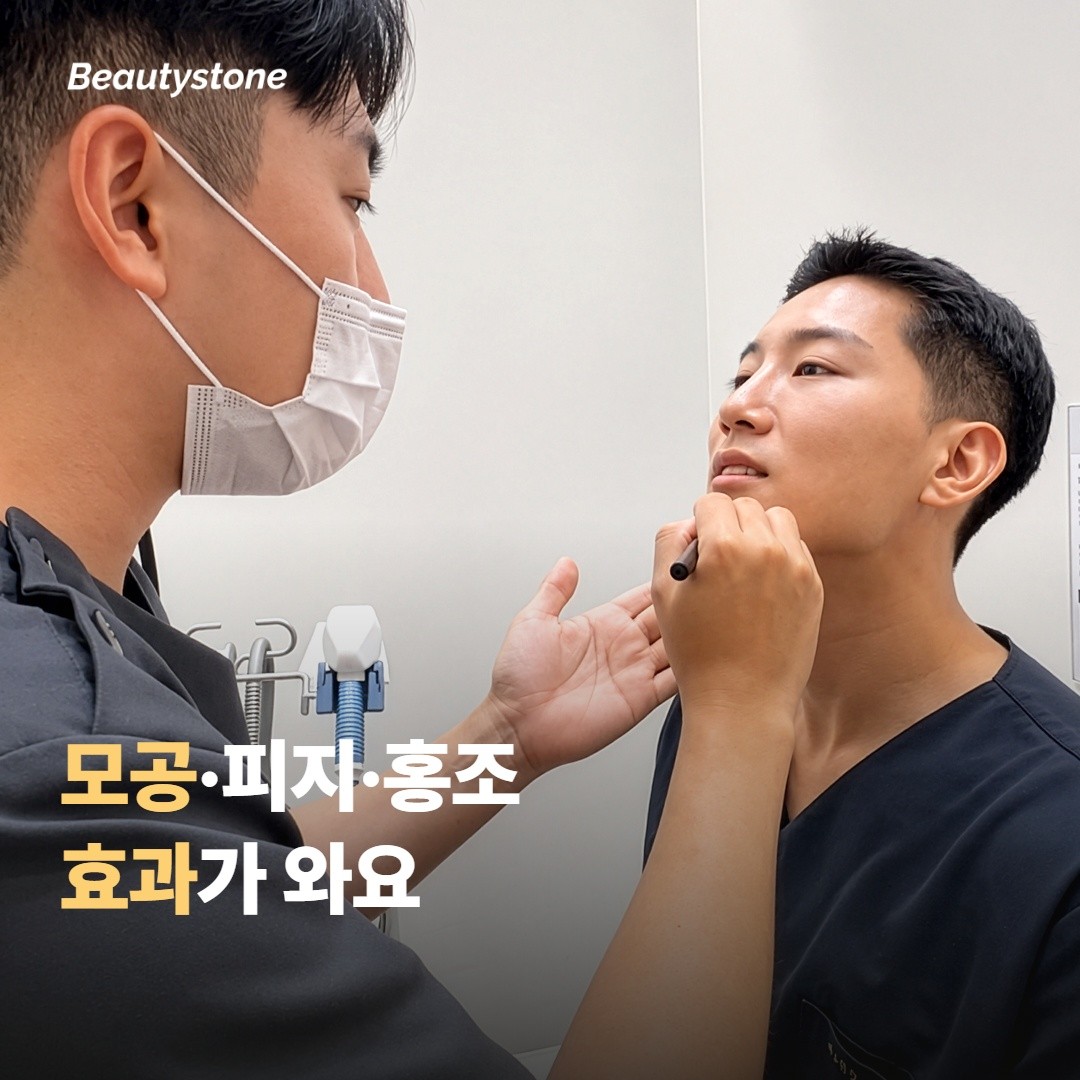
No need to worry about pseudoptosis (drooping eyelids)
Since Skin Botox only targets the dermis, it rarely reaches the forehead muscle or the levator palpebrae superioris muscle. This means there is virtually no risk of 'pseudoptosis' for those who rely on their forehead muscles to open their eyes. Even if your self-diagnosis suggests a strong reliance on these muscles—making classic forehead Botox unsuitable—you can still comfortably receive Skin Botox.
Here is a quick summary of the differences between the two treatments:
Category | Forehead Botox (Classic) | Skin Botox (Meso/Micro) |
|---|---|---|
Target Layer | Forehead muscle (Frontalis) — Muscle | Dermis*, sebaceous glands, hair follicles — Skin |
Depth | Muscle layer (5–6 mm) | Dermis (1–2 mm) |
Dosage (per point) | 2–4 U | 0.5–1 U (Diluted) |
Key Benefits | Reduces horizontal forehead lines | Improves pores, sebum, redness, and texture |
Duration | 3–4 months | 2–3 months |
Risk of Pseudoptosis | Present if you rely on forehead muscles | Virtually none |
Expression Style | Modified (Forehead movement is limited) | Completely natural (No muscle freeze) |

Where is it targeted and how is it performed?
Skin Botox is typically administered in tiny droplets spaced 1 to 2 cm apart across the facial T-zone (forehead, nose, chin), cheeks, and jawline. A standard session involves about 50 to 100 injection points. You will start noticing your pores tightening within a week, with the full, beautiful results showing by the second week.
If you wish to receive forehead Botox as well, they can be done on the same day since they target different depths. However, if you rely heavily on your forehead muscles to open your eyes, we recommend a safer approach: get Skin Botox first, observe how your skin responds over two weeks, and then decide on forehead Botox. Remembering that 'same product does not mean same risk' will make your decision-making much simpler and stress-free.
Frequently asked questions
Q. Will my face become stiff after getting Skin Botox?
A. It rarely stiffens. Because the medicine is injected only into the dermis layer, it barely comes into contact with the muscles that control facial expressions. However, even at a shallow depth, if it is injected slightly too deep, it can affect the muscles. This is why the practitioner's precise control over the injection depth is crucial.
Q. If I can't get forehead Botox, is Skin Botox still an option for me?
A. Yes, it is possible in almost all cases. Even if you usually avoid forehead Botox due to heavy reliance on your forehead muscles, Skin Botox barely reaches the muscle, so you can receive it without worrying about temporary eyelid drooping (pseudoptosis). It is also an even better fit for other concerns like pore control and sebum reduction.
Q. Is skin Botox also effective for fine wrinkles between the brows or around the eyes?
A. While it can help somewhat with fine lines, botox for the forehead, between the brows, and around the eyes (targeting the muscles) is much more effective for deep expression lines (such as the '11' lines between the brows and crow's feet). Skin botox is designed to refine and smooth the skin's texture, making it more of a supportive treatment to beautifully even out your skin tone and texture.
Q. When will I start seeing results from Skin Botox, and how long do they last?
A. Typically, you will notice your pores looking tighter within a week, with more distinct results appearing by the second week. The effects last about 2 to 3 months, which is shorter than forehead Botox because the dermis heals faster than muscle. For regular maintenance, an interval of 8 to 12 weeks is generally recommended.




Contouring & Volume
Hip Dip Filler Before and After: 4 Checks

Body
Potenza Treatment Interval: Why 4 Weeks?

Lifting
Ultherapy Before and After: Why Wait 90 Days?

Contouring & Volume
Belotero Revive Cost: 2cc Price vs. 3 Sessions

skin
Lip Hyperpigmentation Laser: Does It Work?

Contouring & Volume
Men's Forehead Filler: Hollow or Just Lines?