Ulthera Pain Truth: "Gritting through it won't lift better"
"Does it really hurt that much?" The clinic director candidly explains how to manage Ulthera pain
Ulthera Pain:
Endure It or Manage It?

Honestly,
every time I run on the treadmill,
my sagging face drives me crazy.
I'm also very interested in lifting treatments,
and I perform Ulthera very frequently.
The question I get asked the most is,
"I heard you offer sedation — Doctor, does it really hurt that much?"
Today, I want to give that question a proper answer.
Q. With Ulthera, do you really just have to
grit your teeth and bear it?
No.
It doesn't have to hurt.
You can opt for sedation if you'd like!
Q. If you get it with less pain,
does the effect decrease too?
Yes, that can happen.
The balance between pain control and energy level
is what really matters.
Q. Is applying numbing cream alone
enough?
No. Numbing cream is only the beginning.
What you use at each stage matters far more.
Ulthera Pain:
Why Does It Hurt So Much?
Ulthera is a procedure that focuses ultrasound energy deep into the skin
to generate heat.
The goal is for energy to reach the SMAS layer (fascial layer),
not just the surface.
The deeper the energy penetrates, the more
nerve endingsalong that path get stimulated.
That is the root cause of Ulthera pain.
This is especially why areas with thin fat layers and proximity to bone —
the cheekbones, jawline,
and the edges of the forehead — tend to hurt the most.
To be honest,it can really hurt quite a lot.
Being mentally prepared beforehand
will help you stay calm during the procedure.
Step-by-Step Ways
to Reduce Pain
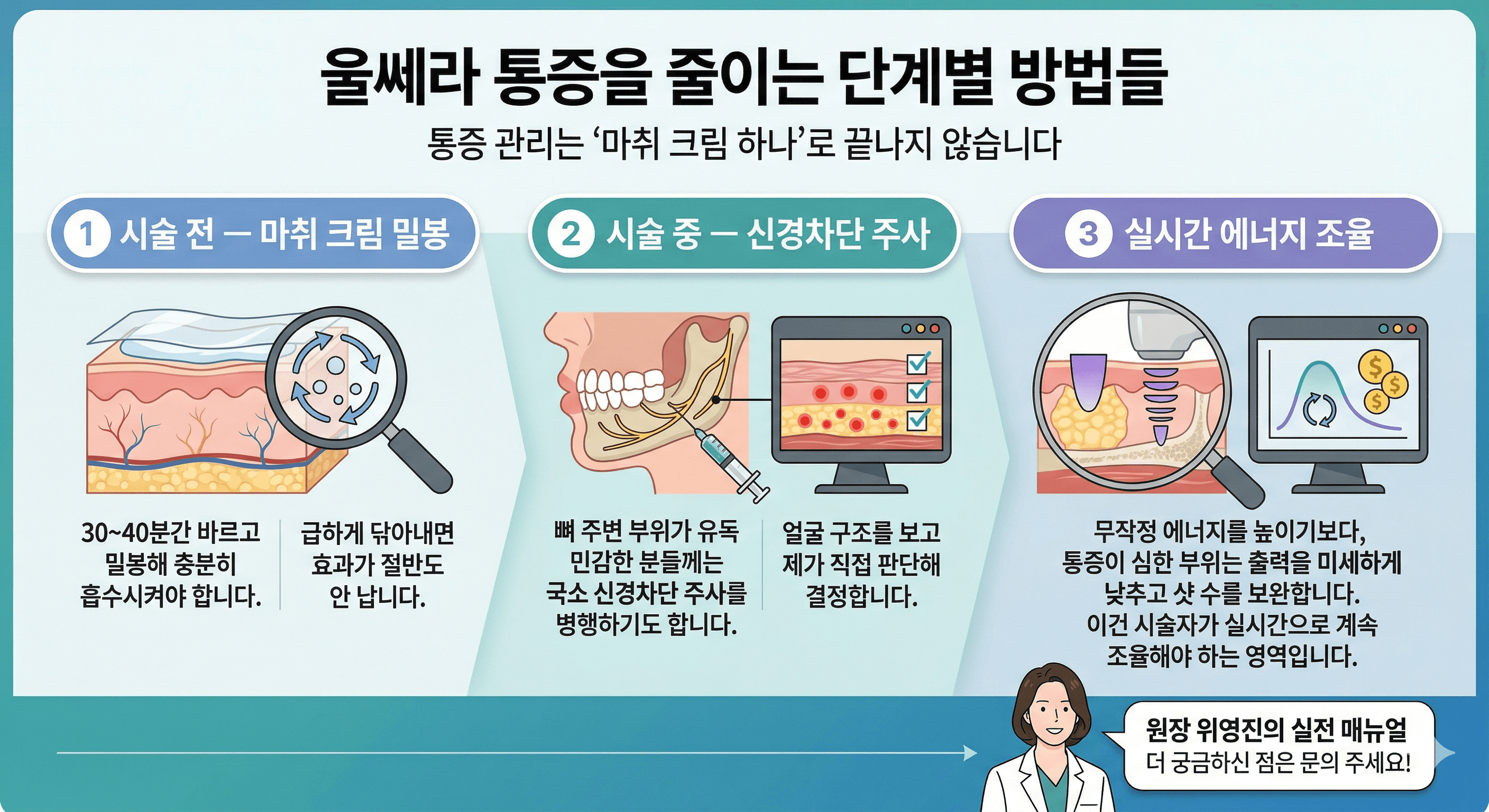
Pain management doesn't end with
"just slapping on some numbing cream."
1. Before the Procedure — Occluded Numbing Cream
Apply for 30–40 minutes under occlusion
to allow full absorption.
Wiping it off too soon can cut the effect by more than half.
2. During the Procedure — Nerve Block Injection
For patients who are especially sensitive around bony areas,
we may combine a local nerve block injection.
I assess your facial structure and make that call myself.
3. Real-Time Energy Adjustment
Rather than blindly cranking up the energy, for particularly painful areas
we slightly lower the output and compensate with additional shots.
This is something the practitioner
must continuously fine-tune in real time.
Dr. Wi Youngjin's Clinical Note:
In my experience, the most painful areas are
the temple-to-preauricular line, and thechin tip.
One thing I always want patients to know:
if you lower the energy too aggressively to eliminate pain entirely,
you may not see any lifting results at all.
Some level of discomfort is actually a
"signal" that the treatment is being delivered properly.
If Pain Is Reduced,
Does Efficacy Decrease Too?
I get this question all the time.
The short answer is:
pain alone is not an indicator of efficacy.
However, when energy reaches the target depth,
there is definitely a response you should be able to feel.
So, dialing it down to a "tolerable level" is perfectly fine —
but if there's "no sensation at all," that's when you should question whether it's working.
Key Takeaway:
Pain can be controlled,
but eliminating it entirely may mean compromising your results.
What to Confirm Before Your Procedure
1. Disclose your pain sensitivity(individual differences vary greatly)
2. Identify your main concern areas(pain intensity differs by area)
3. Share your previous procedure experience(let us know how difficult it was in the past)
The one drawback is cost.
The more meticulous the pain management preparation,
the more involved the process can become.
But it's far better to build a proper pain management plan from the start
than to have to drastically cut energy mid-procedure because it becomes unbearable.
Frequently Asked Questions (FAQ)
Q1. Can I get through it
with numbing cream alone?
A. It's possible for those with lower sensitivity.
However, numbing cream has limited effect around bony areas,
so additional measures may be needed.
Q2. If it hurts too much,
can we pause for a moment?
A. Absolutely.
Pushing through the pain won't improve your results.
Communicating throughout and adjusting energy as needed is always the right approach.
Q3. How long does post-procedure discomfort last?
A. Soreness typically fades the same day or the next day.
Temporary sensory changes usually resolve within a few weeks.
If you have any questions, feel free to
reach out to us on KakaoTalk.
This has been Dr. Wi Youngjin.
✦ You Might Also Like
Ulthera Pain:
Endure It or Manage It?

Honestly,
every time I run on the treadmill,
my sagging face drives me crazy.
I'm also very interested in lifting treatments,
and I perform Ulthera very frequently.
The question I get asked the most is,
"I heard you offer sedation — Doctor, does it really hurt that much?"
Today, I want to give that question a proper answer.
Q. With Ulthera, do you really just have to
grit your teeth and bear it?
No.
It doesn't have to hurt.
You can opt for sedation if you'd like!
Q. If you get it with less pain,
does the effect decrease too?
Yes, that can happen.
The balance between pain control and energy level
is what really matters.
Q. Is applying numbing cream alone
enough?
No. Numbing cream is only the beginning.
What you use at each stage matters far more.
Ulthera Pain:
Why Does It Hurt So Much?
Ulthera is a procedure that focuses ultrasound energy deep into the skin
to generate heat.
The goal is for energy to reach the SMAS layer (fascial layer),
not just the surface.
The deeper the energy penetrates, the more
nerve endingsalong that path get stimulated.
That is the root cause of Ulthera pain.
This is especially why areas with thin fat layers and proximity to bone —
the cheekbones, jawline,
and the edges of the forehead — tend to hurt the most.
To be honest,it can really hurt quite a lot.
Being mentally prepared beforehand
will help you stay calm during the procedure.
Step-by-Step Ways
to Reduce Pain

Pain management doesn't end with
"just slapping on some numbing cream."
1. Before the Procedure — Occluded Numbing Cream
Apply for 30–40 minutes under occlusion
to allow full absorption.
Wiping it off too soon can cut the effect by more than half.
2. During the Procedure — Nerve Block Injection
For patients who are especially sensitive around bony areas,
we may combine a local nerve block injection.
I assess your facial structure and make that call myself.
3. Real-Time Energy Adjustment
Rather than blindly cranking up the energy, for particularly painful areas
we slightly lower the output and compensate with additional shots.
This is something the practitioner
must continuously fine-tune in real time.
Dr. Wi Youngjin's Clinical Note:
In my experience, the most painful areas are
the temple-to-preauricular line, and thechin tip.
One thing I always want patients to know:
if you lower the energy too aggressively to eliminate pain entirely,
you may not see any lifting results at all.
Some level of discomfort is actually a
"signal" that the treatment is being delivered properly.
If Pain Is Reduced,
Does Efficacy Decrease Too?
I get this question all the time.
The short answer is:
pain alone is not an indicator of efficacy.
However, when energy reaches the target depth,
there is definitely a response you should be able to feel.
So, dialing it down to a "tolerable level" is perfectly fine —
but if there's "no sensation at all," that's when you should question whether it's working.
Key Takeaway:
Pain can be controlled,
but eliminating it entirely may mean compromising your results.
What to Confirm Before Your Procedure
1. Disclose your pain sensitivity(individual differences vary greatly)
2. Identify your main concern areas(pain intensity differs by area)
3. Share your previous procedure experience(let us know how difficult it was in the past)
The one drawback is cost.
The more meticulous the pain management preparation,
the more involved the process can become.
But it's far better to build a proper pain management plan from the start
than to have to drastically cut energy mid-procedure because it becomes unbearable.
Frequently Asked Questions (FAQ)
Q1. Can I get through it
with numbing cream alone?
A. It's possible for those with lower sensitivity.
However, numbing cream has limited effect around bony areas,
so additional measures may be needed.
Q2. If it hurts too much,
can we pause for a moment?
A. Absolutely.
Pushing through the pain won't improve your results.
Communicating throughout and adjusting energy as needed is always the right approach.
Q3. How long does post-procedure discomfort last?
A. Soreness typically fades the same day or the next day.
Temporary sensory changes usually resolve within a few weeks.
If you have any questions, feel free to
reach out to us on KakaoTalk.
This has been Dr. Wi Youngjin.
✦ You Might Also Like
Recommended post
Recommended post
Latest post
Latest post

skin
리쥬란 힐러, 저도 처음엔 별로 안 좋아했어요
리쥬란 힐러 효과가 왜 '재생'에 집중되는지, PN 성분의 작동 원리와 임상에서 본 실제 변화를 솔직하게 정리했습니다. 모든 피부에 만능은 아니라는 점도 함께요.

skin
시크릿RF 시술시 마취크림만 하면 꽤 아플 수 있습니다.
시크릿RF 시술 통증이 얼마나 되는지, 마취 크림부터 당일 관리 루틴까지 실제 진료실 기준으로 솔직하게 정리했습니다.
![[위영진 칼럼] 리프팅과 탄력을 한 번에? 마이크로웨이브 온다리의 과학적 원리](https://framerusercontent.com/images/0I5A75u4XMBCQ13dSSY6Gq0CZnw.jpg?width=1080&height=1080)

Hair Removal
With GentleMax Pro Plus, using both wavelengths does not mean the results are the same.
We explain through clinical cases why GentleMax Pro Plus uses two wavelengths—755nm Alexandrite and 1064nm Nd:YAG—tailored to hair type and skin tone.

Hair Removal
[Wi Young-jin Column] The scientific reason women’s Brazilian hair removal is especially painful and less effective
Women’s Brazilian hair removal: why do some areas hurt more and others less. Explaining the real difference made by wavelength and cooling systems
![[Wi Young-jin Column] Sunken temples determine the eye shape: the principles of non-surgical eye lifting](https://framerusercontent.com/images/oLHU9fbSahBOq3wrgjVihCSXGdg.jpg?width=1080&height=1080)
Contouring & Volume
Still feeling heavy after eye correction? Why you should check the temple tenting effect
The tent effect of eye lifting works by supporting sunken temples with volume, allowing the outer corners of the eyes and the eyebrows to naturally lift. It explains the mechanism by which the eyes appear larger without pulling.

Contouring & Volume
When deciding which collagen booster filler to use, consider the treatment area.
Based on clinical experience, we compare the ingredient differences, duration, and selection criteria by skin type for three collagen booster fillers (Sculptra, Radiesse, and Juvelook).


![[Beauty Stone] How to Avoid Failing at Dark Circle Filler? "The Precision of 0.3cc Changes the Results"](https://framerusercontent.com/images/F4Q84TUWgjbZJV6MNheLnWHnaw.jpg?width=1080&height=1080)