

How long until Ultherapy Prime results show? Changes peak at 3–6 months and last about a year.
Published -
Updated -

Author
Wi Young-jin · Chief director
Seoul National University College of Medicine · Seoul National University Hospital Specialist
→
Here is the short answer first: after Ultherapy Prime*, the most common question we hear is, "So when will I actually see results?" The treatment itself takes about an hour, but the waiting—standing in front of the mirror looking for change—can feel a lot longer than the appointment did.
In plain terms: on the day of treatment you may feel a slight, temporary tightness, but the real lifting builds gradually over the following weeks. Your skin needs time to make new collagen, so results are usually clearest around the 2-to-3-month mark and then hold for a good while after that. Individual results may vary, so rather than judging it the day after, it helps to watch your progress week by week. This is general information from Beautystone, a skin clinic in Seoul—not medical advice—so confirm anything specific with the provider who treats you. Last updated June 2026.
This article shares general treatment information from Beautystone, a skin clinic in Seoul.
What you will learn in this article
Why Ultherapy Prime results show up over time instead of right after the treatment
What to expect day by day and week by week, so you know what is normal
Simple daily habits that help your results last longer
How to tell a common reaction from a sign worth a second look
Ultherapy Prime lifts gradually over time, not all at once
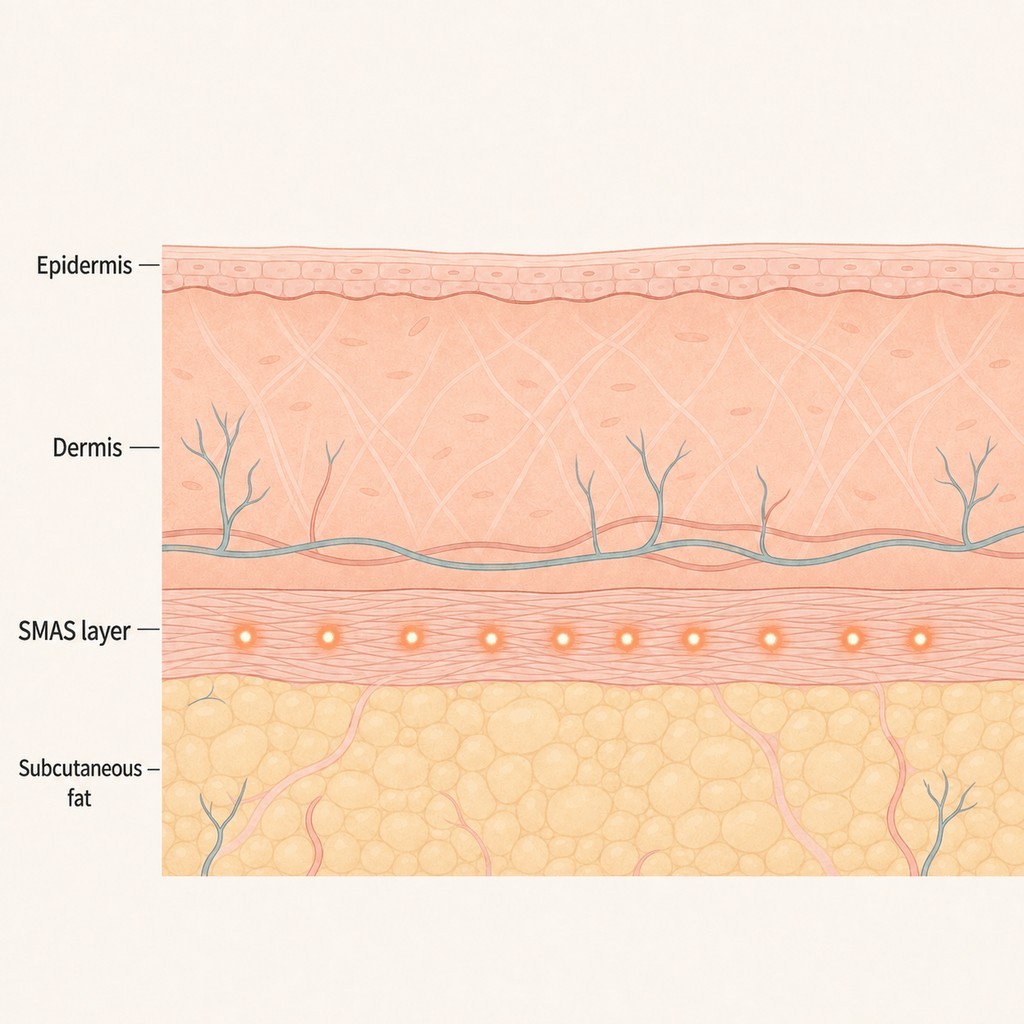
Ultherapy Prime uses microfocused ultrasound* to send energy past the surface and concentrate it in deeper layers of skin, where it creates tiny points of controlled heat. When that energy reaches the SMAS layer—the supportive tissue under your expression and facial contours—the tissue contracts and your body is prompted to build fresh collagen. Because that collagen takes time to form, the effect does not appear right away; it rises slowly. In the US, Ultherapy is an ultrasound device and is FDA-cleared for lifting (a device is "cleared," whereas a drug like Botox is "approved")—and how strong and how fast your result looks can differ from person to person.
Microfocused ultrasound*: a method that focuses ultrasound energy on a single point beneath the skin to create a tiny zone of controlled heat. It is designed to leave the surface untouched and stimulate only a set depth.
In fact, one study found that facial wrinkles and laxity improved noticeably around the 3-month mark after high-intensity focused ultrasound, with the effect holding through 6 months—a good reminder that this is a treatment where change accumulates slowly. The tightness you feel on treatment day is closer to temporary swelling and warmth; the real lifting follows later, which makes the wait easier to sit with.
What to expect day by day and week by week
While you wait, it is natural to wonder, "Is what I am feeling right now normal?" Here is the timeline most people experience, point by point:
Timeline | What your skin feels like | Common reaction |
|---|---|---|
Treatment day | A slight tightness, a little warmth | Mild redness or tingling |
Days 3–7 | Little visible change; normal daily life | Faint pressure marks at most |
Weeks 2–4 | Contours start to look a bit sharper | Most reactions have settled |
Months 2–3 | The clearest lifting—the peak window | Almost none |
Around 6 months | Effect holds, then eases gently | Almost none |
Seen as a curve, the change does not arrive all at once—it climbs gently to a peak around 3 months and then eases off slowly over the following year.
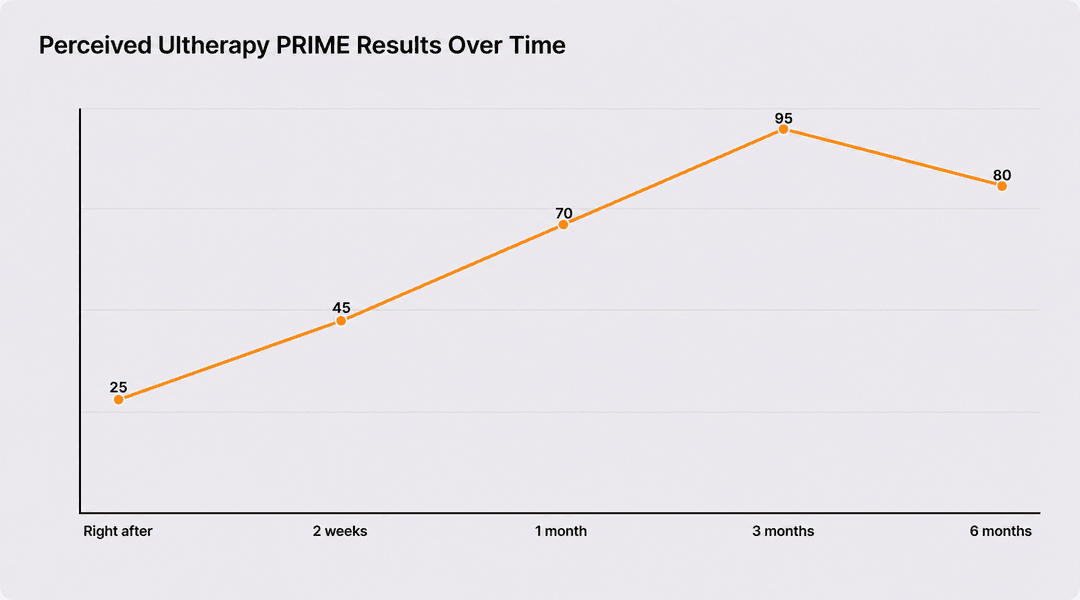
So judging the result at week 2 is a bit early. Give it at least a month, and for the most accurate read, compare before-and-after photos side by side at the 2-to-3-month mark.

Habits that help your results last longer
The collagen Ultherapy Prime helps build still follows the natural aging process over time. To carry your results further, these habits help:
Wear sunscreen daily — UV is a leading cause of collagen breakdown, so daily SPF directly supports your lift.
Stay hydrated and moisturized — a stable skin barrier keeps texture smooth.
Avoid big weight swings — rapid changes over a short period can shift your contours.
Go easy on smoking and alcohol — both are tied to slower collagen recovery.
Do not pre-book your next session — most people set the next timing with their provider after seeing how long results hold.
More than treating one session as the whole story, it works better to follow your own skin's pace and build from there.
Is it worth it? Honestly, it depends on your goals. Ultherapy Prime is a good fit if you want gradual, natural-looking tightening with little to no downtime and you are comfortable waiting a few months for the payoff. It is less satisfying if you expect a dramatic, same-day change or a permanent result—it helps reduce the appearance of mild laxity rather than replacing what surgery does, and results may vary. As a ballpark, microfocused-ultrasound lifting in the US commonly runs around $1,000–$5,000 depending on the area treated, the device, and your provider, and many clinics offer financing such as Cherry or 0% APR plans; treat any figure as a rough range and confirm pricing in your own market. On RealSelf, this category of ultrasound lifting has long drawn a mixed-but-mostly-positive "Worth It" rating, which fits the honest read here: real but subtle.

Where you have it done still matters
Beautystone is a small skin clinic in Seoul, and we tend to walk through the timeline that follows a treatment before the treatment itself. Even with the same Ultherapy Prime, the moment results become visible shifts a little from person to person depending on skin thickness and how fast you rebuild collagen—so we map out, ahead of time, which reactions are common on which days and which signs are worth a second look. If you are in the US, the same principle applies: look for a qualified, licensed provider who assesses your skin and adjusts the settings before treating, and book a follow-up with the clinic that treated you so someone can track your recovery and help you time any next step.

Common reactions vs. signs worth a second look
In the first few days, mild reactions are common. Most settle on their own without any special care.
Mild redness or tingling — usually a few hours to a day.
Pressure marks or faint swelling — fades within 2 to 3 days.
A slightly numb feeling under the jaw or cheeks — eases within a few days.
A little tightness when chewing — can show up briefly.
That said, if you notice any of the following, it is safest to check in with the provider who treated you—and for anything that worsens quickly, seek urgent care:
One-sided drooping or an asymmetric, unnatural expression — often temporary, but it should be evaluated.
Swelling that has not settled after 2 weeks
Pain or heat that keeps getting worse — this can signal a problem; contact your provider right away or seek urgent care.
Blisters or scabbing on the skin surface — uncommon, so please reach out.
This article is general information, not a diagnosis. Whether the treatment is right for you and how to handle recovery should be decided with the licensed provider who actually examines you.

Frequently asked questions
Q. I do not feel anything on the day of treatment—did it not work?
A. It worked. With Ultherapy Prime, feeling little on day one is actually the normal pattern. The slight tightness you notice that day is closer to temporary heat and swelling; the real lifting becomes clear around 2 to 3 months as collagen rebuilds. Give it at least a month before you judge, and individual results may vary.
Q. How long does it last?
A. It varies by person, but the effect usually holds gently for a while even after the clearest window passes—often roughly a year before it gradually eases. Staying consistent with sunscreen and moisturizer helps stretch that out. Set your next timing based on how your own skin recovers rather than a fixed date.
Q. Can I go back to my normal routine right after?
A. Yes—most people can wash their face, wear makeup, and head to work right after. Just skip things that spike heat and blood flow on treatment day—saunas, hard workouts, heavy drinking—for about a day.
Q. What if I still do not see a change after a few weeks?
A. Compare before-and-after photos taken at the same angle and lighting—that is the most reliable check, since daily mirror time hides slow change. If you still do not see a difference at 2 to 3 months, talk with the provider who treated you to review your skin and plan the next step.
Read more


Tattoo removal
손가락 문신은 작으니까 금방 지워질 거라 생각하셨나요?

Tattoo removal
문신제거 견적이 병원마다 다른 이유, 크기 기준부터 달라서예요

Tattoo removal
10회 결제했는데 그 전에 다 지워지면 돈이 아깝지 않을까요?

Lifting
Forehead Thread Lifting: How Far Can It Go?

skin
Skin Booster Prices: What to Check in a Quote

Contouring & Volume
InMode Cost: Why One Area, Three Line Items