

Weight loss doesn't dissolve hip filler, but it changes the shape your dose is planned on. When to wait, when to start small, and what to track before your consult.
Published
Updated

Author
Wi Young-jin · Chief director
Seoul National University College of Medicine · Seoul National University Hospital Specialist
→
If you still plan to lose more weight, it's usually wiser to decide the full amount of hip filler after your weight has stopped changing. If you really want treatment now, don't fill to your final goal in one session. Start with a smaller first round, then reassess once your weight settles. The amount is planned around your current shape, and while you're losing weight, that shape can change week by week.
Losing weight doesn't make the filler itself dissolve. Filler and body fat are separate. What changes is the fat around the filler, and that fat helps shape the side and lower curves of your buttocks. So the real question isn't "Will weight loss erase my filler?" It's "When should I decide how much to put in?"
Quick summary
Still losing weight? Keep the first round small, based on how much you have left to lose. Set the total amount once your weight stops changing.
Want it now anyway? Know before you start that ongoing weight loss may shorten how long results last, and a follow-up session may be needed.
Reading the research: A one-year hip filler study followed 30 women and excluded people with big recent weight changes, so its numbers don't transfer neatly to someone mid-diet.
Choosing a product: Ask at your consultation which product will be used and whether it's approved for the buttock area.
Weight Loss Doesn't Dissolve Filler, but It Moves the Target
Hip filler is a non-surgical treatment that adds volume and shape to the buttocks and hips. A gel-like product, often a hyaluronic acid (HA) filler, is injected into the tissue under the skin. Unlike a fat transfer, which moves your own fat from one area to another, filler is a separate material that sits in place and supports the contour from within.
The filler sits in the subcutaneous fat layer, the layer of fat just under the skin. This is the layer that gets thinner or thicker as your weight changes. Your buttock shape is a team effort between the filler, that fat, and the muscle underneath.
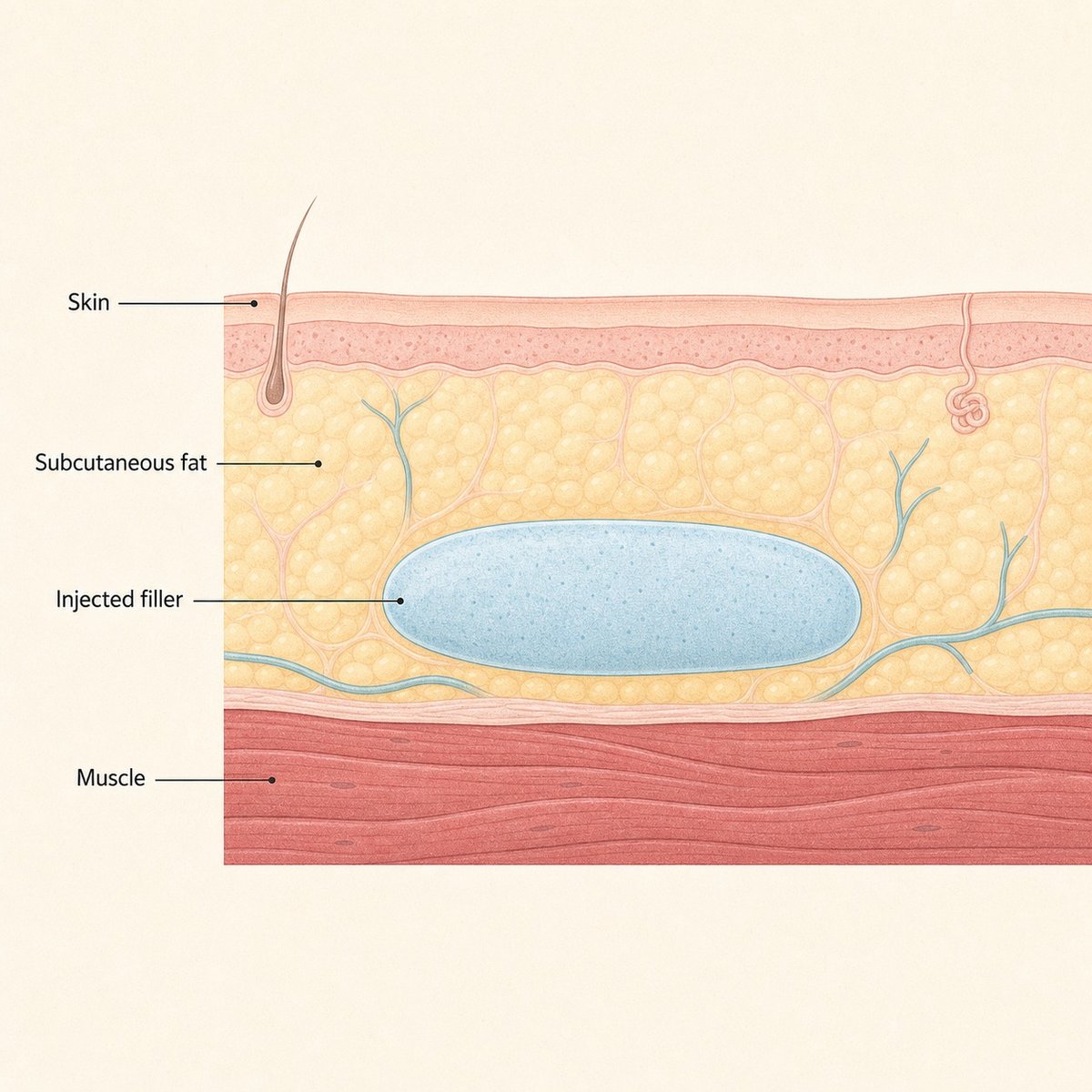
When your weight drops, it's mainly the fat that changes. The filler doesn't melt away because the number on the scale goes down. But as the fat layer thins, the side curve can look more hollow. Or the opposite can happen: your waist gets smaller and your buttocks stand out more. Which way it goes depends on where you lose fat, and that's hard to predict ahead of time.
That's why timing matters. If you fill to your goal based on your pre-diet shape, the same amount can look like too much or too little a few months later, once your contour has changed.
Gradual changes: Slow, steady weight management tends to keep results looking more consistent, since your body composition shifts more evenly.
Rapid changes: Crash diets tend to strip fat quickly and all over, so your hips and buttocks can lose their surrounding fullness faster, which may change how your filler looks.
Wait or Start Small Now? What Decides It
Expert guidance on cosmetic treatment timing for weight-loss patients notes that some people wait until their weight is stable. The goal is to avoid over- or under-correction and make results easier to predict. That guidance is based on face and neck treatments, so for the hips it works as a way of thinking, not a direct rule. Side by side, the two options look like this:
What to compare | Plan once after weight stops changing | Small first round now, reassess later |
|---|---|---|
When the total amount is set | Once, after your weight settles | Again, after your weight settles |
Number of visits | Fewer | More, for the first round and the reassessment |
Your shape while losing weight | No filler during this period | The filler stays on a changing contour |
Good fit when | You still have a lot to lose and your schedule is flexible | You have only a little left to lose and the side curve bothers you now |
How much weight you have left to lose is the deciding factor. If only a few kilograms remain, a small first round with a reassessment is the lighter option. If you still have a long way to go, waiting makes it easier to get the total amount right in one plan.
Losing Weight Fast? Plan the Follow-Up From Day One
If your weight is dropping quickly through diet changes or medication, book a reassessment date when you book your first round. The same expert guidance recommends that, when treating patients who are still losing weight, the consent process should cover two things. Results may last less long with continued weight loss, and additional treatment may be needed. Treat that extra visit as part of the plan, not a failure. Then a change in shape after the first round won't catch you off guard.
The records you need for the reassessment are simple:
Your weight, measured on the same morning each week.
Side and back photos, taken in the same spot and in similar clothing.
With these records, the doctor can see where you lost volume and where it stayed. That helps decide whether a second round makes sense or whether to leave things as they are. At Beautystone, the same doctor who examines you performs the treatment, keeps a record of what was done, and plans the next step from there.
How Long Hip Filler Lasts, and What One Study Can't Tell You
Hip filler isn't permanent, and that's by design. HA-based products are gradually broken down and absorbed by your body, so the volume softens rather than vanishing overnight. In most cases, results tend to hold for several months to a couple of years before the volume noticeably fades. A few factors move the needle:
Metabolism: A faster metabolism can process filler a bit quicker.
Activity level: Very active people, especially those doing a lot of high-intensity exercise, may find their filler softens sooner.
Product and volume: Different formulations and amounts wear off on different timelines.
In a one-year study of hyaluronic acid filler in the buttocks, 62% of participants (18 people) said they still saw aesthetic improvement at day 360. The amount injected was set individually, based on each patient's anatomy and aesthetic goals, and the study's discussion also listed body weight as a factor in the dose. That's encouraging, but look at the conditions. The study included 30 women aged 20 to 45, and people with significant weight change in the previous six months were excluded from the start. If you get filler while you're still losing weight, you're outside the range that number describes.
Side Effects, Aftercare, and What to Bring to Your Consultation
Like any injectable, hip filler comes with trade-offs. Right after treatment, redness, swelling, and bruising are common and usually settle within a few days to about a week. Mild tenderness is also normal early on. The American Academy of Dermatology lists more serious filler side effects as lumps, overfilled areas, allergic reactions, skin discoloration, infection, and severe swelling. Putting in your full target amount mid-diet can leave an area looking overfilled once your weight settles. That's one more reason to keep the first round small.
Some symptoms need prompt attention. If you notice severe or spreading pain, swelling that keeps getting worse, a firm lump that doesn't ease, skin that turns pale or dusky, or fever, don't wait it out. Seek medical care right away.
In the first few days: Avoid heavy pressure or vigorous massage on the treated area, and try not to sit for long stretches without shifting position. Skip intense workouts and hot saunas at first, then ease back in as you heal.

To settle timing and amount quickly at your consultation, write down three things:
Your goal weight.
How your weight has changed over the last few months.
How you're losing weight: diet, exercise, medication, or a mix.
With those three lines, deciding between a small first round now and waiting can happen in one conversation. If you're also concerned about hip dips, the hollow on the side of the hips, that area changes shape as you lose weight too, so track it with the same records. Photos also show whether any left-right difference was there to begin with, which makes comparing after the first round easier.
Cost, the right product, and the amount you'll need all depend on your anatomy and goals, so the details are sorted out at a consultation. You can find current pricing on our price page. Beautystone is a dermatology clinic in Seoul's Hapjeong area. See current offers at /en/promotion.
Frequently asked questions
Q. Will hip filler disappear if I lose weight?
A. No. The filler itself doesn't dissolve because you lose weight. It's a separate material from your body fat. But if you lose a lot of weight, the surrounding fat thins out and your contour can look different, even though the filler hasn't gone anywhere. Individual results vary.
Q. Should I get hip filler before or after losing weight?
A. If you still have a lot to lose, it's usually better to set the total amount after your weight has stabilized. If only a little is left and you want treatment now, a smaller first round followed by a reassessment is an option. Tell your provider your weight-loss plan so they can factor it into the timing.
Q. I'm losing weight quickly. Will I need another session?
A. Possibly. Continued weight loss may shorten how long results last, and an additional session may be needed. It helps to book a reassessment with your first round and keep weekly weight records and photos.
Q. How long does hip filler last?
A. It depends on the product, the amount placed, the area, and your metabolism. In most cases, results hold for several months to a couple of years before the volume noticeably fades. HA-based fillers are gradually absorbed by your body, so the effect softens over time.
Q. Does hip filler hurt, and what's the recovery like?
A. Most people feel some pressure and tenderness rather than sharp pain, and numbing is typically used. Afterward, redness, swelling, and bruising are common and usually settle within a few days to a week. If pain is severe, swelling worsens, or a firm lump lingers, contact your provider right away.





Contouring & Volume
Hip Dip Filler Before and After: 4 Checks

Body
Potenza Treatment Interval: Why 4 Weeks?

Lifting
Ultherapy Before and After: Why Wait 90 Days?

Contouring & Volume
Belotero Revive Cost: 2cc Price vs. 3 Sessions

skin
Lip Hyperpigmentation Laser: Does It Work?

Contouring & Volume
Men's Forehead Filler: Hollow or Just Lines?