

With hyaluronidase, timing is all: 80% recovery within 4 hours—call your clinic now.
Published
Updated

Author
Wi Young-jin · Chief director
Seoul National University College of Medicine · Seoul National University Hospital Specialist
→
When it comes to nose filler side effects, almost every variable that decides between 'made a full recovery' vs. 'was left with a scar' comes down to just one thing: how quickly you receive hyaluronidase (hyalase). If administered within 4 to 6 hours, almost everyone recovers. If it passes 24 hours, recovery becomes very difficult. While hyalase is the same everywhere, knowing this "golden hour" and immediately contacting the clinic where you received the procedure is the ultimate key.
[!quick] > If you notice warning signs of suspected vascular occlusion (dark blue or purplish discoloration, throbbing pain, sudden paleness, or blistering), please contact the clinic where you had your procedure immediately. Injecting high-dose hyalase combined with massage and warm compresses within 4 to 6 hours leads to an 80%↑ recovery rate. Beyond 24 hours, that rate drops to less than half.
What exactly does hyalase do?
Hyaluronidase* is an enzyme that dissolves hyaluronic acid (HA). Any HA filler can be melted away using this enzyme. In Korea, it is registered with the Ministry of Food and Drug Safety under brand names like 'Lidase' or 'Hylaza', but its common clinical name is 'hyalase.'
The role of hyalase in an emergency is simple: it dissolves the filler that is blocking the blood vessel to restore blood flow. That is all. This is why time is the most critical factor. The faster it is dissolved, the higher the chances that the tissue supplied by that artery will survive.
* Hyaluronidase: An enzyme that breaks down hyaluronic acid. Clinically referred to as "hyalase" in Korea. In emergencies, high doses of 150 to 1,500 IU are injected broadly into the blocked area to dissolve the filler. For minor shape corrections, a low dose of 30 to 75 IU is used.

The 4-Hour Golden Hour: Why is this window so vital?
There is a strict limit on how long human tissue can survive without oxygen. The skin and dermis can endure for about 4 to 6 hours, while nerves are shorter, and the retina's fate is decided within 90 minutes. Here is how the timeline unfolds:
Time | Likelihood of Recovery | Treatment |
|---|---|---|
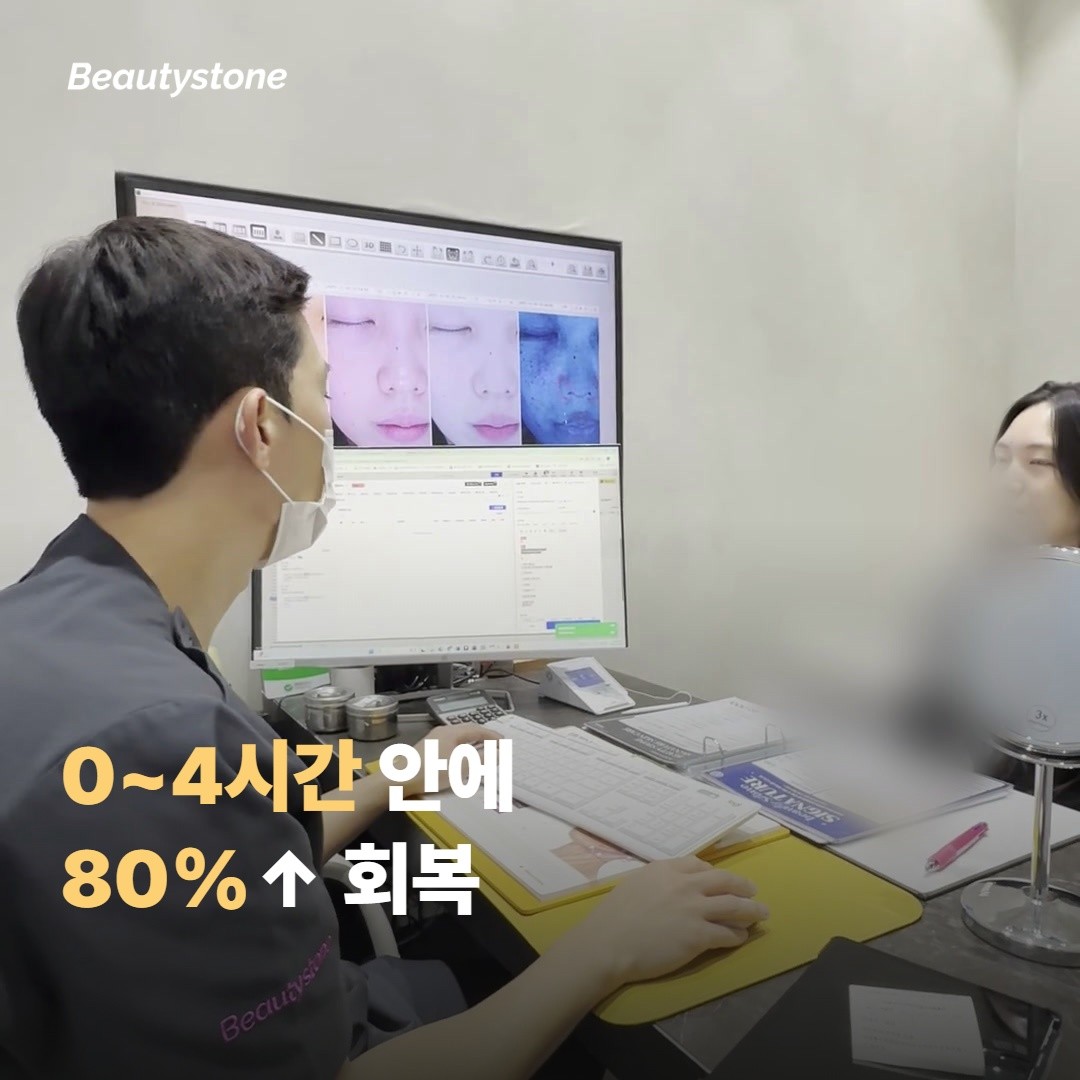
0 to 4 hours | 80%↑ | High-dose hyalase + Massage + Warm compress |
4 to 24 hours | 30% to 50% | Same treatment + microvascular laser assistance |
24 to 48 hours | Under 20% | Treat immediately, but some scarring may remain |
Over 48 hours | Under 10% | Necrosis solidifies; progresses to reconstruction phase |
With vascular emergencies, time is the ultimate solution. Any hesitation directly reduces your chance of recovery.
Emergency Protocol: What happens at the clinic?
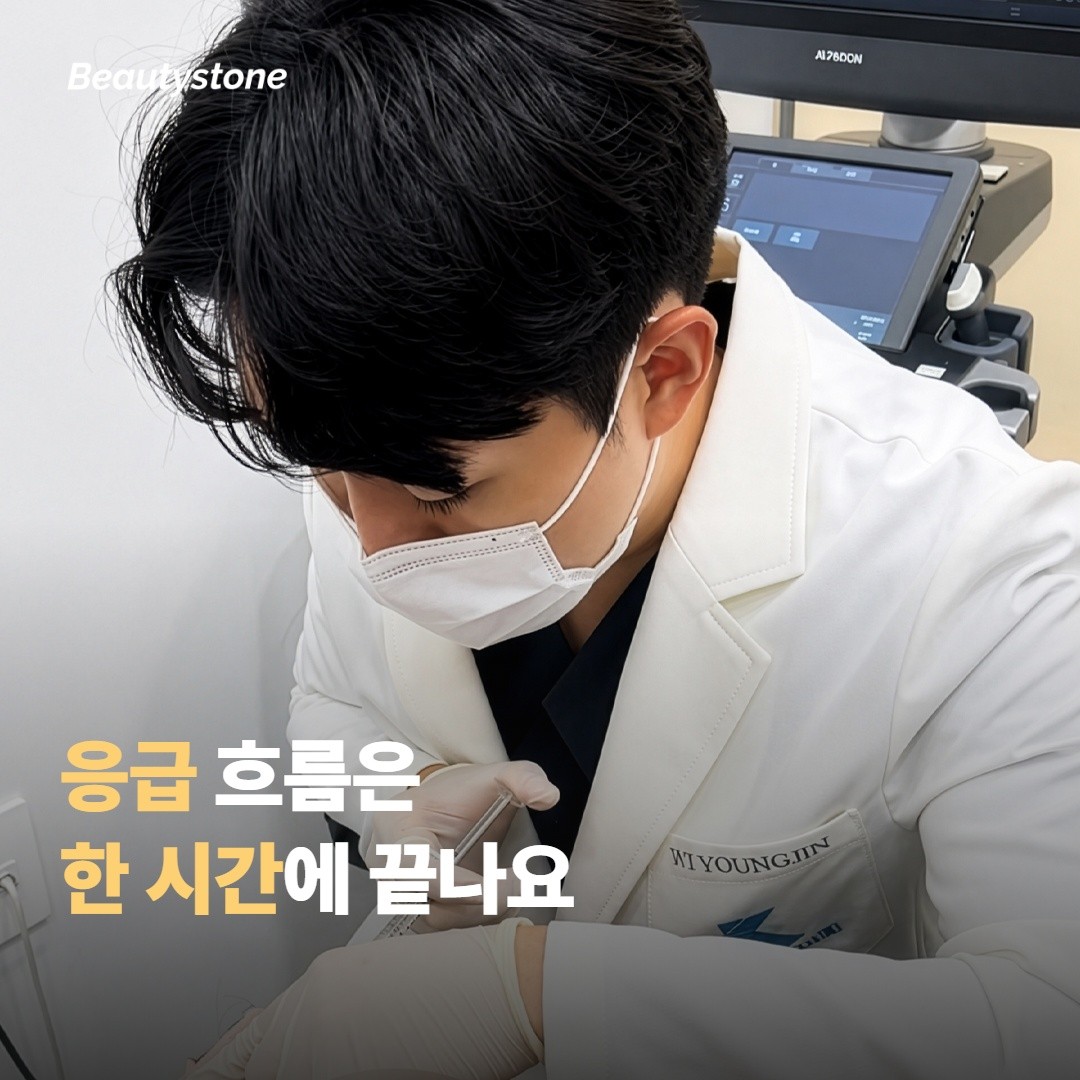
The standard is to complete everything—the phone call, your arrival at the clinic, and the treatment—within a single hour.
1. High-Dose Hyalase Injection – Diligently injected across and around the blocked area (150 to 1,500 IU). 2. Manual Massage – Helps disperse the dissolved filler and encourages blood flow. 3. Warm Compress – Dilates the blood vessels to boost circulation, performed alongside massage. 4. Anti-clotting agents like Aspirin – Prescribed at the doctor's discretion to prevent blood clots. 5. Microcirculation Regulating Lasers (V-beam, IPL) – Used as supportive therapy to shorten healing time.
After the emergency care, we will perform follow-up monitoring for 2 to 3 days. If healthy color returns to your skin and the pain subsides, you are safely on the path to recovery. If the dark discoloration persists, additional clinical measures are taken.
Glabellar (Between the Brows) Occlusion: Checking your vision within 90 minutes is key
In glabellar filler procedures, if the supratrochlear artery becomes blocked, the filler can flow backward into the ophthalmic artery and end up blocking the retinal artery*. If the retinal artery is not treated within 90 minutes, it can lead to permanent vision loss. This makes it a different level of emergency compared to other side effects.
* Retinal artery: The artery that supplies blood to the retina. It branches off from the ophthalmic artery. Because the retina can only survive for about 90 minutes without oxygen, an occlusion here demands much faster action than other tissues.
[!warning] > If you experience blurry vision or see dark spots after a forehead or nose procedure, dial 119 (or emergency services) immediately. This is a case where going straight to the emergency room is much faster than heading back to the clinic, as emergency ophthalmology treatment is required.
Fortunately, glabellar occlusions are extremely rare, and using safe techniques like cannulas and deep periosteal injections can prevent almost all of them. However, please remember that if signs do appear, the time window is exceptionally brief.

Our Clinic's Emergency Protocol
[!clinical] > In my practice, I always share an 'Emergency Hot Line' before any nose filler procedure. If anything feels unusual after your treatment, you can call at any time—including nights and weekends. If you can arrive within 30 minutes, almost every case can be guided safely toward complete recovery. We always keep ample hyalase in stock, ready for immediate injection.
Choosing a clinic that is fully prepared for emergency situations is half the battle won when dealing with side effects. Simply verifying "Can this clinic handle emergency responses?" before your procedure will significantly enhance your safety. In Part 5 of this series, we will cover the step-by-step checklist for choosing a safe clinic.
Frequently asked questions
Q. If I get a Hyalase injection, will all of my filler disappear?
A. Yes, the obstructed area will dissolve completely. You can have a touch-up procedure to restore the shape at least 2 to 4 weeks after recovery. Fortunately, having experienced an obstruction once does not increase the risk of it happening again during your next treatment. However, you should be cautious about using the same doctor or technique.
Q. Are there any side effects to Hyalase?
A. Allergic reactions are rare (especially with products derived from sheep or bovine testes). The practitioner may perform a skin test before the treatment. However, in an emergency, immediate injection is administered as resolving the occlusion takes priority over the risk of an allergic reaction.
Q. Can I receive emergency treatment at your clinic for dermal fillers done at another clinic?
A. Yes, Hyalase can dissolve HA fillers regardless of where you received them. However, having information on 'which product, how much, and where' it was injected makes the treatment much more precise. If possible, bringing your chart information from the clinic where you received the procedure, along with before and after photos, would be very helpful.
Q. If my vision becomes blurry after a frown line treatment, should I go back to the clinic where I received the treatment?
A. In some cases, calling 911 or visiting the emergency room can be much faster than coming to our clinic. If the supratrochlear artery in the forehead becomes blocked and affects the retinal artery, the retina must be treated within 90 minutes. This requires immediate emergency ophthalmic care.






Contouring & Volume
Hip Dip Filler Before and After: 4 Checks

Body
Potenza Treatment Interval: Why 4 Weeks?

Lifting
Ultherapy Before and After: Why Wait 90 Days?

Contouring & Volume
Belotero Revive Cost: 2cc Price vs. 3 Sessions

skin
Lip Hyperpigmentation Laser: Does It Work?

Contouring & Volume
Men's Forehead Filler: Hollow or Just Lines?