

Radiesse 1:1 vs 1:2 Dilution: What's Different?
Radiesse 1:1 vs 1:2 Dilution: What's Different?
Radiesse 1:1 vs 1:2 Dilution: What's Different?
Radiesse dilution ratio affects volume, collagen, longevity. Clinical guide to 1:1 vs 1:2.
Published -
Updated -

Author
Wi Young-jin · Chief director
Seoul National University College of Medicine · Seoul National University Hospital Specialist
→
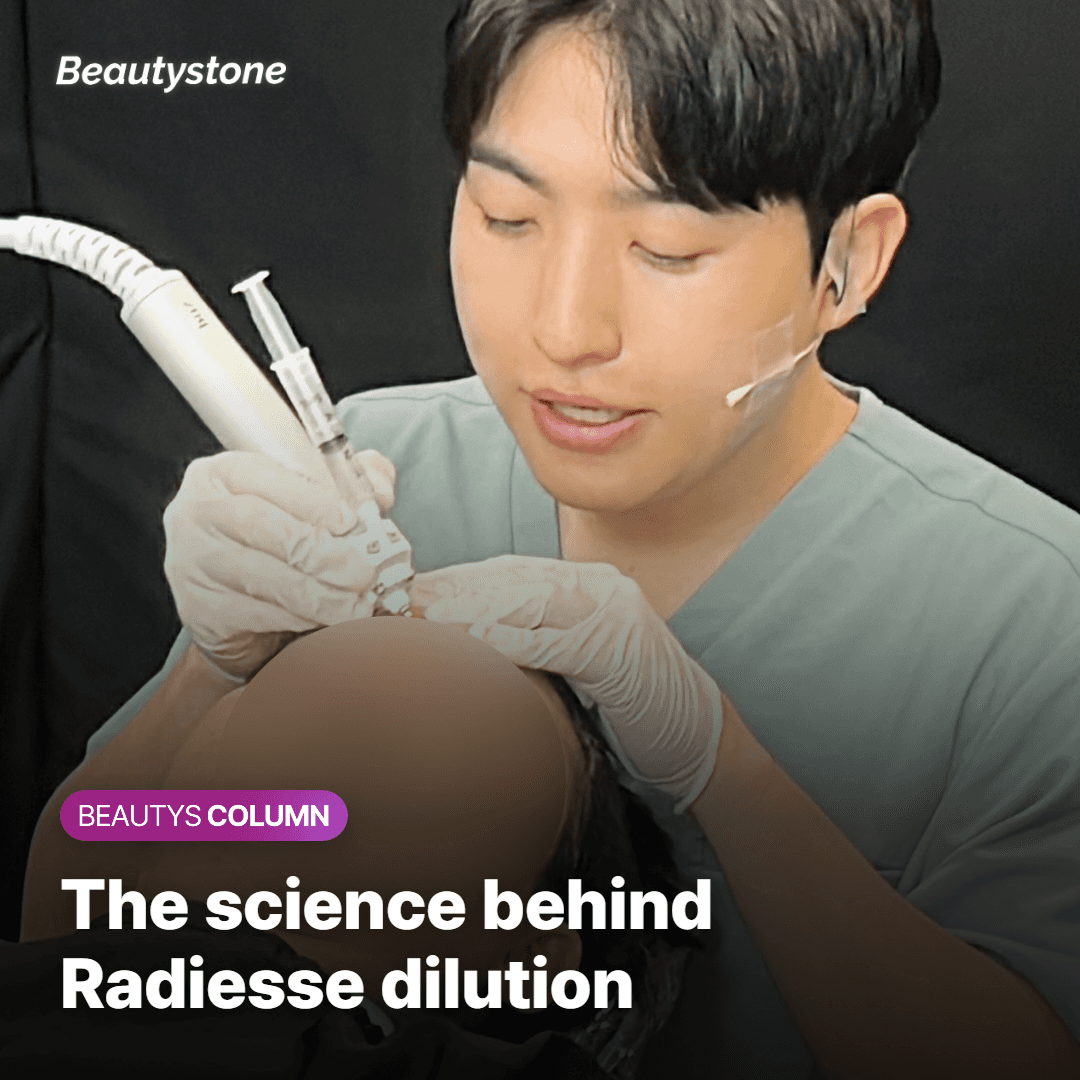
Radiesse dilution ratio,
what’s the difference between 1:1 and 1:2?
I’m Dr. Wi Young-jin of Beaute's Doctor.
Please check this before reading
Q. If you dilute it a lot,
doesn’t the effect decrease?
A. It doesn’t simply get thinner.
Depending on the ratio, the range of collagen stimulation and
the way volume is maintained change completely.
Q. Then which ratio is better?
A. There is no "better ratio."
The answer changes depending on the treatment area and purpose.
Key points of this article
The science behind Radiesse dilution ratios—how 1:1 and 1:2
differ in their effects on the skin
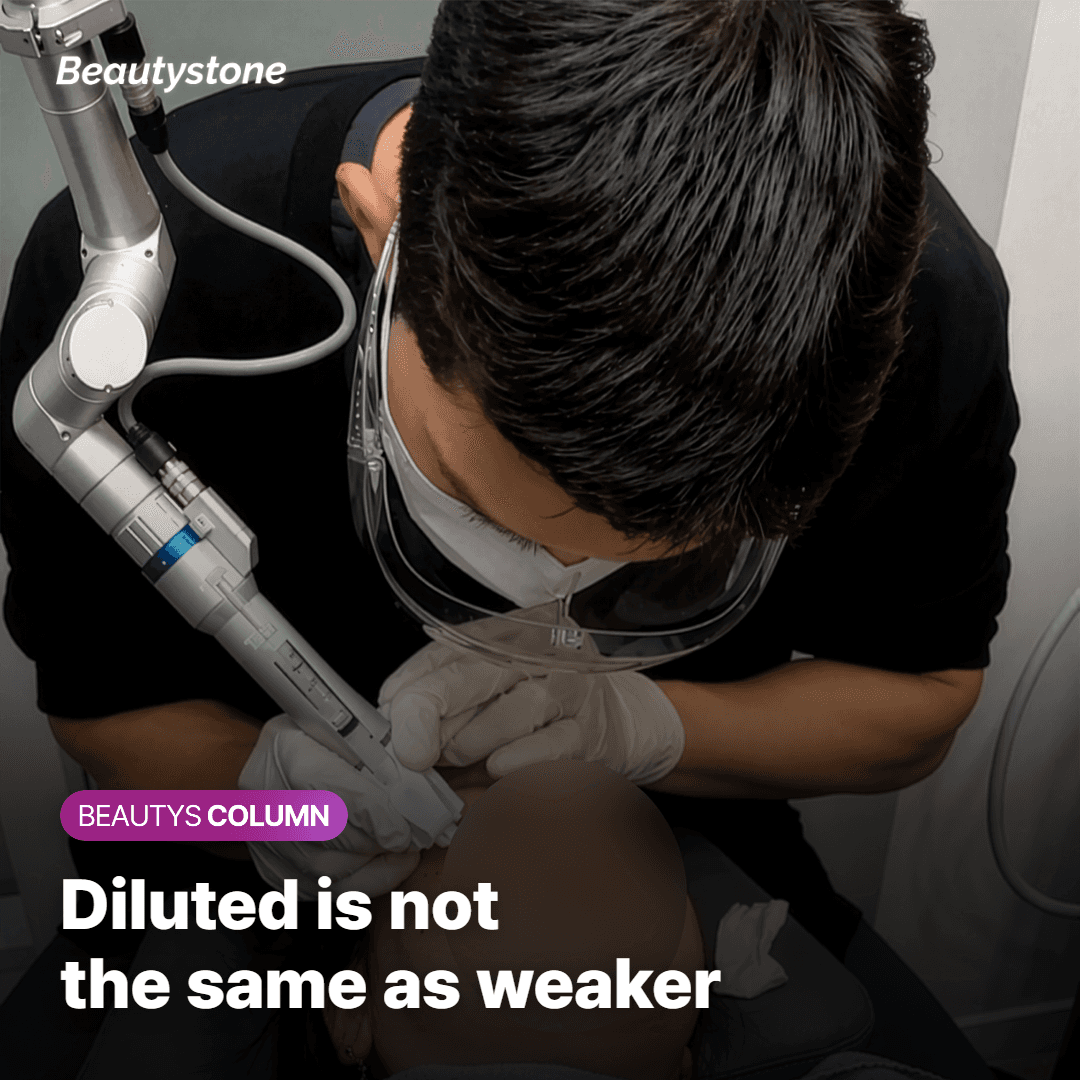
What is Radiesse?
Radiesse is
a filler made of calcium hydroxyapatite (CaHA) microspheres
suspended in a gel carrier.
Unlike hyaluronic acid (HA) fillers,
the gel is gradually absorbed after injection, and
the CaHA particles in the surrounding tissue
stimulate the body’s own collagen production.
So it acts as both a "volume filler"
and a "collagen booster."
But there’s one important thing here.
Radiesse can be used as is, but
it is much more commonly diluted with saline or lidocaine
before use.
And the results of the procedure change completely
depending on this dilution ratio.
The scientific reason the dilution ratio changes the result
This is a common misconception, but
"dilution = weaker" is not true.
The key ingredient in Radiesse is
the CaHA microspheres.
You can think of each one of these particles
as a seed that creates collagen.
When diluted, these seeds
spread evenly over a wider area.
On the other hand, with less dilution,
the seeds are concentrated in one place.
To be honest,
even with the same 1cc of Radiesse, the reaction in the skin is completely different
when diluted at 1:1 versus
1:2.
1:1 dilution (Radiesse : diluent = 1 : 1)
The CaHA particle density is relatively high.
The volume is more noticeable immediately after injection, and
collagen forms intensively in one area.
It is suitable for areas like the cheeks or chin,
where you need to define contours.
1:2 dilution (Radiesse : diluent = 1 : 2)
The CaHA particles are distributed more widely.
The immediate volumizing effect is weaker,
but collagen forms in a thin, broad area.
It is used for the neck, back of the hands, or forehead,
to improve the skin’s texture itself.
This is a bit tricky,
because changing the ratio also changes the viscosity.
1:1 is thicker, so
it tends to stay where it is injected,
while 1:2 spreads more easily because it is thinner.
So, even though it’s the same Radiesse,
just changing the ratio can make it a "filler" or
a "skin booster."
This is how I usually explain it.
"1:1 is like building a structure,
while 1:2 is like leveling the ground evenly."
It becomes a completely different treatment purpose.
Radiesse dilution ratios at a glance
Category | 1:1 dilution | 1:2 dilution |
CaHA particle density | High (concentrated placement) | Low (widely distributed) |
Immediate volume after injection | Noticeable | Natural (minimal) |
Range of collagen formation | Narrow and deep | Wide and shallow |
Viscosity (thickness) | High (stays in place) | Low (excellent spreadability) |
Typical treatment areas | Cheeks, chin, nose (contouring) | Neck, back of hands, forehead (skin texture) |
Duration | About 12–18 months | About 8–12 months |
Treatment type | Volume filler | Skin booster |
Dr. Wi Young-jin’s key summary
The dilution ratio is not about "how thin it is"
but about "at what density the CaHA particles are placed."
It’s a matter of
If the goal is volume, use 1:1. If the goal is skin texture improvement, use 1:2.
Adjusting this to match the area and purpose is
the doctor’s role.
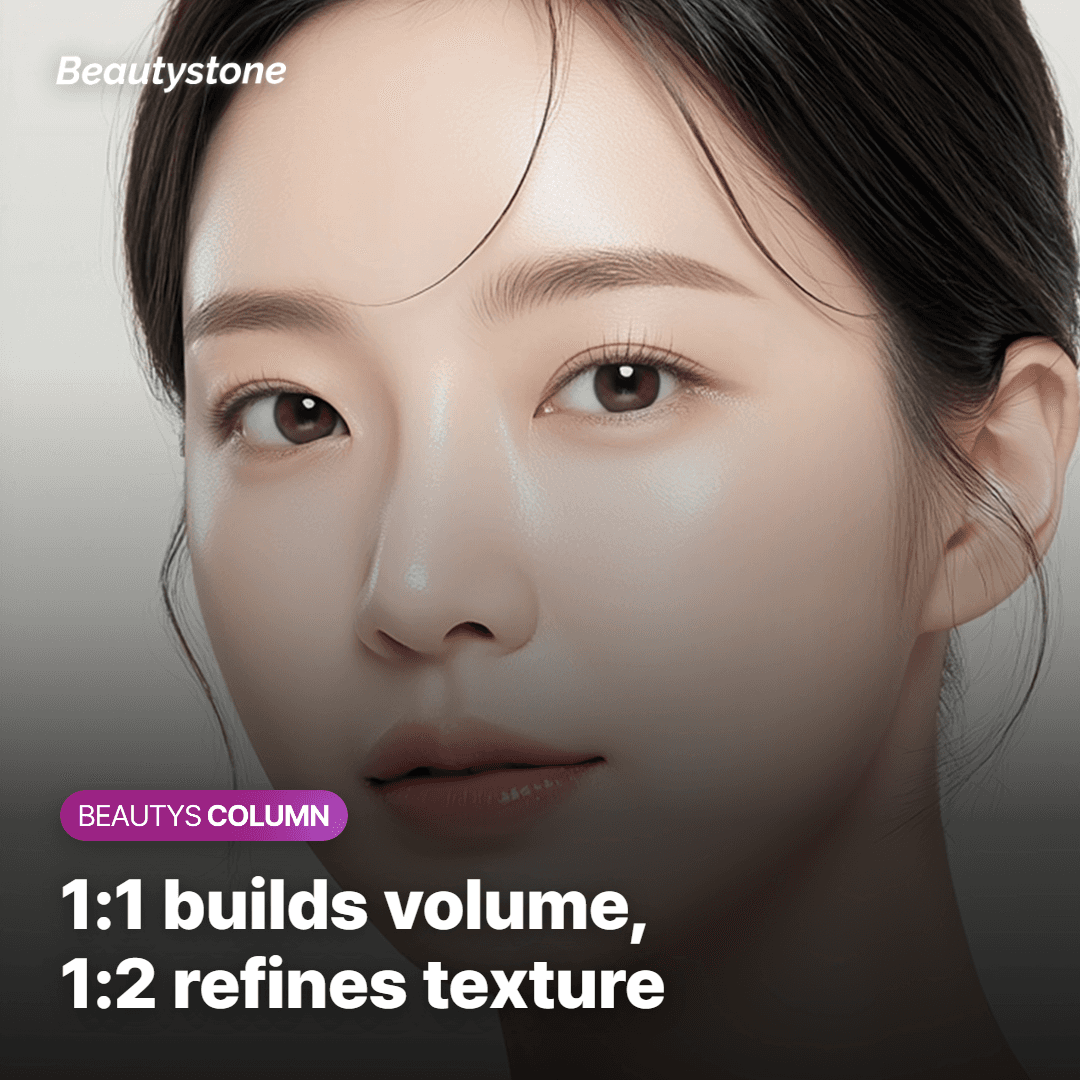
How to choose ratios by area and purpose
For those mainly concerned about hollow cheeks
→ Inject into the deep layer at a 1:1 ratio.
You’ll feel the volume restored right away, and over time
collagen fills in the area.
For those worried about neck wrinkles or aging hands
→ Spread it more broadly at a 1:2 ratio.
As a collagen network forms in a thin layer under the skin,
the texture itself changes.
For those who want both forehead wrinkles and some volume
→ A middle ratio of around 1:1.5 is sometimes used.
Small adjustments change the result.
In actual forehead cases using a 1:1.5 ratio,
there were quite a few cases where both volume maintenance and
improvement in fine wrinkles were seen at the same time.
But that doesn’t always mean it’s good.
One important thing I need to mention is
that Radiesse cannot be dissolved like HA fillers.
That means once it’s injected, it can’t be "reversed."
So if the ratio is chosen incorrectly,
it can become uneven or form nodules.
However, with enough experience, a doctor
can prevent this by placing the right amount in the proper layer.
Frequently asked questions
Q1. When diluting Radiesse,
do you also mix in lidocaine?
A. Yes, in actual clinical practice, lidocaine is often mixed in
to reduce pain while diluting it.
Because the viscosity changes depending on the lidocaine ratio,
this is also something the doctor adjusts.
Q2. How much does one treatment session cost,
and how many sessions are needed?
A. Because the amount used changes depending on the ratio,
the total cost can also vary.
If the goal is a skin booster, 2 to 3 sessions is standard,
and if the goal is volume, one session is often enough.
Q3. How long do bruising and swelling last after the procedure?
A. Usually, there is mild swelling for about 3 to 7 days.
Areas with thin skin, such as the back of the hands or the neck,
tend to bruise more easily,
so it’s best to avoid treatment one week before an important schedule.
I recommend getting enough consultation before the procedure
and then making your decision.
That was Dr. Wi Young-jin.
Read next
▶Chin filler side effects, effects, and duration, all explained at once
▶Where in Hongdae is a good place for forehead fillers?
▶Collagen injections—how are they different from fillers?
▶Is one treatment enough? Radiesse dilution methods and effects
Radiesse dilution ratio,
what’s the difference between 1:1 and 1:2?
I’m Dr. Wi Young-jin of Beaute's Doctor.
Please check this before reading
Q. If you dilute it a lot,
doesn’t the effect decrease?
A. It doesn’t simply get thinner.
Depending on the ratio, the range of collagen stimulation and
the way volume is maintained change completely.
Q. Then which ratio is better?
A. There is no "better ratio."
The answer changes depending on the treatment area and purpose.
Key points of this article
The science behind Radiesse dilution ratios—how 1:1 and 1:2
differ in their effects on the skin
What is Radiesse?
Radiesse is
a filler made of calcium hydroxyapatite (CaHA) microspheres
suspended in a gel carrier.
Unlike hyaluronic acid (HA) fillers,
the gel is gradually absorbed after injection, and
the CaHA particles in the surrounding tissue
stimulate the body’s own collagen production.
So it acts as both a "volume filler"
and a "collagen booster."
But there’s one important thing here.
Radiesse can be used as is, but
it is much more commonly diluted with saline or lidocaine
before use.
And the results of the procedure change completely
depending on this dilution ratio.
The scientific reason the dilution ratio changes the result
This is a common misconception, but
"dilution = weaker" is not true.
The key ingredient in Radiesse is
the CaHA microspheres.
You can think of each one of these particles
as a seed that creates collagen.
When diluted, these seeds
spread evenly over a wider area.
On the other hand, with less dilution,
the seeds are concentrated in one place.
To be honest,
even with the same 1cc of Radiesse, the reaction in the skin is completely different
when diluted at 1:1 versus
1:2.
1:1 dilution (Radiesse : diluent = 1 : 1)
The CaHA particle density is relatively high.
The volume is more noticeable immediately after injection, and
collagen forms intensively in one area.
It is suitable for areas like the cheeks or chin,
where you need to define contours.
1:2 dilution (Radiesse : diluent = 1 : 2)
The CaHA particles are distributed more widely.
The immediate volumizing effect is weaker,
but collagen forms in a thin, broad area.
It is used for the neck, back of the hands, or forehead,
to improve the skin’s texture itself.
This is a bit tricky,
because changing the ratio also changes the viscosity.
1:1 is thicker, so
it tends to stay where it is injected,
while 1:2 spreads more easily because it is thinner.
So, even though it’s the same Radiesse,
just changing the ratio can make it a "filler" or
a "skin booster."
This is how I usually explain it.
"1:1 is like building a structure,
while 1:2 is like leveling the ground evenly."
It becomes a completely different treatment purpose.
Radiesse dilution ratios at a glance
Category | 1:1 dilution | 1:2 dilution |
CaHA particle density | High (concentrated placement) | Low (widely distributed) |
Immediate volume after injection | Noticeable | Natural (minimal) |
Range of collagen formation | Narrow and deep | Wide and shallow |
Viscosity (thickness) | High (stays in place) | Low (excellent spreadability) |
Typical treatment areas | Cheeks, chin, nose (contouring) | Neck, back of hands, forehead (skin texture) |
Duration | About 12–18 months | About 8–12 months |
Treatment type | Volume filler | Skin booster |
Dr. Wi Young-jin’s key summary
The dilution ratio is not about "how thin it is"
but about "at what density the CaHA particles are placed."
It’s a matter of
If the goal is volume, use 1:1. If the goal is skin texture improvement, use 1:2.
Adjusting this to match the area and purpose is
the doctor’s role.
How to choose ratios by area and purpose
For those mainly concerned about hollow cheeks
→ Inject into the deep layer at a 1:1 ratio.
You’ll feel the volume restored right away, and over time
collagen fills in the area.
For those worried about neck wrinkles or aging hands
→ Spread it more broadly at a 1:2 ratio.
As a collagen network forms in a thin layer under the skin,
the texture itself changes.
For those who want both forehead wrinkles and some volume
→ A middle ratio of around 1:1.5 is sometimes used.
Small adjustments change the result.
In actual forehead cases using a 1:1.5 ratio,
there were quite a few cases where both volume maintenance and
improvement in fine wrinkles were seen at the same time.
But that doesn’t always mean it’s good.
One important thing I need to mention is
that Radiesse cannot be dissolved like HA fillers.
That means once it’s injected, it can’t be "reversed."
So if the ratio is chosen incorrectly,
it can become uneven or form nodules.
However, with enough experience, a doctor
can prevent this by placing the right amount in the proper layer.
Frequently asked questions
Q1. When diluting Radiesse,
do you also mix in lidocaine?
A. Yes, in actual clinical practice, lidocaine is often mixed in
to reduce pain while diluting it.
Because the viscosity changes depending on the lidocaine ratio,
this is also something the doctor adjusts.
Q2. How much does one treatment session cost,
and how many sessions are needed?
A. Because the amount used changes depending on the ratio,
the total cost can also vary.
If the goal is a skin booster, 2 to 3 sessions is standard,
and if the goal is volume, one session is often enough.
Q3. How long do bruising and swelling last after the procedure?
A. Usually, there is mild swelling for about 3 to 7 days.
Areas with thin skin, such as the back of the hands or the neck,
tend to bruise more easily,
so it’s best to avoid treatment one week before an important schedule.
I recommend getting enough consultation before the procedure
and then making your decision.
That was Dr. Wi Young-jin.
Read next
▶Chin filler side effects, effects, and duration, all explained at once
▶Where in Hongdae is a good place for forehead fillers?
▶Collagen injections—how are they different from fillers?
▶Is one treatment enough? Radiesse dilution methods and effects


Latest post
Latest post

Hair Removal
레이저 제모 1회에도 남는 몫이 있어요 — 밀도를 모자이크로 보는 법

Tattoo removal
Why Extremity Tattoos Are Slower to Remove

Tattoo removal
Tattoo Removal Cost: Why Quotes Vary by Area

Tattoo removal
Unused Tattoo Removal Sessions: What Happens?

Lifting
Forehead Thread Lifting: How Far Can It Go?

skin
Skin Booster Prices: What to Check in a Quote
1:1 Custom Approach
1:1 Consultation Whatsapp
🌸 Beautystone Clinic attends the Meditox Bangkok Cadaver Workshop 🌸
1:1 Custom Approach