

A Guide to the Effects and Side Effects of Radiesse, a Collagen-Stimulating Filler
Published -
Updated -

Author
Wi Young-jin · Chief director
Seoul National University College of Medicine · Seoul National University Hospital Specialist
→
Before Getting Radiesse Filler
3 Things You Must Know

The weather has been really up and down these days.
In this season when mornings are chilly and afternoons are mild,
your skin and overall body condition
can feel inconsistent for many people.
Today’s topic is
Radiesse.
You’ve probably heard the name a lot,
and also, it’s from the famous Ulthera company
product haha
But the thing is,
a lot more people than you’d think
are confused about how it differs from other fillers.
So today, I’ll go over just the key points.
Q. Is Radiesse
the same as a hyaluronic acid filler
?
A. No. The ingredients themselves are different.
I’ll explain the differences in detail below.
Q. If you get Radiesse once,
how long does it last?
A. In my experience,
it usually lasts about 12–18 months.
It lasts quite a long time because collagen regenerates.
However, it depends on the area and individual differences,
and I’ll also summarize this in the main text.
Q. Can Radiesse be dissolved?
A. No.
Hyaluronidase (the filler-dissolving injection)
does not work on it.
This is the most important point,
so make sure to read below.
Why Radiesse Is
Different from Other Fillers

When people say filler, they usually
first think of hyaluronic acid (HA)-based fillers.
Radiesse has a completely different composition.
Its main component is CaHA,
calcium hydroxyapatite.
Just from the name, it can sound like something hard is being injected,
so some people get scared.
But it is actually a substance that already exists in our body,
and in bones and teeth
it is a naturally occurring mineral.
It is injected in a gel form
with dispersed microscopic spherical particles.
If hyaluronic acid filler
creates volume by attracting moisture,
Radiesse
provides direct volumizing effects at first,
and over time, CaHA particles
stimulate collagen production.
In other words, it both fills and stimulates production,
doing two things at once.
Areas Where Radiesse Is Often Used Well,
and Areas Where It Is Not
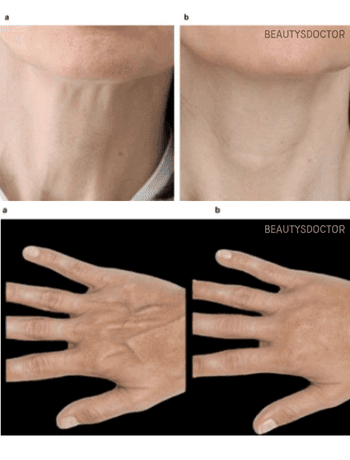
Areas where Radiesse is especially effective are
the cheeks, jawline, nasolabial folds, and back of the hands.
In places like the cheeks, where the area is broad and support is needed,
CaHA’s physical properties are a great match.
It varies by case,
but this is usually how I approach it.
For people with cheek sagging and
overall reduced skin elasticity,
I recommend Radiesse as the first option.
For somewhat older patients,
who want both volume and
a lifting effect, it tends to fit very well.
But there is one important thing here.
Around the eyes, especially the tear trough area,
we do not use Radiesse.
In areas with complex vascular distribution
and thin tissue,
CaHA particles can cause problems.
So for this area, going with
hyaluronic acid filler is much safer.
This is a common misunderstanding,
but just because Radiesse lasts long and is good,
doesn’t mean it can be used everywhere.
Radiesse is also used for hand volume,
and this area tends to have high satisfaction
for people with thin skin and visible veins.
However, because the hands move a lot,
bruising may last longer or swelling
may continue for several days.
I always explain this in advance as well.
Director Kaeul Kim’s Practical Note:
The most important point with Radiesse is
that “there is no dissolving injection.”
With hyaluronic acid fillers, if you dislike the shape
or if side effects occur, it can be removed quickly,
but Radiesse cannot.
Because of this limitation, for first-time patients
I tend to start conservatively with the amount,
and injector experience is
truly important with this filler.
In my experience, starting with a slightly smaller amount
and adding more after 2–4 weeks is much safer.
Before and After Radiesse,
What You Realistically Need to Know
To be honest, Radiesse
has a somewhat stronger initial reaction than other fillers.
Swelling and bruising can last for a few days,
and especially first-time patients
may feel, “Is this normal?”
Usually right after treatment, due to the gel carrier,
the volume can look excessive,
but after 1–2 weeks
it settles in and looks natural.
Over the following months, the particles
stimulate collagen production,
so even if it looks like the volume has slightly decreased,
skin elasticity itself often improves.
This is a bit of a downside,
but during MRI scans, Radiesse
may appear as white dots on imaging.
Radiologists can be confused by this,
so you must disclose your filler procedure history before an MRI.
And another downside is the cost ^^..
Compared to hyaluronic acid fillers, the unit price is higher,
and when compared per 1cc, the difference is quite large.
Still, because it lasts longer
and has a collagen-stimulating effect,
many people view it as more economical
in the long term.
Radiesse,
Who It’s a Good Fit For
1 People with cheek sagging who also want a lifting effect
2 People who have already tried fillers,
and feel that HA fillers disappear too quickly
3 People bothered by prominent veins
due to lost volume on the back of the hands
4 People who want to improve the mid-face line rather than the tear trough
On the other hand, for these people
I recommend other options.
1 First-time filler users
(Consider after checking response with HA filler)
2 People whose main goal is correction around the eyes
3 People who want immediate removal if they dislike the result
What I consider most important is
before using Radiesse,
clearly identifying why it has to be Radiesse.
Frequently Asked Questions
Q1. Is it okay even for
first-time filler patients?
Because there is no dissolving injection, predicting the result is important,
and if you have
never experienced filler response before,
there is risk in applying it
directly as a first procedure.
Q2. If the effect disappears,
does it return to the original state?
A. Over time, the particles break down in the body,
and the direct volumizing effect decreases.
However, because collagen production effects accumulate,
it often does not
completely return to square one.
Q3. Can I get Botox
on the same day?
A. Yes, if the treatment areas do not overlap.
However, swelling and bruising can overlap,
and the treatment order and combination must be
determined by me after checking your individual condition.
If you have any questions, feel free
to contact us via WhatsApp or phone.
You can also ask on WhatsApp before visiting.
This was Kaeul Kim.
Content
![[Wi Young-jin Column] Hard lumps after Radiesse nodules](https://framerusercontent.com/images/pHmbmCumB15G7SqX0GFlbXipTY.jpg?width=1080&height=1080)
![[Wi Young-jin] 3 things to ask before Radiesse in Seoul](https://framerusercontent.com/images/V2IvaqyTQrQhrwtfq3N937GKw7o.jpg?width=1080&height=1080)



skin
Why Does Fractional CO2 Take Longer to Heal?

Contouring & Volume
How Many cc Does Forehead Filler Need?

skin
Why Is My Skin Oily but Tight in the Fall?

Hair Removal
Underarm Laser Hair Removal Cost: Do the Math

Tattoo removal
Laser Before a Cover-Up: How Many Sessions?

skin
큐어젯 다운타임, 다음 날 출근과 화장은 언제부터 될까요?