

Rejuran Healer injects PN from salmon or trout DNA into the dermis to improve skin gradually. Studies, side effects, sessions, and Seoul trip timing.
Published
Updated
Author
Wi Young-jin · Chief director
Seoul National University College of Medicine · Seoul National University Hospital Specialist
→
Rejuran Healer is a polynucleotide (PN) injection that places tiny amounts of DNA-derived material into the dermis, the layer just under the skin's surface, to improve skin quality gradually. It isn't a moisturizer, and one session won't change your face overnight. If you're planning a Seoul trip, one session can still be worth it, as long as you know what it's meant to do and you plan it around your flights and photos.
Most people who search for it have seen the "salmon DNA" headlines and want a plain answer. What does it actually do? Will marks show in trip photos? Is one visit enough? In this article, we'll cover what the treatment is, why injection depth changes from one area of the face to another, how sessions are usually spaced, the side effects reported in studies, and how to fit it into a short stay in Seoul.
What Does Rejuran Healer Actually Do?
It delivers polynucleotides into the skin so the dermis has better material to work with. The goal is gradual improvement in fine lines, texture, and elasticity, not instant hydration.
Polynucleotides used for skin rejuvenation are derived from purified DNA of salmon or trout gonads. That's where the "salmon injection" nickname comes from.
So what does the research actually show? A 2025 systematic review included nine studies, of low and moderate quality, describing a population of 219 patients receiving PN treatment.
In that review, PN injections showed promising outcomes in reducing wrinkles, improving skin texture, and enhancing elasticity.
The same reviewers are candid that there is limited consensus regarding their optimal use. In other words, it's a promising tool with honest gaps, and the way it's planned matters. Individual results vary.
Here's how I frame it when someone sits down and says their skin "just looks tired." I don't treat that as one problem. I separate it into layers: the surface (dullness, rough texture), the dermis (thinning, crepey fine lines), and the deeper structure (volume loss, sagging). Rejuran Healer works on the dermis. If your main concern is a hollow cheek or a sagging jawline, it isn't the right first tool, and I'd rather tell you that before you book anything.

Why Injection Depth Matters More Than the Shot Count
The dermis isn't the same thickness everywhere on your face, so the depth of each tiny injection, area by area, is the real planning variable. It matters more than how many points are placed.
In a high-resolution ultrasound study of 31 patients, the overall mean dermal thickness was 0.53 mm at the lower eyelid, compared with 1.18 mm at the temple.
That's roughly a twofold difference on the same face. A depth that suits the thicker areas won't sit the same way under the eye, where the skin is thinnest. This is the detail I'd want any patient to know about before choosing where to go: the plan has to change as the needle moves from cheek to under-eye.
In a survey of Korean board-certified dermatologists, many opted for a 33G needle and the serial puncture technique targeting the dermis.
Serial puncture means many small, evenly spaced injection points rather than one larger deposit. Each point is a chance to get the depth right or wrong, which is why the map matters.
This is also the honest answer to the "half face" question. You don't have to treat the whole face. I start by marking where thin, finely lined skin is actually the issue, often the cheeks, the under-eye area, or both, and then set the depth for each zone. Two treatments with the same product can look and feel different depending on where it goes and how deep.

Is One Session Enough, or Do You Need a Series?
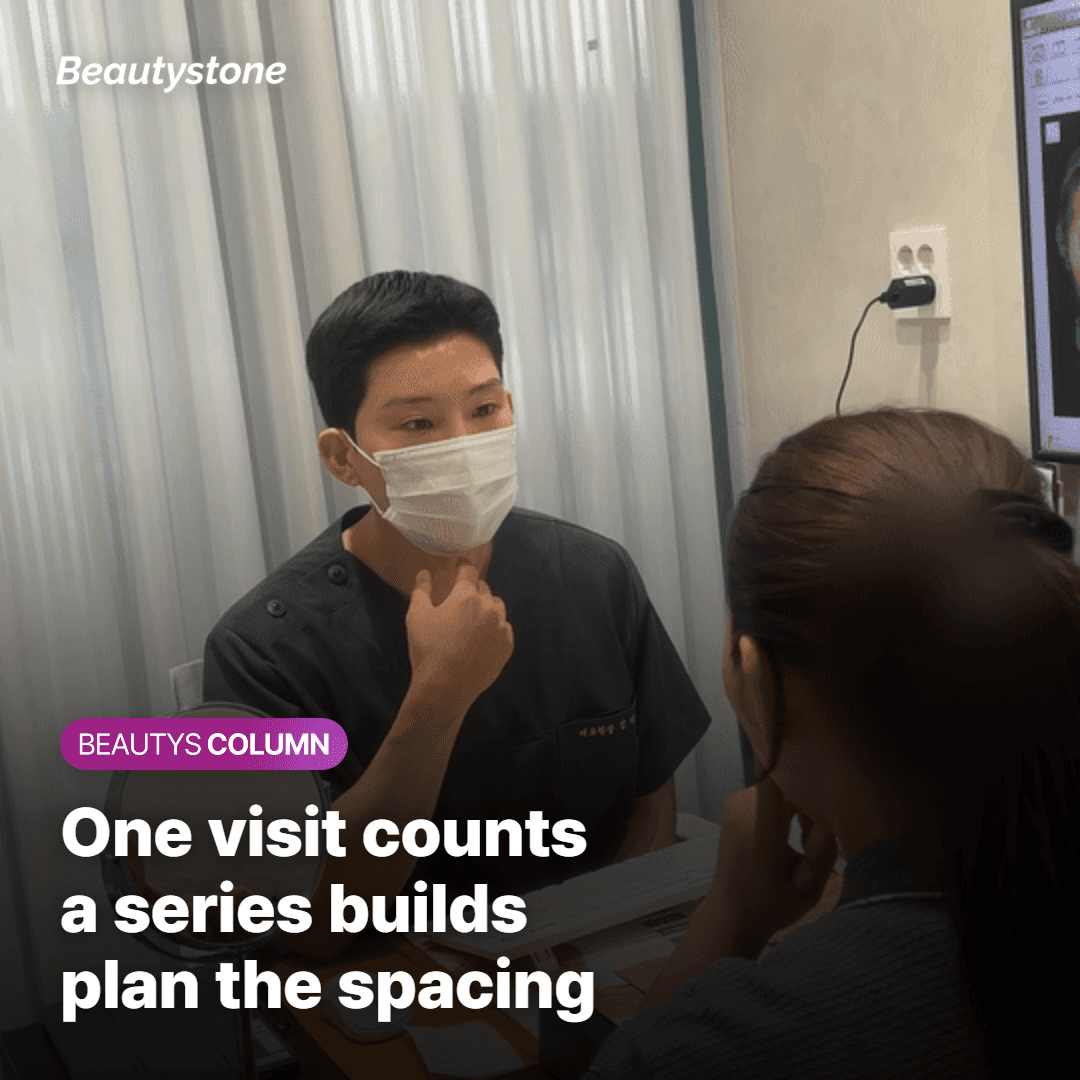
One session is a real start, but PN treatments are usually planned as a short series rather than a single visit.
In the same dermatologist survey, a total of three sessions of PN injection spaced 4 weeks apart was the plan most often recommended.
That's a common pattern, not a rule, and it assumes you live near the clinic. For a traveler, there are two realistic options:
One session this trip: A good fit if your goal is to start improving skin quality and you're happy to judge it over the following weeks at home. Change here is gradual. It moves your skin a little closer to how it used to look rather than transforming it at once.
A series over a longer stay or repeat visits: If you're in Seoul for a month or more, or you come to Korea regularly, sessions can be spaced the way the survey describes. If your trips are further apart than that, we'd work out the spacing together at consultation.
My verdict for the typical reader here: if your concern is thin, dull, or finely lined skin and you have a free morning early in your trip, one session now makes sense. If you're hoping for a dramatic difference for an event later this same week, Rejuran Healer isn't built for that timeline.
Side Effects and Downtime: What Studies Report
Reported side effects are usually mild and short-lived, but it's still an injection, so soreness, swelling, and redness are part of the process.
In the systematic review, side effects were generally mild and transient, while patient satisfaction was moderate to high.
In everyday terms, expect things like soreness at the injection points, swelling, itching, redness, or a small bruise.
Pain is the other question people ask first. A split-face clinical trial notes that polynucleotide (PN) filler often causes pain when applied via intradermal injection using a traditional needle.
So expect some discomfort, and it's fair to ask at consultation how it will be managed for your skin and the areas being treated. Mention any medications, especially blood thinners, and any past reaction to injectables, so the plan can be adjusted.
Some signs shouldn't be waited out: pain or swelling that keeps getting worse, redness that spreads, pus, or a fever. If you notice any of these, seek medical care right away, wherever you are.

Within Your Travel Schedule: Flights, Photos, and Follow-Up at Home
Unless you're having sleep sedation that day, flying home after the treatment isn't a reason to postpone it.
Photos are a separate question. Because swelling and redness can show at first, I'd keep the treatment away from the day of a planned photo shoot and ask at consultation how long marks tend to stay visible on skin like yours. Putting the session early in the trip gives you more room either way.
If this trip only allows one visit, it isn't wasted. The change builds gradually, and the next session can be planned around your next trip to Korea.
After you fly home, if something looks off, you can send photos of the treated area through WhatsApp and ask. If you see a strong warning sign, such as spreading redness, pus, or fever, see a local doctor first rather than waiting for a reply.
If you've been searching for Rejuran in Hongdae, Beautystone is in Hapjeong, Mapo-gu, one subway stop from Hongik University Station on Line 2, the station that the airport railroad also serves.

The Bottom Line: Ask Which Areas, How Deep, and How Often
Rejuran Healer places PN, made from purified fish DNA, into the dermis to improve skin quality gradually.
Skin thickness changes across the face, so depth has to be set area by area.
A short series is the usual plan; one session during a trip is a realistic start.
Side effects are usually mild and short-lived, but warning signs need prompt care.
Like any procedure, it comes with trade-offs. Ultimately, the choice depends on your skin, your goals, and your travel dates.
When you compare clinics, the shot count tells you less than you'd think. Ask three things instead: which areas will be treated, how the depth will change between the under-eye area and the cheeks, and how sessions would be spaced around your trip. A clear answer to all three tells you how carefully the plan was made.
If you're considering Rejuran Healer during your visit, you can message Beautystone on WhatsApp with your dates and a photo. A first message can be as simple as: "I'm in Seoul from [date] to [date] and I'm interested in Rejuran Healer for my cheeks and under-eyes. Here's a photo. Can I book a consultation, and how would sessions fit my dates?"



Contouring & Volume
Hip Dip Filler Before and After: 4 Checks

Body
Potenza Treatment Interval: Why 4 Weeks?

Lifting
Ultherapy Before and After: Why Wait 90 Days?

Contouring & Volume
Belotero Revive Cost: 2cc Price vs. 3 Sessions

skin
Lip Hyperpigmentation Laser: Does It Work?

Contouring & Volume
Men's Forehead Filler: Hollow or Just Lines?