Rejuran Results: The Golden Time Doctors Reveal
[Beautystone Report] Why Results Peak After 3rd Rejuran
Rejuran Healer Treatment Intervals —
Shorter Is Better?
Why That's Actually Ruining Your Skin

As spring arrives, certain things start to bother you.
You know how it is.
Pores, skin texture, dullness —
these concerns are why inquiries about Rejuran Healer
spike this time of year.
Today, I'll give you a complete guide on the Rejuran Healer treatment interval
.
Let's start by clearing up whether
"the more often, the better" is actually true.
Q. Does getting Rejuran Healer
more frequently lead to better results?
A. No. Ignoring tissue recovery time
can actually produce the opposite effect.
I'll explain in detail below.
Q. Should the interval be different
between the initial stage and the maintenance stage?
A. Yes, it should.
I'll break down how it differs by stage below.
Q. If combined with other procedures,
can the interval be shortened?
A. Not necessarily.
There are actually combinations that can conflict,
and I'll cover that below as well.
What Rejuran Healer Does in the Skin —
Here's What You Need to Know First

The main ingredient of Rejuran Healer is
PDRN (polynucleotide).
Derived from salmon DNA,
when injected into the skin, it promotes the repair of damaged cells
and helps create an environment for collagen production.
What's important to understand is that Rejuran Healer
doesn't fill the skin like an instant filler —
it works by
signaling the skin to heal itself.
That's why it takes time
for the effects to appear.
Rather than seeing results right after the treatment,
many people notice at the 2–4 week mark: "Oh, my skin looks so much better."
In other words, after the injection, the skin needs
time to actually create change.
If you ignore this and do treatments at intervals that are too short,
you're essentially introducing another stimulus
before recovery has had a chance to complete.
So How Long Should
the Interval Be?
It varies by individual, but
here's how I usually explain it.
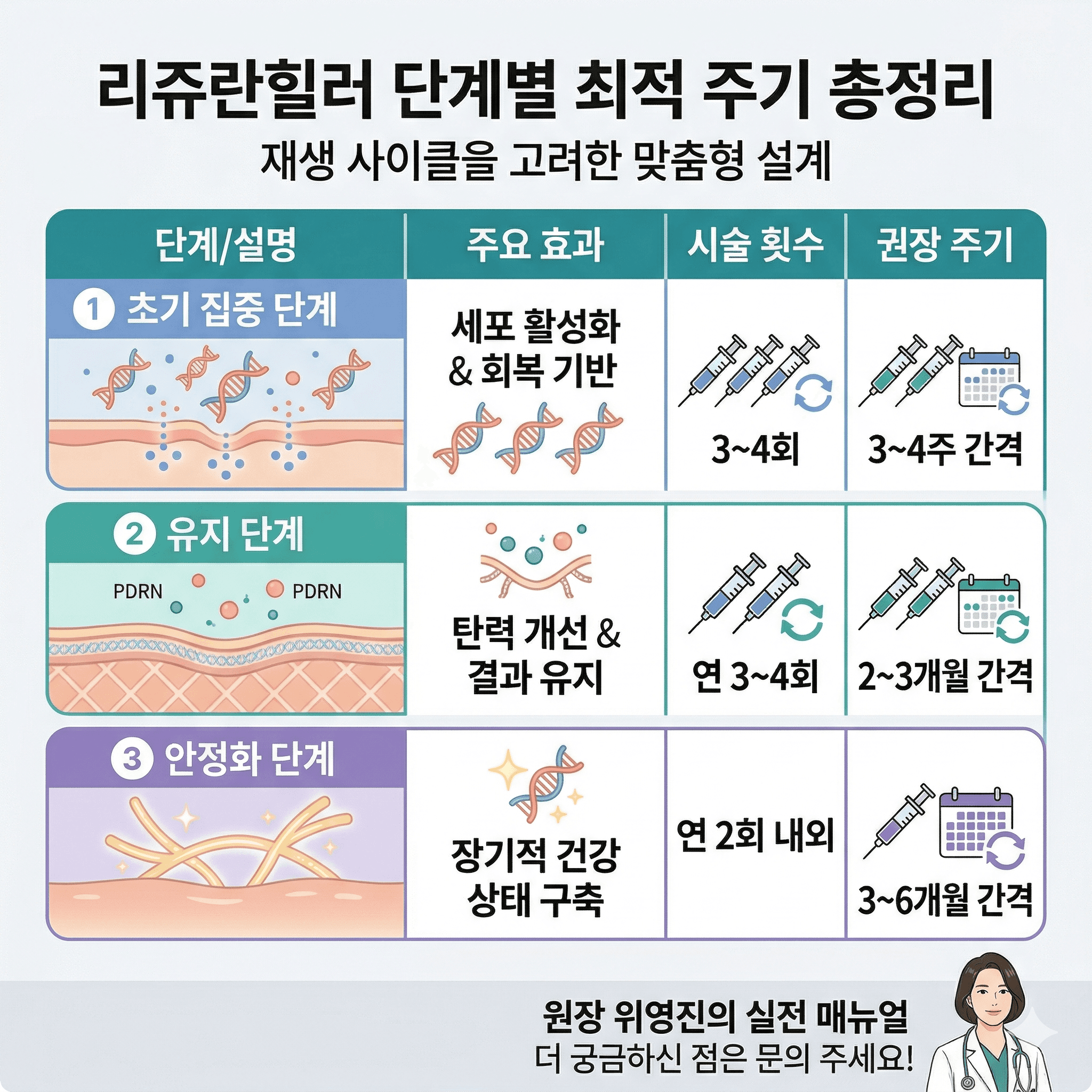
Starting with sessions every 3–4 weeks
is based on the skin's natural regeneration cycle.
The epidermal cell turnover cycle
is typically around 4 weeks.
Some people say, "I want faster results,
so I'll come every 2 weeks,"
but honestly, that may not be doing your skin any favors.
This is a common misconception:
with Rejuran Healer, "proper timing" matters far more
than "frequency."
Dr. Wi Youngjin's Clinical Note:
In my experience, among first-time visitors,
there are occasional cases where patients say, "I was getting it every 2 weeks at another clinic,
and my skin actually became more sensitive."
They came having experienced firsthandthat a shorter interval doesn't necessarily mean better results.
I always bring this up in advance —
rather than going fast and often,
adjusting the interval based on your skin's condition consistently leads to better outcomes.
This is especially true for those with a compromised skin barrier —
even in the initial stage, giving yourself 4 weeks or more between sessions is the safer approach.
What Happens When You Ignore the Interval
Here's what can go wrong
when sessions are repeated at intervals that are too short.
1. Increased Skin Sensitivity
Each injection is a micro-injury to the skin.
When repeated before recovery is complete, the skin's defense response escalates,
leading to increased sensitivity.
2. Effect Saturation
When PDRN is already sufficiently present in the skin, additional injections
may reach a point where the skin simply stops responding.
(This is known as receptor saturation.)
3. Unnecessary Cost
And of course, there's the cost ^^..
You end up paying for sessions that aren't adding any real benefit.
Key Takeaway:
The standard guideline for Rejuran Healer is every 3–4 weeks
for the initial 3–4 sessions, followed by
every 2–3 months for maintenance.
How to Adjust Your Interval
When Combining with Other Procedures
Even the best treatments
won't deliver good results if the combination and timing are off.
Here's how I usually explain it.
1. Laser + Rejuran Healer
When the skin is sensitized after laser treatment,
getting Rejuran Healer right away
can actually interfere with recovery.
It's best to wait at least 1–2 weeks for the skin to stabilize first.
2. Botox + Rejuran Healer
If areas overlap or swelling is significant,
I generally recommend leaving about a 2-week gap.
3. Filler + Rejuran Healer
Injecting into the same area right after a filler treatment
can cause the filler to shift.
We recommend waiting at least 2–4 weeks.
Frequently Asked Questions (FAQ)
Q1. If I'm not noticing results,
should I shorten the interval?
A. Rejuran Healer typically takes 2–4 weeks to show effects.
Before shortening the interval, it's worth reviewing the injection method — depth and concentration —
first.
Q2. Is it okay to continue Rejuran Healer
for more than a year?
A. Yes, absolutely. That said, during the maintenance phase,
an interval of 2–3 months or more is appropriate.
There's no need to come in every month.
Q3. I live near Sinchon or Ewha —
where should I go?
A. With Rejuran Healer, injection depth and area selection
have a significant impact on results.
Choose a clinic with solid experience performing this treatment.
If you have any questions,
feel free to reach out via KakaoTalk.
— Dr. Wi Youngjin
✦ Further Reading
Rejuran Healer Treatment Intervals —
Shorter Is Better?
Why That's Actually Ruining Your Skin

As spring arrives, certain things start to bother you.
You know how it is.
Pores, skin texture, dullness —
these concerns are why inquiries about Rejuran Healer
spike this time of year.
Today, I'll give you a complete guide on the Rejuran Healer treatment interval
.
Let's start by clearing up whether
"the more often, the better" is actually true.
Q. Does getting Rejuran Healer
more frequently lead to better results?
A. No. Ignoring tissue recovery time
can actually produce the opposite effect.
I'll explain in detail below.
Q. Should the interval be different
between the initial stage and the maintenance stage?
A. Yes, it should.
I'll break down how it differs by stage below.
Q. If combined with other procedures,
can the interval be shortened?
A. Not necessarily.
There are actually combinations that can conflict,
and I'll cover that below as well.
What Rejuran Healer Does in the Skin —
Here's What You Need to Know First

The main ingredient of Rejuran Healer is
PDRN (polynucleotide).
Derived from salmon DNA,
when injected into the skin, it promotes the repair of damaged cells
and helps create an environment for collagen production.
What's important to understand is that Rejuran Healer
doesn't fill the skin like an instant filler —
it works by
signaling the skin to heal itself.
That's why it takes time
for the effects to appear.
Rather than seeing results right after the treatment,
many people notice at the 2–4 week mark: "Oh, my skin looks so much better."
In other words, after the injection, the skin needs
time to actually create change.
If you ignore this and do treatments at intervals that are too short,
you're essentially introducing another stimulus
before recovery has had a chance to complete.
So How Long Should
the Interval Be?

It varies by individual, but
here's how I usually explain it.
Starting with sessions every 3–4 weeks
is based on the skin's natural regeneration cycle.
The epidermal cell turnover cycle
is typically around 4 weeks.
Some people say, "I want faster results,
so I'll come every 2 weeks,"
but honestly, that may not be doing your skin any favors.
This is a common misconception:
with Rejuran Healer, "proper timing" matters far more
than "frequency."
Dr. Wi Youngjin's Clinical Note:
In my experience, among first-time visitors,
there are occasional cases where patients say, "I was getting it every 2 weeks at another clinic,
and my skin actually became more sensitive."
They came having experienced firsthandthat a shorter interval doesn't necessarily mean better results.
I always bring this up in advance —
rather than going fast and often,
adjusting the interval based on your skin's condition consistently leads to better outcomes.
This is especially true for those with a compromised skin barrier —
even in the initial stage, giving yourself 4 weeks or more between sessions is the safer approach.
What Happens When You Ignore the Interval

Here's what can go wrong
when sessions are repeated at intervals that are too short.
1. Increased Skin Sensitivity
Each injection is a micro-injury to the skin.
When repeated before recovery is complete, the skin's defense response escalates,
leading to increased sensitivity.
2. Effect Saturation
When PDRN is already sufficiently present in the skin, additional injections
may reach a point where the skin simply stops responding.
(This is known as receptor saturation.)
3. Unnecessary Cost
And of course, there's the cost ^^..
You end up paying for sessions that aren't adding any real benefit.
Key Takeaway:
The standard guideline for Rejuran Healer is every 3–4 weeks
for the initial 3–4 sessions, followed by
every 2–3 months for maintenance.
How to Adjust Your Interval
When Combining with Other Procedures
Even the best treatments
won't deliver good results if the combination and timing are off.
Here's how I usually explain it.
1. Laser + Rejuran Healer
When the skin is sensitized after laser treatment,
getting Rejuran Healer right away
can actually interfere with recovery.
It's best to wait at least 1–2 weeks for the skin to stabilize first.
2. Botox + Rejuran Healer
If areas overlap or swelling is significant,
I generally recommend leaving about a 2-week gap.
3. Filler + Rejuran Healer
Injecting into the same area right after a filler treatment
can cause the filler to shift.
We recommend waiting at least 2–4 weeks.
Frequently Asked Questions (FAQ)
Q1. If I'm not noticing results,
should I shorten the interval?
A. Rejuran Healer typically takes 2–4 weeks to show effects.
Before shortening the interval, it's worth reviewing the injection method — depth and concentration —
first.
Q2. Is it okay to continue Rejuran Healer
for more than a year?
A. Yes, absolutely. That said, during the maintenance phase,
an interval of 2–3 months or more is appropriate.
There's no need to come in every month.
Q3. I live near Sinchon or Ewha —
where should I go?
A. With Rejuran Healer, injection depth and area selection
have a significant impact on results.
Choose a clinic with solid experience performing this treatment.
If you have any questions,
feel free to reach out via KakaoTalk.
— Dr. Wi Youngjin
✦ Further Reading
Recommended post
Recommended post
Latest post
Latest post

Contouring & Volume
팔자주름, 선이 문제가 아닙니다! 필러로 '그늘'을 지워야 하는 이유
팔자주름 필러, 어떤 원리로 어려 보이게 만들까요? 꺼진 부위에 생기는 그늘과 필러 탄성의 관계를 알기 쉽게 설명합니다.

skin
기미 레이저, 세게 쏠수록 잘 빠진다? "오히려 더 진해질 수 있습니다"
기미 치료, 강한 레이저가 능사가 아닙니다. 뿌리 깊은 기미일수록 약한 에너지로 반복 토닝해야 하는 이유를 원리부터 설명합니다.

Hair Removal
다리 제모 싸다고 덥석 결제하면 사실 손해인 이유
레이저 제모는 금액이아닌 효과를 중점적으로 봐야합니다. 다리 제모 레이저는 왜 5회 이상 필요할까요? 왜 에너지와 파장이 중요한지. 알려드립니다.


Hair Removal
남자 제모, 병원마다 결과가 다른 진짜 이유는?
홍대 남자제모 피부과를 찾는다면 레이저 장비 차이부터 확인해야 합니다. 피부 타입에 맞춘 파장 설정이 효과와 부작용 여부를 가릅니다.

Contouring & Volume
턱선 보톡스, 진짜 어디에 맞는 건지 아세요?
턱선 보톡스의 핵심은 광대나 저작근이 아닌 경광근(platysma) 억제에 있습니다. 원리와 적합한 대상을 정리했습니다.


Contouring & Volume
Jaw Botox 60U: Don’t believe the claim that more is always better.
Why 60U of jaw Botox is not simply a "large dose." The clinic director personally explains the appropriate dosage 기준 and the differences in effects by gender and body type.

![[Beauty Stone] How to Avoid Failing at Dark Circle Filler? "The Precision of 0.3cc Changes the Results"](https://framerusercontent.com/images/F4Q84TUWgjbZJV6MNheLnWHnaw.jpg?width=1080&height=1080)