

What to expect right after Sculptra vs months later, and why it's done in sessions.
Published
Updated

Author
Wi Young-jin · Chief director
Seoul National University College of Medicine · Seoul National University Hospital Specialist
→
When looking into Sculptra because you have sunken cheeks or shadows under your eyes, the first question that naturally comes to mind is, "How long does it take for the results to show?" We all understand that it is a volume-restoring treatment, but many people are confused about whether the area fills up immediately after the procedure or if it builds up gradually over time.
To give you a quick answer, Sculptra works by stimulating collagen* production to create volume. Therefore, rather than seeing an instant change immediately after a single session, the volume fills in naturally over several weeks to a few months. However, understanding why there is a slight temporary fullness right after the procedure, why it temporarily fades, and when the real visible transformation actually begins will make your waiting process much easier and more comfortable.
Collagen*: A structural protein deep within the skin that supports elasticity and volume. As we age, its production slows down, which is one of the main reasons the skin begins to look sunken.
This article provides general informational guidelines. To ensure safety and determine if this treatment is suitable for you, as well as to plan your session schedule, please consult with your medical practitioner for a personalized assessment.
In this article, you will learn:
How Sculptra works to rebuild natural volume
The difference between immediate post-treatment results and the changes seen months later
The chronological timeline of how collagen builds up
The reasons behind multiple sessions and the science behind the treatment intervals
There are multiple ways to restore volume to sunken areas
Loss of skin volume occurs due to a combination of factors, including a decrease in hyaluronic acid*, shifting fat layers, and collagen depletion. Because of this, the method of replenishing volume depends entirely on the materials used.
Hyaluronic Acid*: A polysaccharide component that holds moisture within the skin and creates volume. Hyaluronic acid fillers inject this substance directly to create immediate physical volume.
Hyaluronic acid fillers occupy physical space on their own, creating instant volume immediately after injection. On the other hand, Sculptra (PDLLA*) works by stimulating your skin to produce its own natural collagen. Rather than providing instant puffiness, it is a process of gradual accumulation over time. Understanding this key difference helps explain why you might feel "nothing has changed yet" shortly after your first Sculptra session.
PDLLA (Poly-D,L-Lactide)*: The active ingredient in Sculptra. It slowly degrades in the body while stimulating collagen synthesis. The byproduct, lactic acid, is safely metabolized by the body.
The table below compares how hyaluronic acid fillers and Sculptra work.

Why does a temporary fullness appear and then fade immediately after injection?
Some individuals may notice a noticeable plumpness for the first few days after receiving Sculptra. This temporary volume is actually not from the Sculptra particles themselves, but from the sterile water used to dissolve and inject the product.
Clinical reviews on the progression of PDLLA injection show that immediate post-treatment volume is caused by the mixed solution (usually a blend of sterile saline and lidocaine) injected along with the microparticles*. Within 2 to 3 days, this liquid is naturally absorbed by the body, causing the temporary swelling to subside.
PDLLA Microparticles*: The active ingredient in Sculptra is formulated as spherical particles with a diameter of about 40 to 63 μm. As they slowly degrade after injection, they stimulate fibroblasts in the surrounding tissues.
Therefore, feeling as though your face is beautifully full right after the treatment and then feeling "oh, it went back to how it was" a few days later is a completely normal and expected part of the recovery process. During this initial stage, Sculptra has not yet begun its actual collagen-stimulating work.

What is the timeline for collagen restoration?
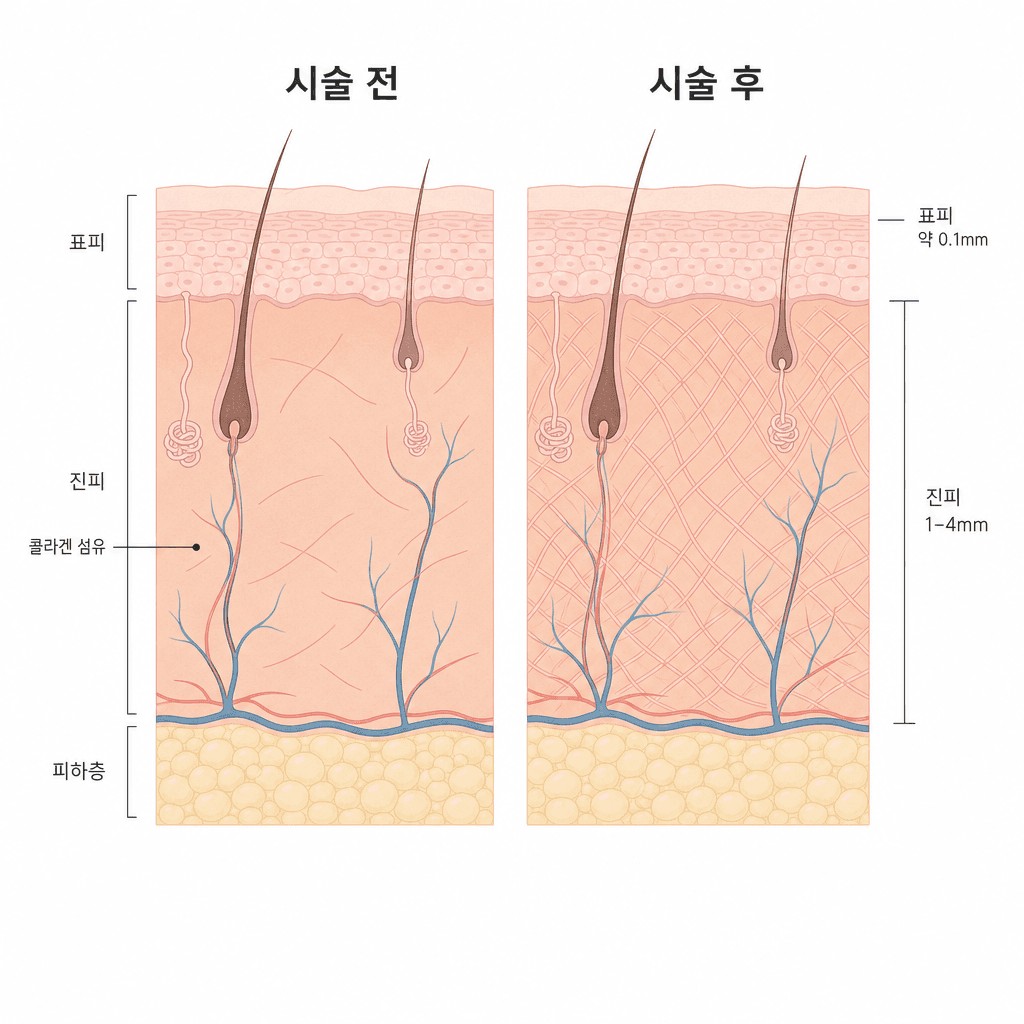
Once the fluid has been absorbed, the PDLLA microparticles slowly break down in the dermal layer, constantly stimulating the surrounding fibroblasts*. As these fibroblasts produce new collagen, real volume begins to build up gradually.
Fibroblasts*: Cells residing in the dermis layer that produce structural proteins like collagen and elastin. The gentle stimulation from the breakdown process of PDLLA is known to enhance the active function of these cells.
Research summarizing clinical data on Sculptra's active ingredients indicates that cellular changes showing a significant increase in collagen production progress over several weeks, peaking and becoming most visible a few months after treatment. The speed and degree of this restoration vary individually based on the treated area and skin condition.
The illustration below shows the general progression of collagen building up after a Sculptra treatment. Please note that individual experiences can vary, so use this as a general guide.

Why Beautystone Hapjeong?
At Beautystone Hapjeong, we understand that Sculptra's results do not appear instantly but unfold beautifully over time. Therefore, we emphasize discussing and planning the entire treatment course together from the very beginning. Even with the same procedure, the rate of collagen generation varies depending on the depth of the sunken area, the location, and individual skin conditions. Rather than judging the results after just a single session, we believe it is much more effective to assess the overall progression before deciding on the next steps. Located just a convenient 4-minute walk from Hapjeong Station exit adjacent to Mecenatpolis, patients can easily drop by for quick follow-up checks during their travels.

There is a specific reason for staging the treatment over multiple sessions
Dividing your Sculptra treatment into 2 to 3 sessions is not just to avoid administering too much at once. Because collagen building takes time, spacing out the stimulation allows for a more natural-looking development of volume.
Studies analyzing multi-session protocols for Sculptra suggest that receiving spaced-out treatments yields a higher cumulative effect on collagen production than a single session, resulting in a more even and long-lasting outcome. The sessions are typically scheduled 4 to 6 weeks apart, but since the exact count and intervals depend on the degree of volume loss and the treated area, it is ideal to first map out a plan with your provider.
Rather than rushing into an early touch-up because you do not see immediate changes after the first session, giving collagen some time to settle often leads to far superior results. Waiting for the proper timeline is always a safer and more balanced approach than receiving premature touch-ups.

Frequently Asked Questions
Q. I felt immediate volume right after Sculptra, but it was gone after two days. Did the treatment fail?
A. Not at all. The immediate fullness is due to the sterile liquid injected with the product. Once this fluid is absorbed, it can temporarily feel as though the volume has disappeared. Actual collagen production begins after this phase.
Q. When will I see the most noticeable results?
A. Based on research data, as collagen accumulates over several months, the changes become much more distinct after about 2 to 3 months. However, there are individual differences based on the treatment area and the state of your skin.
Q. How long will the results last once they appear?
A. This varies by individual and depends on how your body naturally breaks down collagen. While it is common for the effects to last over a year, it is difficult to generalize as maintenance routines can also play a role.
Q. Can I massage the area or exercise while the collagen is building up?
A. For a few days immediately after the session, it is best to avoid applying strong pressure or friction to the treated area. Most daily activities can be resumed without issues afterward. Please consult with your medical practitioner for specific, safe post-care instructions.



![[Wi Young-jin] Sculptra 3-Session Package: Why Not at Once?](https://framerusercontent.com/images/05xhMvbOUj2YiU4scHROwwLx1s.jpg?width=1080&height=1080)


Contouring & Volume
Hip Dip Filler Before and After: 4 Checks

Body
Potenza Treatment Interval: Why 4 Weeks?

Lifting
Ultherapy Before and After: Why Wait 90 Days?

Contouring & Volume
Belotero Revive Cost: 2cc Price vs. 3 Sessions

skin
Lip Hyperpigmentation Laser: Does It Work?

Contouring & Volume
Men's Forehead Filler: Hollow or Just Lines?