

Sofwave vs Ultherapy: find out which lifting treatment actually suits your age. See the difference.
Published -
Updated -
Author
Wi Young-jin · Chief director
Seoul National University College of Medicine · Seoul National University Hospital Specialist
→
As spring arrives, many of us suddenly
start noticing little things that bother us about our skin.
Now that the weather is warming up and we are finally taking off our masks,
you might find yourself looking in the mirror and focusing on
a softening jawline or sagging cheeks.
Today, I've prepared a comprehensive guide on
the most common comparison we get asked about when it comes to lifting treatments:
Sofwave vs. Ultherapy.
Q. Do Sofwave and Ultherapy
work the same way?
No, actually. While they both utilize ultrasound energy,
their energy delivery methods and target depths are quite different.
I'll explain this in detail below.
Q. Is Ultherapy always
more effective than Sofwave?
Not necessarily.
Depending on your unique skin condition and goals,
the opposite can sometimes be true.
Since this is the most common misunderstanding,
I'll make sure to break it down clearly.
Q. Is it beneficial to get
both treatments together?
While it depends on the individual case,
there are definitely situations where combining them works wonders.
I will cover those scenarios in the final section.
The Difference Hidden Behind
Their Shared Ultrasound Technology
Both Sofwave and Ultherapy
use ultrasound energy to generate heat within the skin tissue,
promoting collagen regeneration to achieve a lifting effect.
That part is correct.
However, there is an important distinction to make.
Their energy delivery methods and
target depths are completely different.
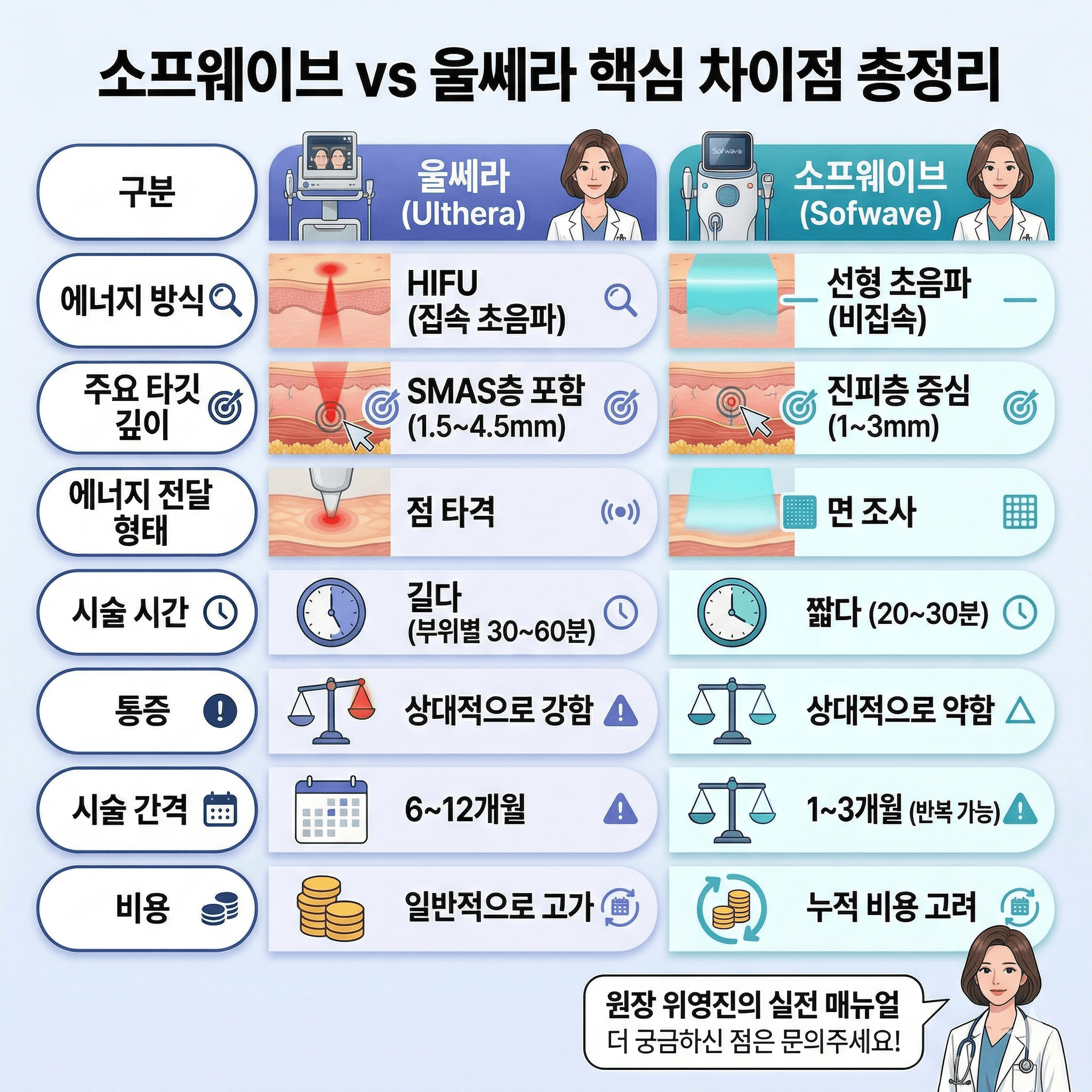
Ultherapy utilizes HIFU (High-Intensity Focused Ultrasound) technology.
This method concentrates energy into a single point, targeting a specific depth—
primarily the SMAS layer (the superficial muscular aponeurotic system of the face)—
to stimulate it directly.
Think of it as a precise, point-by-point targeting method.
On the other hand, Sofwave uses Synchronous Ultrasound Parallel Beam
(linear unfocused ultrasound) technology.
Rather than focusing energy into a single point,
it delivers thermal energy uniformly over a wider area.
Its target is primarily the mid-to-deep dermis,
and it does not directly reach the SMAS layer.
Sofwave vs Ulthera: The Side-by-Side Comparison
Ulthera and Sofwave both run on ultrasound, but Ulthera concentrates that energy on a single point in the SMAS layer to lift tissue that has already dropped, while Sofwave spreads it evenly through the mid-to-deep dermis to rebuild firmness and texture — so the choice comes down to whether your concern is sagging or slack skin, not which one goes deeper.
One naming note before the table, because it confuses a lot of people searching for this: Ulthera is the device, Ultherapy is the name of the procedure performed with it, and they refer to the same treatment. Sofwave is also frequently typed as "Softwave" — Sofwave is the correct spelling.
| Sofwave | Ulthera (Ultherapy) |
|---|---|---|
Type of ultrasound | Synchronous Ultrasound Parallel Beam — linear, unfocused, delivered uniformly across a wide area | HIFU — focused into a single point, aimed at one specific depth |
Main target depth | Mid-to-deep dermis; it does not directly reach the SMAS layer | The SMAS layer, the superficial muscular aponeurotic system of the face |
What it does best | Overall skin elasticity, pore appearance, skin texture | Structural lifting — sagging cheeks, jawline definition, neck wrinkles |
Who tends to be happiest with it | Early-to-mid 30s, where texture and early loss of elasticity bother you more than deep sagging | 40s and beyond, where the cheeks have visibly begun to sag |
Discomfort during treatment | Gentler — a reasonable option if you are sensitive to pain | Noticeably more intense; many patients prefer numbing, and areas close to bone such as the cheekbones and jawline feel sharper |
Afterwards | No downtime, so you can return to your day immediately | Swelling or bruising tends to linger a little longer than with Sofwave |
Sessions before you feel a change | Plan on at least 3 to 4 sessions for a meaningful change in elasticity | A single session can bring a more noticeable lifting change |
Read down that table and the pattern is clear enough: neither device is the upgraded version of the other, because they are not working on the same layer. Ulthera reaches under the skin to pull structure back up. Sofwave stays within the dermis and works on the quality of the skin itself. Picking the "stronger" one when your actual concern is texture simply means paying for depth you do not need, and enduring more discomfort for it.
Two practical points worth weighing before you book either one. With Ulthera, results vary considerably with the practitioner — how energy levels are customized for your face and how precisely the target layer is found makes a real difference, so who performs it matters as much as the device. And Sofwave is not a one-off: because it relies on repeat sessions to hold its results, it is worth pricing out the full course rather than one visit. Individual results differ in both cases, which is why an in-person assessment beats guessing from the mirror.
Just Because Ultherapy Goes Deeper
Doesn't Mean It's Always Better
This is a very common misconception.
Many clients ask me, "Since Ultherapy reaches the SMAS layer,
isn't it naturally the more effective treatment?"
To be completely honest, that isn't always the case.

Ultherapy excels at stimulating the SMAS layer
to lift sagging facial tissue.
It is highly effective when your main goal is structural lifting,
such as lifting sagging cheeks, defining the jawline, or smoothing neck wrinkles.
However, this intensity comes with a trade-off.
Because the focused energy targets deep layers,
it is accompanied by a higher level of discomfort.
It can be quite painful.
Quite a few clients find it difficult to undergo without proper numbing.
Post-treatment swelling or bruising
also tends to last a bit longer compared to Sofwave.
In contrast, Sofwave distributes uniform energy
across a broader area,
making it fantastic for overall skin elasticity, minimizing pores,
and refining skin texture.
Rather than causing a dramatic, sudden change,
it is a wonderful treatment for maintaining skin health
and achieving gradual, beautiful improvements over time.
In short, they serve different purposes.
If sagging is your primary concern, Ultherapy is excellent.
If you are looking to boost overall skin elasticity,
Sofwave might be the perfect fit for you.
Dr. Wi Young-jin's Clinical Notes:
In my experience, patients in their early-to-mid 30s
who are more concerned about skin texture and early loss of elasticity
rather than deep sagging are often highly satisfied with
consistent Sofwave treatments alone.
Conversely, for patients in their 40s and beyond,
where the cheeks have visibly begun to sag,
achieving the desired results without Ultherapy can be challenging.
There is one crucial point I must emphasize:
with Ultherapy, the outcome varies significantly
depending on the practitioner's skill and experience.
How the energy levels are customized
and how precisely the target layers are focused
will greatly influence your results.
One downside of both treatments is the investment required.
Since Sofwave is not a informationone-off procedure and requires repeat sessions
to maintain the best results,
it is wise to consider the cumulative cost beforehand.
So, Is It Better to Get
Both Treatments Combined?
Every individual is unique,
but this is how I usually advise my patients:
For those experiencing both sagging and a loss of skin elasticity simultaneously,
combining the two treatments is highly beneficial.
We can use Ultherapy to stimulate the SMAS layer
for deep, structural lifting,
and use Sofwave to stimulate the dermal layer
to restore overall firmness to the skin's surface.
Because they target entirely different depths,
they complement rather than duplicate each other.
However, performing both on the exact same day
requires careful consideration.
Since it increases the total thermal load on the skin,
depending on your skin condition and recovery capacity,
planning them with a safe interval in between is often the gentler, wiser approach.
Key Summary
Ultherapy is for SMAS lifting,
while Sofwave is for dermal elasticity.
—They are beautiful treatments with different goals.
If You Ask Me Which One
I Would Recommend for You...
I typically guide patients based on these guidelines:
[Who is Sofwave best for?]
Those in their early-to-mid 30s whose main concerns are skin texture and elasticity rather than severe sagging.
Those who are sensitive to discomfort and pain.
Those who want to consistently maintain and nurture their skin health.
Those who need an immediate return to daily life with zero downtime.
[Who is Ultherapy best for?]
Those in their 40s and beyond whose main goals are correcting cheek sagging and redefining the jawline.
Those looking for a noticeable, single-session lifting transformation.
Those with structural sagging that requires targeted SMAS layer stimulation.
It can sometimes be difficult to evaluate this on your own.
When looking in the mirror, many people find it hard to tell
whether they are experiencing true sagging or simply a loss of elasticity.
An in-person consultation is always the most accurate way to find out.
Frequently Asked Questions (FAQ)
Q1. How many Sofwave sessions
are needed to see results?
A. In my experience, you should plan for at least 3 to 4 sessions
to truly feel a meaningful change in skin elasticity.
If you are expecting a dramatic transformation
after just a single session, you may find yourself disappointed.
This is because rebuilding collagen in your skin
is a natural process that takes time.
Q2. Is Ultherapy pain
really as intense as they say?
A. While pain tolerance varies individually,
to be candid, it is quite uncomfortable.
In particular, areas closer to the bone,
such as the cheekbones or the jawline, tend to feel the sensation more sharply.
It is not a completely pain-free procedure.
Q3. I'd love to schedule a consultation
near Hongdae or Hapjeong.
How can I do that?
A. We welcome any pre-visit questions via WhatsApp!
Our clinic is located very close to Hapjeong Station for your convenience.
Please feel free to reach out to us on WhatsApp anytime with your questions.
This has been Dr. Wi Young-jin. Thank you!
Content



skin
Why Does Fractional CO2 Take Longer to Heal?

Contouring & Volume
How Many cc Does Forehead Filler Need?

skin
Why Is My Skin Oily but Tight in the Fall?

Hair Removal
Underarm Laser Hair Removal Cost: Do the Math

Tattoo removal
Laser Before a Cover-Up: How Many Sessions?

skin
큐어젯 다운타임, 다음 날 출근과 화장은 언제부터 될까요?