

Zygoma Botox done wrong can twist your smile. See why injection depth & point choice matter.
Published -
Updated -

Author
Wi Young-jin · Chief director
Seoul National University College of Medicine · Seoul National University Hospital Specialist
→
💡 Read this first
Q. Is it normal for the corners of my mouth to twist after cheekbone Botox?
A. No, it isn't. If your side cheek muscles bulge when you smile,
choosing the wrong injection depth and point can pull your mouth corners off-center.
This isn't a side effect — it's the result of a poor technical choice.
Q. Isn't cheekbone Botox just injected into the masseter
(jaw muscle)?
A. When the issue is the 'side' of the cheekbone,
muscles other than the masseter come into play.
Where you inject and how deep you go completely changes the outcome.
📌 Key takeaways
If your side cheek muscles stand out when you smile,
a too-shallow cheekbone Botox injection can twist your mouth corners.
In these cases, you need a longer needle
that reaches the deeper muscle layer.
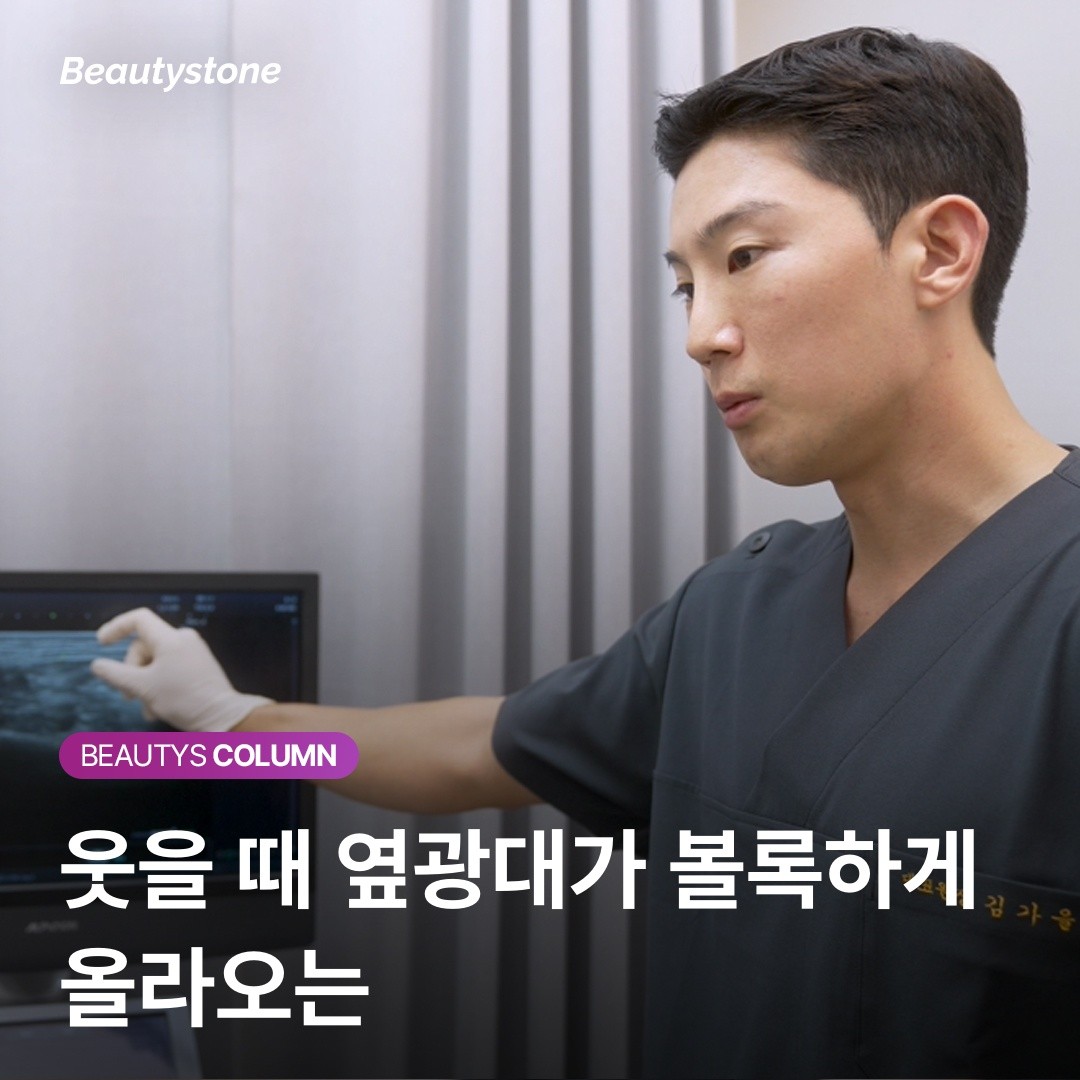
If your side cheekbone bulges up when you smile,
here's why this matters
During cheekbone Botox consultations,
there's one question I get a lot.
"I had it done somewhere else and my expression looks off.
Why did that happen?"
For these patients, I always ask one thing:
"Does the area beside your cheekbone get firm and bulge when you smile?"
That single question pretty much pins down the cause.
The side of your cheekbone has several muscles running through it in layers.
The ones that pop out when you smile are
the 'zygomaticus minor' and 'zygomaticus major' —
in plain terms, the muscles that pull up the corners of your mouth
and let you smile.
As they run along the side of the cheekbone,
they sometimes sit very close to the skin's surface.
And here's the critical part.
If the needle used for cheekbone reduction Botox
is short and only goes in superficially,
the toxin can spread into these smile muscles.
So what happens then?
The muscles that lift your mouth corners weaken,
so when you smile, one side may rise less, or your mouth may pull subtly to one side.
"My expression looks weird" — this is exactly that case.
Honestly,
you can't just apply the standard cheekbone Botox protocol
to patients like this.
When the side cheek muscles bulge during a smile,
the tissue layers are often arranged differently.
In these cases, you need a longer needle
to precisely target a deeper layer.
Catching the outer cheekbone muscles in the deep layer —
the upper masseter (jaw muscle) and the muscles below the cheekbone —
is what minimizes the toxin spreading
into the surface smile muscles.
👨⚕️ Director Wi Young-jin's key points
If your side cheekbone bulges up when you smile,
your surface smile muscles are likely sitting close to the skin.
Using a shallow needle for cheekbone Botox in these patients
can twist the corners of the mouth.
A needle that reaches the deeper layer is what lets you
reduce cheekbone volume without distorting the smile.

So which type are you?
Here's how to tell
There's a simple way to check.
Stand in front of a mirror and smile broadly.
If the side of your cheekbone — toward the area in front of your ear —
becomes firm and bulges out as the muscle pops,
that's when I tell patients, "You need to switch needles."
Here's where it gets tricky.
You may just think your cheekbones are 'too wide,'
but whether the cause is bone structure, muscle volume,
or a structure that only shows up when you smile
determines whether Botox will actually work for you.
Botox works on muscle,
so it won't do much if the issue is large bone or thick skin.
It varies case by case,
but here's how I usually break it down.
① Cheekbones that look prominent even at rest
→ Bone structure and upper masseter volume
are usually both involved.
Reducing the upper masseter with Botox can refine the contour to a degree,
but if the bone itself flares outward, there's a limit to what it can do.
② Cheekbones that only stand out when smiling or tensing
→ This is exactly the case we're talking about today.
These patients have strong muscle activity,
so they tend to respond well to Botox.
But the point and depth have to be dialed in correctly.
③ A wide face where the cheekbone area feels filled with 'soft tissue' rather than muscle
→ For these patients, Botox alone usually leaves them unsatisfied.
You need to think about other approaches alongside it.
A common misconception:
cheekbone Botox isn't the answer for every cheekbone concern.
For type ② patients, it's quite effective —
and in those cases, I've often seen the facial width
measured at the philtrum become noticeably more refined
about 3 to 4 weeks after the injection.
But the prerequisite is 'the right point, the right depth.'
One thing I really need to mention
cheekbone Botox isn't all upside.
If you keep the masseter or cheek muscles relaxed for too long,
the muscles can shrink and the cheeks may sag.
Anyone in their 40s or older, or anyone who didn't have much cheek volume to begin with,
really needs to factor this in.
That said, this kind of change usually shows up
in patients who've been getting Botox repeatedly for years.
It's uncommon for first-timers to sag dramatically
after just one or two sessions.
Still, you do need to assess your facial volume beforehand
and decide whether it's the right call.
Frequently asked questions
Q1. How often should I get cheekbone Botox?
A. The effect typically lasts 3 to 6 months,
but if your goal is cheekbone reduction,
it's best to start with 2 to 3 sessions at 6-month intervals
to see how your muscles respond.
After that, many people stretch the intervals out for maintenance.
More frequent isn't always better.
Q2. Will I see results right after cheekbone Botox?
A. No. Botox works by gradually relaxing the muscle
so volume decreases over time,
and visible results show up about 3 to 4 weeks after the injection.
A lot of people ask, "Why hasn't it changed right away?"
but unlike Filler, which adds volume instantly,
Botox shrinks the area by resting the muscle, so it takes time.
Q3. I've heard Botox doesn't work on me —
why is that?
A. There are two main possibilities.
One is that the cause was never muscle to begin with —
it's bone or skin thickness.
The other is that the injection point was wrong.
I've had patients who saw no results after multiple sessions elsewhere,
but once we changed the point and depth,
they felt a real change for the first time.
Before deciding you're just someone Botox doesn't work on,
you need to identify the actual cause first.
If you have any questions, feel free to reach out via WhatsApp or phone.
This has been Wi Young-jin from Seoul Beautystone Clinic.
Read more
▶PicoWay tattoo removal: how many sessions does it usually take?
▶Saxenda vs Mounjaro: honestly, Mounjaro wins by a mile.
▶Acne scar treatment before your wedding: why 6 months out is the golden window
▶Duoderm replacement cycle: just know this
▶Pico toning results: how many sessions until melasma fades? 4 stages of change by session


Hair Removal
레이저 제모 1회에도 남는 몫이 있어요 — 밀도를 모자이크로 보는 법

Tattoo removal
Why Extremity Tattoos Are Slower to Remove

Tattoo removal
Tattoo Removal Cost: Why Quotes Vary by Area

Tattoo removal
Unused Tattoo Removal Sessions: What Happens?

Lifting
Forehead Thread Lifting: How Far Can It Go?

skin
Skin Booster Prices: What to Check in a Quote