

Sagging 'empty space' is drooping tissue, not fat—how Ultherapy lifts the foundation.
Published
Updated

Author
Wi Young-jin · Chief director
Seoul National University College of Medicine · Seoul National University Hospital Specialist
→
ud83dudcda Facial Space Reduction u00b7 Series Table of Contents
1. Understanding Facial Space
2. Space Created by Muscles
3. Space Created by Fat
3.1 Sagging Fat u00b7 Ultherapy (Current Post)
4. Designing Space
Try this in front of the mirror. Some people find that their jawline looks sharp and slim when they lie down, but as soon as they stand up, their cheeks sag and their jawline loses its definition.
This isn't actually due to excess fat. It means the tissues that belong in place have sagged downward. For this kind of volume, treatments that remove fat can actually make your face look more hollow. The real answer is to lift it back up.
Quick Summary: If your face looks slim when lying down but sags when standing up, your tissues have migrated downwards. Instead of removing volume, you need to lift it back up with treatments like Ultherapy to define your facial contours.
Sagging space is not about having 'too much' fat, but rather about 'sagging'
As we age or due to gravity, the layer called the SMAS* beneath the skin becomes lax. As the fat and tissues supported by this layer sag downwards, the cheeks droop, jowls begin to form, and the jawline loses its definition.
* SMAS: The superficial muscular aponeurotic system, which wraps around the muscles beneath the skin. It acts as a foundation supporting your facial tissues; when it loses elasticity, the tissues above it sag downward.
The important thing to note here is that this is not caused by an increase in fat. Therefore, trying to dissolve it with fat-dissolving injections reduces the support even further, which can actually make you look hollower and older. For sagging space, you must lift the supporting foundation back up.
If you gently pull your cheeks upward with your hands and your overall impression improves, it is a key sign that sagging is your primary concern.

How Ultherapy lifts your skin
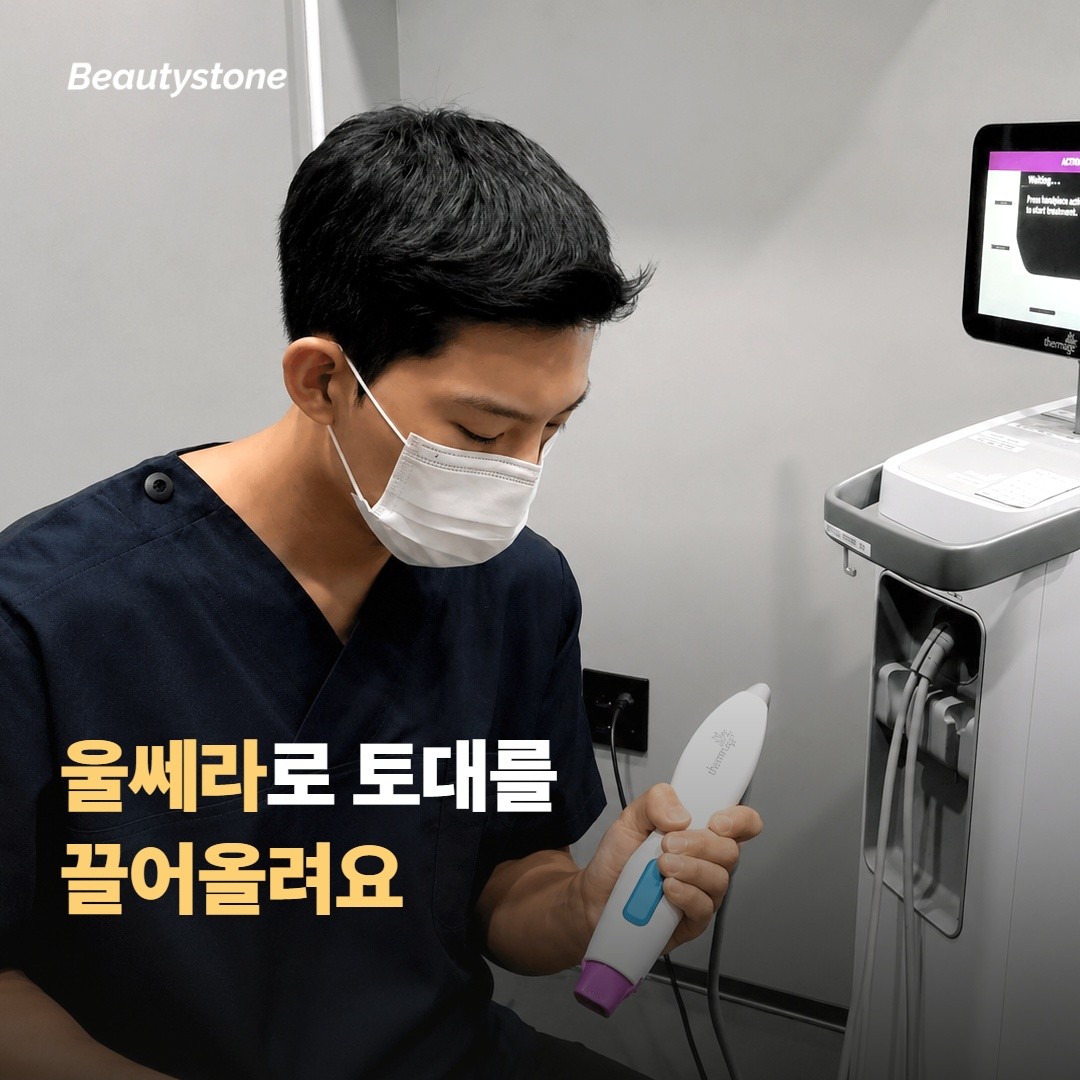
Ultherapy uses an ultrasound technology called HIFU* to lift the sagging foundational layer.
* HIFU: High-Intensity Focused Ultrasound. This technology focuses ultrasound energy on a single point deep within the skin, much like focusing sunlight with a magnifying glass.
When ultrasound energy is focused on a single point deep within the skin, it creates thermal coagulation points at temperatures of 60 to 70 degrees Celsius. This stimulates the deep layers without harming the skin surface. This stimulation triggers collagen regeneration and tissue contraction, lifting and tightening the lax foundation.
The key benefit of Ultherapy is its ability to reach the SMAS layer without a single incision. It targets the deepest lifting layer that can be reached non-surgically.
It is easy to confuse this with other skin elasticity treatments, but the way they deliver heat is different. While radiofrequency (RF) treatments warm up a broad surface of the skin to improve overall elasticity, Ultherapy focuses ultrasound energy on precise points to target and lift the deep foundation. This is why Ultherapy is so frequently recommended in non-surgical facelift categories when sagging is the main cause of facial space.
Targeting different areas with different depths
Skin thickness and structure vary across different areas of the face. That is why Ultherapy uses cartridges of different depths, tailored carefully to each area.
Cartridge Depth | Target Layer | Primary Treatment Areas |
|---|---|---|
4.5mm | SMAS (Fascia Layer) | Jawline & lower face sagging |
3.0mm | Deep Dermis | Cheeks & mid-face |
1.5mm | Superficial Dermis | Thin skin & areas with less cheek fat |
The deepest 4.5mm cartridge is the main tool for lifting a sagging jawline. This is combined with shallower depths to address overall skin elasticity at the same time. Customizing the depth to match each specific area yields far more natural results than using a single depth throughout.
When do the results show, and how long do they last?
Ultherapy does not provide a dramatic, instant lift right after the procedure. While there is a slight contraction immediately following the treatment, the true benefits appear over 2 to 3 months as collagen rebuilds. Clinical studies have shown visible jawline lifting results at the 3-month mark.
The results typically last for 12 to 18 months, which aligns with the natural cycle of collagen remodeling. Receiving treatments consistently can lead to cumulative benefits.
To be precise, non-surgical lifting cannot provide the exact same degree of lifting as a surgical face lift. The MFDS-approved indications for this medical device are clearly defined, and severe sagging may require a combination of other approaches. While advertisements often claim you can "look ten years younger in a single treatment," the actual results depend heavily on the degree of sagging and individual skin condition.
In my clinical practice, I first assess the degree of sagging to determine if Ultherapy is the right step. If the sagging is still mild, I focus on the shallower depths to improve elasticity. If the underlying foundation has sagged significantly, I increase the proportion of the 4.5mm cartridge. If sagging is creating extra facial space, lifting should always come before volume removal.

Frequently Asked Questions
Q. Is Ultherapy painful?
Because it stimulates the deep layers of the tissue, you may feel a deep, prickling sensation during the procedure. However, the discomfort is kept well within a tolerable range using numbing cream or by adjusting the energy levels. Recovery is very quick, allowing you to return to your daily life immediately.
Q. Is a single session enough?
The effects generally last for 12 to 18 months. Since the results appear gradually as collagen rebuilds, it's best to evaluate the outcome after about 3 months. Many clients choose to receive periodic treatments to maintain their youthful look.
Q. How is it different from fat-dissolving injections?
Ultherapy is designed to lift the sagging foundational layers of the face, whereas fat-dissolving injections are meant to melt away localized pockets of fat. Trying to dissolve areas that are actually suffering from sagging can make the face look hollow, so it is crucial to address the root cause correctly.




Contouring & Volume
Hip Dip Filler Before and After: 4 Checks

Body
Potenza Treatment Interval: Why 4 Weeks?

Lifting
Ultherapy Before and After: Why Wait 90 Days?

Contouring & Volume
Belotero Revive Cost: 2cc Price vs. 3 Sessions

skin
Lip Hyperpigmentation Laser: Does It Work?

Contouring & Volume
Men's Forehead Filler: Hollow or Just Lines?