

A dermatologist's guide to picking retinol % by skin type, with starting strengths and step-up tips.
Published -
Updated -

Author
Wi Young-jin · Chief director
Seoul National University College of Medicine · Seoul National University Hospital Specialist
→

The higher the retinol concentration, the better,don't believe it
I’m Dr. Wiyoungjin of Beautys Doctor.
Please check this first before reading
Q. Isn’t retinol more effective the higher the concentration?
A. No. If it goes beyond what the skin can tolerate,
the barrier breaks down instead,
and all you get is trouble, not results.
Q. Then what concentration should I start with?
A. For most adult skin, starting at src="https://framerusercontent.com/images/KFwuuUeDaAQGmz3BcaNBCVhPtI.jpg".undefined~src="https://framerusercontent.com/images/KFwuuUeDaAQGmz3BcaNBCVhPtI.jpg".href="/blog/ultherapy-pain-management-guide"%
is the safest,
and it still builds up enough effect.
Dr. Wiyoungjin's key insight
What retinol concentration suits my skin?
Doctor-recommended starting criteria

What is retinol?
Retinol is a form of vitamin A,
and it promotes skin cell turnover to improve wrinkles, pigmentation, and pores.
It is a representative active ingredient used for these purposes.
Unlike tretinoin (a prescription medication), retinol
can also be formulated into cosmetics, so it is more accessible,
but that also makes concentration selection confusing.

Higher concentration means better results? — This is where the misunderstanding begins
Retinol does not produce
immediate results when applied to the skin.
It must be converted into retinoic acid
through retinal by enzymes in the skin
before it can act on cells.
But there is one important thing here.
The amount of these conversion enzymes is different for each person.
That means there is a limit to the total amount of retinol
my skin can process at once.
No matter how much src="https://framerusercontent.com/images/SFBsvNeXSUSE2F6ioOUip7UkqCs.jpg"% you apply, the rest that the enzymes cannot process
just remains as irritation.
Dr. Wiyoungjin's key takeaway
Retinol's effectiveness depends not on the 'concentration'
but on the 'amount my skin can convert.'
High concentrations that exceed enzyme capacity are
not effectiveness, but irritation.
Starting at a low concentration
and building your skin's enzymatic tolerance
is ultimately the fastest way.

Retinol concentration for my skin, choose it like this
It varies by case, but
this is usually how I guide people.
Skin type | Starting concentration | Frequency | When to increase concentration |
Sensitive · dry skin | src="https://framerusercontent.com/images/KFwuuUeDaAQGmz3BcaNBCVhPtI.jpg".undefined% | src="https://framerusercontent.com/images/SFBsvNeXSUSE2F6ioOUip7UkqCs.jpg"~src="https://framerusercontent.com/images/0ti3tcISzVgx0UG1WYEvEqO1CM.jpg" times a week (night) | After src="https://framerusercontent.com/images/BBEFjzeBhuWxvFScdYgFxnBAAqE.jpg"~href="/blog/tattoo-removal-picoway-sessions" weeks if there is no irritation |
Normal · combination skin | src="https://framerusercontent.com/images/KFwuuUeDaAQGmz3BcaNBCVhPtI.jpg".href="/blog/ultherapy-pain-management-guide"% | src="https://framerusercontent.com/images/0ti3tcISzVgx0UG1WYEvEqO1CM.jpg"~src="https://framerusercontent.com/images/AFQdD2lPGlfX4ZdNUGqdR2ZWNw.jpg" times a week (night) | After src="https://framerusercontent.com/images/AFQdD2lPGlfX4ZdNUGqdR2ZWNw.jpg"~src="https://framerusercontent.com/images/BBEFjzeBhuWxvFScdYgFxnBAAqE.jpg" weeks if there is no irritation |
Oily · tolerant skin | src="https://framerusercontent.com/images/KFwuuUeDaAQGmz3BcaNBCVhPtI.jpg".src="https://framerusercontent.com/images/AFQdD2lPGlfX4ZdNUGqdR2ZWNw.jpg"~src="https://framerusercontent.com/images/KFwuuUeDaAQGmz3BcaNBCVhPtI.jpg".href="/blog/ultherapy-pain-management-guide"% | Every other day ~ daily (night) | Evaluate after href="/blog/tattoo-removal-picoway-sessions"~href="/blog/juvelux-glam-side-effects" weeks |
Applying it every day is right, but
that's a story for 'after the skin has adapted.'
If you apply it daily before your skin adapts, you get stuck in a loop of barrier damage and
dryness and sensitivity repeating over and over.
In my experience, once you get caught in that loop,
people often lose trust in retinol again
and end up giving up altogether.
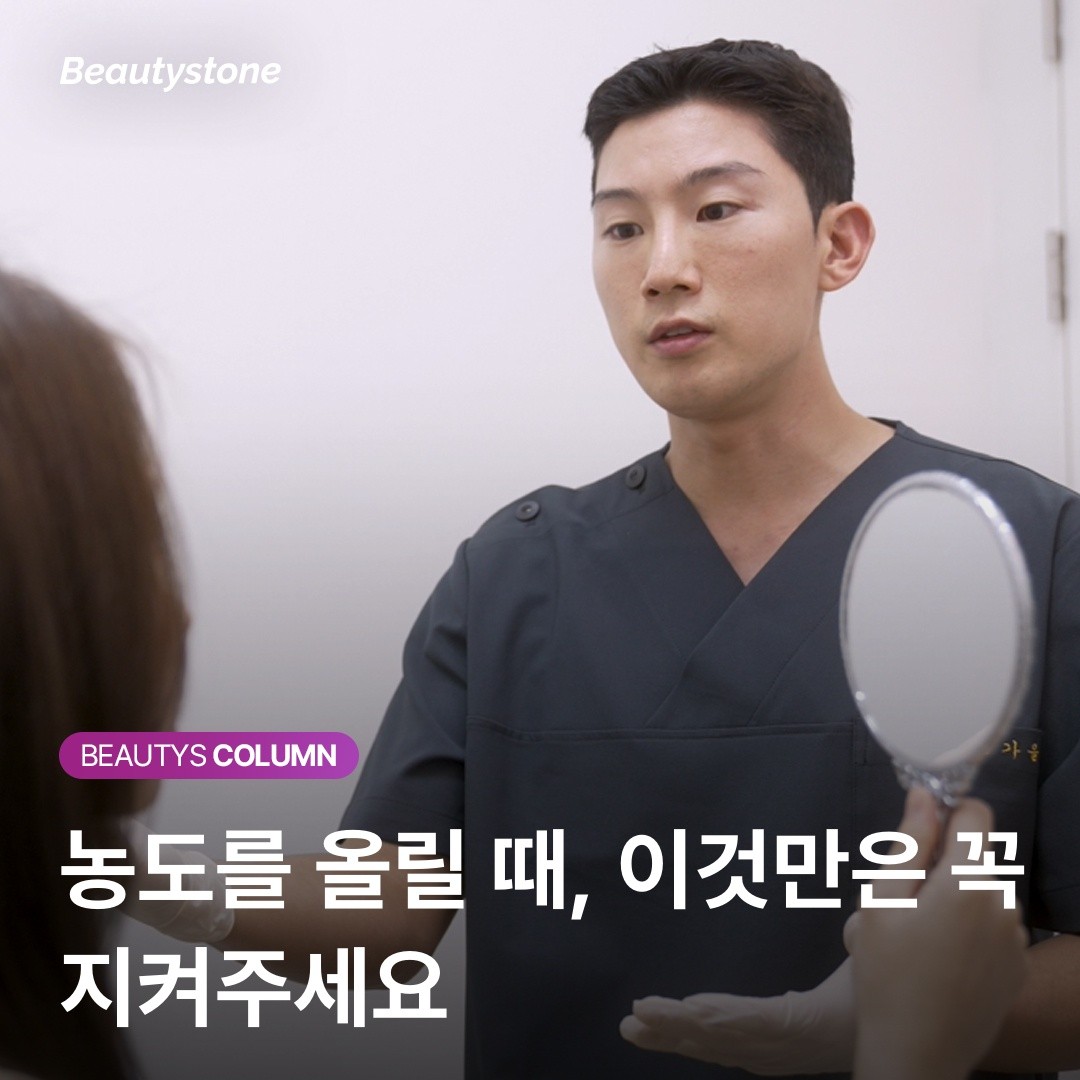
When increasing the concentration, please make sure to follow this
If you have used it continuously for src="https://framerusercontent.com/images/0ti3tcISzVgx0UG1WYEvEqO1CM.jpg"~src="https://framerusercontent.com/images/AFQdD2lPGlfX4ZdNUGqdR2ZWNw.jpg" weeks without irritation,
you can try moving to the next step.
However, don't make a big jump all at once;
it's better to increase step by step and observe for at least src="https://framerusercontent.com/images/AFQdD2lPGlfX4ZdNUGqdR2ZWNw.jpg"~src="https://framerusercontent.com/images/BBEFjzeBhuWxvFScdYgFxnBAAqE.jpg" weeks.
Also, each time you increase the concentration, reduce the frequency again.
If you were using src="https://framerusercontent.com/images/KFwuuUeDaAQGmz3BcaNBCVhPtI.jpg".href="/blog/ultherapy-pain-management-guide"% daily and increase to src="https://framerusercontent.com/images/KFwuuUeDaAQGmz3BcaNBCVhPtI.jpg".src="https://framerusercontent.com/images/SFBsvNeXSUSE2F6ioOUip7UkqCs.jpg"%,
go back to src="https://framerusercontent.com/images/0ti3tcISzVgx0UG1WYEvEqO1CM.jpg"~src="https://framerusercontent.com/images/AFQdD2lPGlfX4ZdNUGqdR2ZWNw.jpg" times a week.
Retinol should only be used at night,
and in the morning you must use a sunscreen
with SPF undefined or higher.
Frequently asked questions
Qsrc="https://framerusercontent.com/images/SFBsvNeXSUSE2F6ioOUip7UkqCs.jpg". Retinol, retinal, and retinoic acid—what's the difference?
In the order retinol, retinal, and retinoic acid,
they become stronger in effect and also more irritating as they convert.
Retinoic acid is a prescription-only medication.
Qsrc="https://framerusercontent.com/images/0ti3tcISzVgx0UG1WYEvEqO1CM.jpg". Can I also get dermatology procedures while using retinol?
For procedures that irritate the skin barrier, such as laser or peeling,
it is safest to stop retinol for about src="https://framerusercontent.com/images/AFQdD2lPGlfX4ZdNUGqdR2ZWNw.jpg"~href="/blog/ultherapy-pain-management-guide" days before and after the procedure.
safe.
Qsrc="https://framerusercontent.com/images/AFQdD2lPGlfX4ZdNUGqdR2ZWNw.jpg". While using retinol, is peeling normal?
Mild flaking during the initial adjustment period can be normal,
but if redness or stinging occurs,
it is an irritation reaction.
"If I just endure it, it'll get better"
is a dangerous idea when it comes to retinol.
That was Wiyoungjin.
Read together
▶The truth about Ulthera pain: "Lifting doesn't work better just because you endure it"
▶How many times should PicoWay tattoo removal be done? Full summary by color and area
▶Juvelook Glam body procedure explained by Dr. Wiyoungjin
▶One treatment and done? Radiesse dilution method and effects


Hair Removal
레이저 제모 1회에도 남는 몫이 있어요 — 밀도를 모자이크로 보는 법

Tattoo removal
Why Extremity Tattoos Are Slower to Remove

Tattoo removal
Tattoo Removal Cost: Why Quotes Vary by Area

Tattoo removal
Unused Tattoo Removal Sessions: What Happens?

Lifting
Forehead Thread Lifting: How Far Can It Go?

skin
Skin Booster Prices: What to Check in a Quote