

Tiny red dots and bruising after a skin booster are common but fade on different timelines. Here is what is normal each day and when to call your provider.
Published
Updated

Author
Wi Young-jin · Chief director
Seoul National University College of Medicine · Seoul National University Hospital Specialist
→
If you've just had a skin booster and you're staring at a cluster of tiny red dots — or a yellow-green bruise spreading across your cheek — you're not alone. These reactions are among the most common reasons people message their clinic the next morning, convinced something went wrong.
The short answer? In most cases, nothing did. But the two types of marks behave differently, fade at different rates, and respond to different aftercare. In this article, we'll cover why each one forms, what a normal day-by-day recovery looks like, which aftercare steps actually help, and the specific red flags that mean it's time to pick up the phone and call your provider.
What Are Skin Booster Injection Marks, Exactly?
Skin boosters — treatments like Juvelook, Rejuran, and other hyaluronic acid or polynucleotide-based injectables — are delivered through a grid of small, shallow injections just beneath the skin's surface. Each needle pass leaves a tiny entry point in the epidermis, and a micro-droplet of product settles in the upper dermis. The result is an instant puff of hydration at each injection site.
Those small, raised red dots you see immediately after treatment are called wheals — sometimes called papules. They're not cuts or inflammation in the classical sense. They're the product sitting in the dermis while your skin's fluid balance adjusts around it. Research on intradermal injection techniques confirms that these papules are a predictable, temporary consequence of the technique itself, not a sign of an adverse reaction.
Bruising is a separate animal entirely. It forms when the needle tip nicks a capillary — a microscopic blood vessel — releasing a small amount of blood into the surrounding tissue. The body then begins breaking down that pooled hemoglobin through a cascade of enzyme reactions, and the byproducts show up on your skin as the classic progression from red-purple to blue-green to yellow.
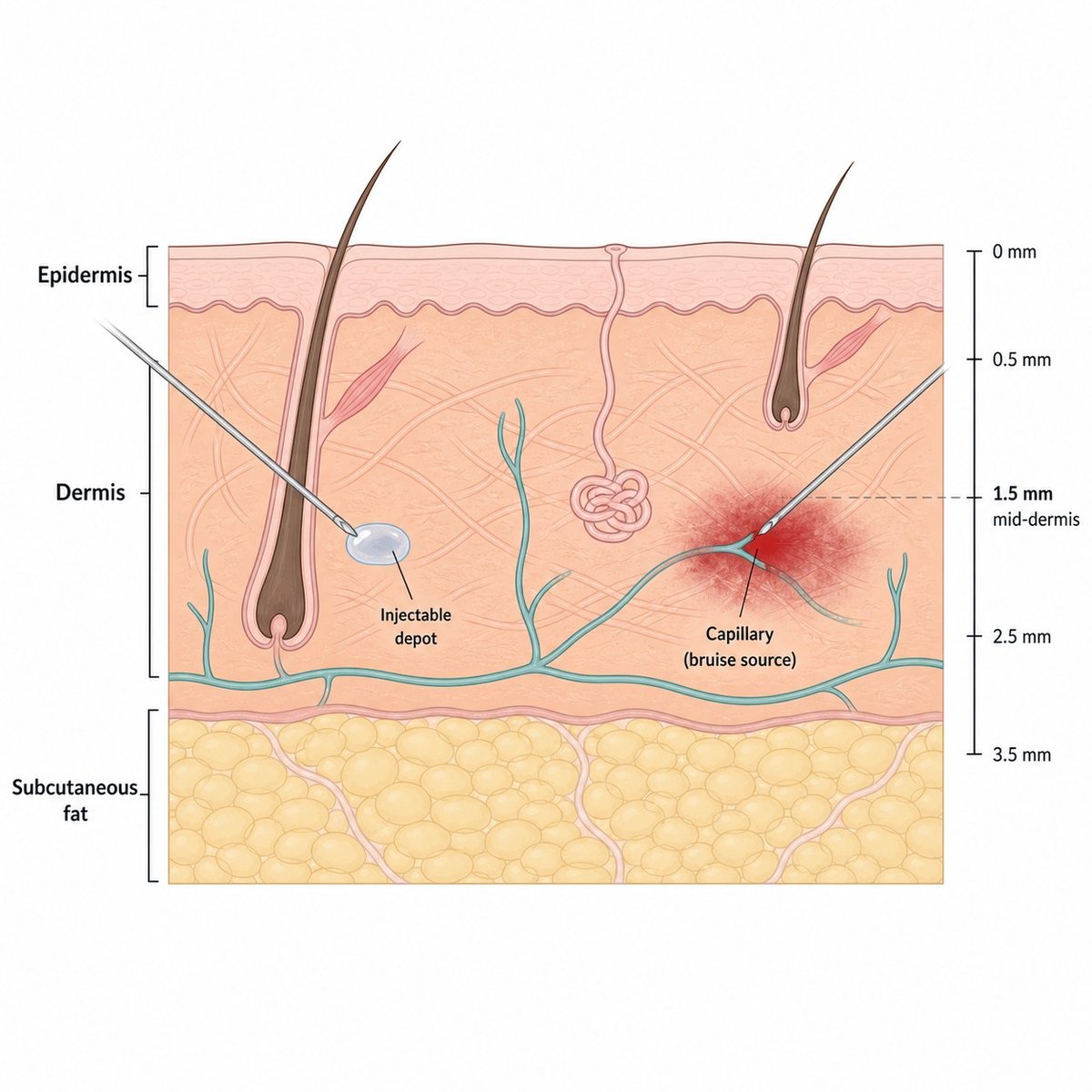
So the key insight — and the one that drives the whole timeline — is this: injection marks form at the level of the product depot in the dermis, while bruises form where a blood vessel was disrupted. Studies on dermal filler and booster tolerability consistently show that these two phenomena peak and resolve on independent schedules. Knowing which one you're looking at tells you roughly how many days you have left.
Day-by-Day Timeline: What Is Normal?
Here is how recovery typically unfolds. Individual results vary based on skin type, injection depth, the specific product used, and your personal clotting tendency — so treat these ranges as a guide, not a guarantee.
Immediately after (0–2 hours): The injection sites look raised, red, and almost pimple-like. There may be mild redness across the whole treated area. This is normal and expected. The wheals at each site contain the product droplet and will begin to flatten as the surrounding tissue absorbs fluid.
Day 1 (the morning after): This is when most people get worried. The wheals may still be visible, and any bruising that's going to appear usually makes its first show on day one — sometimes as a single darker patch, sometimes as a few scattered spots. Swelling from the product is at its peak. The area may feel firm or slightly tender to the touch.
Days 2–3: Injection marks should be noticeably flatter. For many people, the tiny red dots fade almost entirely by day three. Bruising, if present, begins its color shift — from the initial red-purple toward a deeper blue or blue-green. This color change is not a sign that things are getting worse. It's the body's macrophages breaking down hemoglobin into biliverdin, which is green, and bilirubin, which is yellow.
Days 4–5: Injection site redness is usually gone or minimal by this point. Bruising continues its progression toward yellow-green or pale yellow. The product from the booster is integrating into the dermal matrix, and the firmness you felt earlier is softening.
Days 6–10: Most bruising resolves fully within this window. Clinical data on post-injection bruising resolution puts the median for small-vessel bruising (the type most common with skin boosters) at around seven to ten days. Faint yellow staining may linger at the end of this period but is easily covered with foundation.
Two weeks and beyond: Any remaining marks at this point are worth a follow-up message to your provider. True persisting papules or hard nodules beyond two weeks warrant an in-person review — they're uncommon but not unheard of with certain polynucleotide products.
Aftercare Steps That Actually Help
You can't skip the timeline, but you can keep conditions optimal so the marks fade on the faster end of normal. Here's what the evidence supports — and a few things that are more folklore than fact.
Cold compress in the first 24 hours: Applying a clean cold pack (wrapped in cloth — never ice directly on skin) for 10–15 minutes a few times in the first day helps constrict blood vessels and limits the size of any bruise that's forming. After 24 hours, a warm compress does the opposite: it increases circulation and may help the body reabsorb pooled blood faster.
Arnica topical: Topical arnica gel is commonly recommended for bruising. The evidence is modest but positive — it's considered safe and generally worth trying if you have it. Don't apply it to any open micro-puncture site until it's fully closed (usually within a few hours of treatment).
Sun avoidance: This one is non-negotiable. UV exposure to a fresh bruise or inflamed injection site can trigger post-inflammatory hyperpigmentation — a darkening of the skin that's much harder to shift than the original mark. Keep the area covered or use a broad-spectrum sunscreen (SPF 50+) starting the morning after treatment.
Skip the gym for 48 hours: Exercise raises your core temperature and heart rate, which increases blood flow to the face and can worsen bruising. Two full days of skipping intense cardio is usually enough. Light walking is fine.
Avoid alcohol and blood-thinning supplements: Alcohol dilates blood vessels and slows clotting. The same applies to high-dose vitamin E, fish oil, and anti-inflammatory medications like ibuprofen — all of which thin the blood and make bruising worse. If you forgot to stop these before treatment, stopping them now still helps.
Don't massage the area: It's tempting to rub at a bruise, but pressure can push pooled blood into adjacent tissue and make the bruise spread. Published aftercare guidelines for injectable treatments consistently recommend keeping the treated area undisturbed for at least 24 hours.
One thing that's mostly myth: vitamin K cream. While vitamin K is involved in clotting, topical application doesn't meaningfully speed bruise resolution at the concentrations in most over-the-counter creams. You're better off with arnica and good sun protection.
Side Effects and Downtime: What You Should Know
Injection marks and bruising are expected outcomes of skin booster treatment — they're not, strictly speaking, side effects in the adverse sense. But there are real adverse reactions to watch for, and it's worth knowing the difference between normal recovery and a signal that something needs attention.
Normal reactions:
Wheals/papules — raised dots at injection sites, resolve within 1–3 days
Redness — mild general flush, usually gone within 24–48 hours
Bruising — up to 2 weeks, follows the color-shift progression described above
Mild swelling — peaks on day 1–2, mostly resolved by day 5
Tenderness — at injection sites, normal for a few days
Reactions that need a call to your provider:
Nodules that persist beyond 2 weeks — especially if firm and non-tender, these may be product granulomas requiring hyaluronidase or other treatment
Bruise that keeps growing after day 3 — a bruise should stabilize in size by day two or three; ongoing spread is worth flagging
Skin that blanches white — immediate whitening of a patch of skin after injection can signal vascular compromise and needs urgent attention
Increasing redness or warmth that spreads — as opposed to fading, progressive spreading warmth after the first 24 hours suggests infection
If you notice spreading redness, fever, worsening pain, or skin that looks dusky or mottled after the first 24 hours, seek medical care right away. These are rare with skin boosters, but vascular complications — though uncommon — require fast action. Individual results vary, and everyone's skin responds differently to injectable treatment.
Safety and tolerability data from controlled skin booster studies show that the vast majority of post-treatment reactions resolve without intervention within 7 days. Serious adverse events are uncommon but documented — provider skill and product selection matter.

Does Your Skin Type Affect How You Bruise?
Yes — and in ways that are worth understanding before your next session. Several factors influence how readily you bruise and how quickly you resolve those bruises.
Blood vessel fragility: Some people have naturally more fragile capillaries, which makes them prone to bruising from even gentle pressure. This tends to increase with age and with certain medications (blood thinners, steroids, some antidepressants). If you bruise easily in everyday life, plan on bruising more from injections.
Skin tone: Bruising shows up differently depending on your baseline skin tone. On lighter skin, the color shift (purple → blue → green → yellow) is easy to track. On darker skin, the early-stage redness and purple may not be visible, but the healing progression still happens underneath — you may just see the later yellow-green stage rather than the full sequence.
Injection depth and technique: Skin boosters placed in the superficial dermis generally cause less bruising than deeper filler injections. Needle gauge and provider technique also influence capillary injury — experienced injectors minimize vessel trauma through angle, speed, and pressure.
Preparation: The single most controllable factor is what you take (or don't take) before treatment. Stopping NSAIDs, high-dose omega-3 supplements, and alcohol for 5–7 days before a session reduces bruise size and duration for most people. Talk to your provider about your full medication and supplement list.
The Bottom Line
Injection marks and bruising after a skin booster are two separate reactions with different causes and different fade timelines — but both are a normal part of recovery for most people.
Injection site wheals (the raised red dots) typically flatten and fade within 1–3 days
Bruising follows a color-shift progression and usually resolves within 7–10 days
Cold compresses, sun protection, and avoiding blood thinners are the most evidence-backed aftercare steps
Red flags — spreading redness, growing bruise after day 3, white-blanching skin, or fever — warrant an immediate call to your provider
Like any injectable treatment, skin boosters come with trade-offs. The marks are real, but they're temporary. Ultimately, whether the downtime fits your schedule and your goals is a personal decision.
If you're considering a skin booster, a consultation is the best way to understand what your individual recovery might look like. Beautystone is a dermatology clinic in Seoul's Hapjeong area. You can see current treatment options at /en/promotion.
Frequently asked questions
Q. How long do skin booster injection marks last?
A. The small raised red dots (wheals) at each injection site usually flatten and disappear within 1 to 3 days. If you're still seeing visible marks beyond 5 days, let your provider know.
Q. Is bruising normal after a skin booster?
A. Yes, bruising is a common and expected reaction. It forms when the needle nicks a small blood vessel, and it follows the classic color progression from red-purple to blue-green to yellow. Most bruising resolves fully within 7 to 10 days. Individual results vary.
Q. What aftercare helps bruising fade faster?
A. A cold compress in the first 24 hours, arnica gel, strict sun avoidance, skipping intense exercise for 48 hours, and avoiding alcohol and blood-thinning supplements all help keep bruising on the shorter end of normal. Don't massage the treated area.
Q. When should I be worried about marks after a skin booster?
A. Contact your provider if a bruise keeps growing after day 3, if you develop a firm nodule that lasts beyond 2 weeks, or if you see spreading redness, increasing warmth, or skin that turns white or mottled. Seek immediate medical care if you have fever or worsening pain.


Contouring & Volume
Hip Dip Filler Before and After: 4 Checks

Body
Potenza Treatment Interval: Why 4 Weeks?

Lifting
Ultherapy Before and After: Why Wait 90 Days?

Contouring & Volume
Belotero Revive Cost: 2cc Price vs. 3 Sessions

skin
Lip Hyperpigmentation Laser: Does It Work?

Contouring & Volume
Men's Forehead Filler: Hollow or Just Lines?