Why Jaw Botox Every 3 Months Is a Bad Idea
Director Wi Young-jin’s blunt truth: Botox wearing off quickly is not caused by resistance.
It works amazingly well,
but people still come back
for another treatment,
and here’s why I turn them away

When spring comes and we prepare for a fresh start,
square jaw, forehead, and between the brows!
In the areas where it works best,
many people come in saying,
“I should get some Botox this time.”
There are a few common questions we hear every time,
so today I’d like to clear them up for you.
📌 Key questions before Botox treatment
Q. Do I really need it
every 3 months?
No. Three months is only an average.
Metabolism varies from person to person,
so the interval changes too.
*Just get it when you need it!
Q. Does getting it more often
make the results better?
Not necessarily.
In fact, if it’s too frequent,
problems can arise.
*Problem: compensatory muscles can become stronger.
Q. If it wears off quickly,
does that mean I’ve developed resistance?
It has nothing to do with resistance!
Resistance and metabolic speed are
completely different concepts.
1. Why a '3-month cycle'
is not always the right answer

The length of time Botox lasts
varies greatly from person to person.
That’s because the speed at which
nerve signal transmission is blocked and then recovers
differs.
In clinical practice,
patients generally fall into three types.
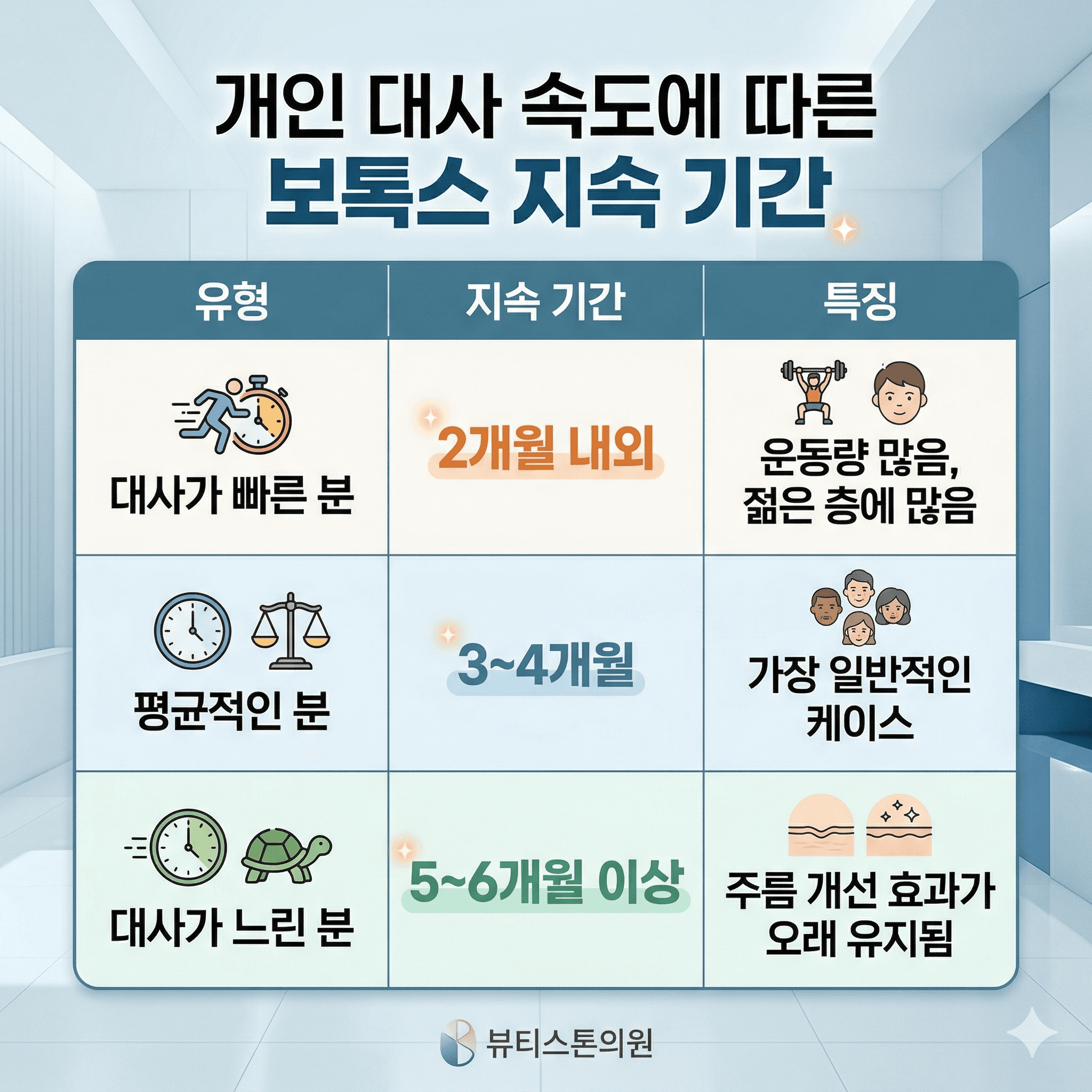
Type | Duration | Features |
Fast metabolizers | Around 2 months | High activity level, common among younger patients |
Average | 3–4 months | Most common case |
Slow metabolizers | 5–6 months or more | Wrinkle improvement lasts longer |
Even though the effect is still holding up strongly,
coming back
“because it’s been 3 months”
is simply an unnecessary expense.
[*We also explain it as a 3-month guideline]
2. The real problem when
you get it too often

If Botox is repeated at intervals that are too short,
antibodies (neutralizing antibodies)
can form in the body.
This is commonly called “resistance,”
and once it develops,
the effect won’t be as good as before.
(*Consider Coretox; because its molecular size is smaller,
the chance of resistance is much lower.)
Of course, with appropriate doses for wrinkle treatment or square-jaw correction,
the risk of resistance is low,
but
repeating treatment while the effect is still present
is not recommended.
I usually say
“the best time for a repeat treatment is when about 70–80% of the effect has worn off.”
that is the most appropriate
timing for retreatment.
👨⚕️ Dr. Wi Young-jin’s
Practical Notes
“It wore off completely in 2 months—
doesn’t that mean resistance?”
Quite a few people come in worried about this.
In most cases, it’s not resistance at all,
but simply a constitution with a fast metabolism.
That’s what we find on examination.
In these cases, rather than changing the product,
fine-tuning the dose or injection sites
slightly
is much more effective.
True resistance cases
are much rarer than people think.
3. Optimal intervals
differ by area

This is because muscle size and
movement differ depending on the area treated.
Forehead · glabella · eye area (3–4 months)
These areas use expression muscles a lot, so metabolism is faster.
Square jaw · calves (4–6 months)
The muscles are larger and thicker, so the effects last longer.
Neck lines (around 3 months)
Because there is a lot of movement, the duration tends to be shorter.
Getting masseter Botox every 3 months,
like forehead Botox,
is often excessive.
4. Can repeated treatments
build up benefits?

If you keep receiving it at the right interval,
the muscle itself
can gradually become thinner.
In particular, for areas like the square jaw or calves,
where the goal is to reduce bulk,
satisfaction is higher when patients receive it consistently 2–3 times.
However, this cumulative effect only appears
when the proper interval is maintained.
If the interval is too short
or too long, the results suffer.
Botox is not a one-time magic fix,
but something to manage consistently
over time.
💬 Frequently Asked Questions (FAQ)
Q1. Will my face look odd
if I get Botox often?
It’s fine as long as the dose and placement are appropriate.
However, if you get another treatment while the effect is still present,
your expression may look unnatural,
so caution is needed.
Q2. If I stop, will it get worse
than before?
No.
It simply returns to how it was before.
In fact, people who have had it for a long time
may look less prominent than before because the muscles have thinned.
Q3. I’m worried about resistance—
what should I do?
Avoid high-dose treatments
and keep the intervals in check.
If you’re concerned,
we recommend a pure toxin formulation
that lowers the chance of resistance.
Please discuss it thoroughly
before treatment and make your decision.
If you have any questions, send us a KakaoTalk message
and we’ll answer directly.
This has been Dr. Wi Young-jin of Hapjeong Beautystone Clinic
Wi Young-jin.
✦ Read more
How to prevent nodules after Sculptra side effects
Can lifting solve facial aging after rapid weight loss?
How much difference can one forehead filler session make in Hongdae, Seoul?
Does fat-dissolving injection really work in Hapjeong and Hongdae, Seoul?
Jaw Botox 50U or 100U? Korean? Xeomin? Beautystone Clinic in Hongdae
It works amazingly well,
but people still come back
for another treatment,
and here’s why I turn them away

When spring comes and we prepare for a fresh start,
square jaw, forehead, and between the brows!
In the areas where it works best,
many people come in saying,
“I should get some Botox this time.”
There are a few common questions we hear every time,
so today I’d like to clear them up for you.
📌 Key questions before Botox treatment
Q. Do I really need it
every 3 months?
No. Three months is only an average.
Metabolism varies from person to person,
so the interval changes too.
*Just get it when you need it!
Q. Does getting it more often
make the results better?
Not necessarily.
In fact, if it’s too frequent,
problems can arise.
*Problem: compensatory muscles can become stronger.
Q. If it wears off quickly,
does that mean I’ve developed resistance?
It has nothing to do with resistance!
Resistance and metabolic speed are
completely different concepts.
1. Why a '3-month cycle'
is not always the right answer

The length of time Botox lasts
varies greatly from person to person.
That’s because the speed at which
nerve signal transmission is blocked and then recovers
differs.
In clinical practice,
patients generally fall into three types.
Type | Duration | Features |
Fast metabolizers | Around 2 months | High activity level, common among younger patients |
Average | 3–4 months | Most common case |
Slow metabolizers | 5–6 months or more | Wrinkle improvement lasts longer |
Even though the effect is still holding up strongly,
coming back
“because it’s been 3 months”
is simply an unnecessary expense.
[*We also explain it as a 3-month guideline]
2. The real problem when
you get it too often

If Botox is repeated at intervals that are too short,
antibodies (neutralizing antibodies)
can form in the body.
This is commonly called “resistance,”
and once it develops,
the effect won’t be as good as before.
(*Consider Coretox; because its molecular size is smaller,
the chance of resistance is much lower.)
Of course, with appropriate doses for wrinkle treatment or square-jaw correction,
the risk of resistance is low,
but
repeating treatment while the effect is still present
is not recommended.
I usually say
“the best time for a repeat treatment is when about 70–80% of the effect has worn off.”
that is the most appropriate
timing for retreatment.
👨⚕️ Dr. Wi Young-jin’s
Practical Notes
“It wore off completely in 2 months—
doesn’t that mean resistance?”
Quite a few people come in worried about this.
In most cases, it’s not resistance at all,
but simply a constitution with a fast metabolism.
That’s what we find on examination.
In these cases, rather than changing the product,
fine-tuning the dose or injection sites
slightly
is much more effective.
True resistance cases
are much rarer than people think.
3. Optimal intervals
differ by area

This is because muscle size and
movement differ depending on the area treated.
Forehead · glabella · eye area (3–4 months)
These areas use expression muscles a lot, so metabolism is faster.
Square jaw · calves (4–6 months)
The muscles are larger and thicker, so the effects last longer.
Neck lines (around 3 months)
Because there is a lot of movement, the duration tends to be shorter.
Getting masseter Botox every 3 months,
like forehead Botox,
is often excessive.
4. Can repeated treatments
build up benefits?

If you keep receiving it at the right interval,
the muscle itself
can gradually become thinner.
In particular, for areas like the square jaw or calves,
where the goal is to reduce bulk,
satisfaction is higher when patients receive it consistently 2–3 times.
However, this cumulative effect only appears
when the proper interval is maintained.
If the interval is too short
or too long, the results suffer.
Botox is not a one-time magic fix,
but something to manage consistently
over time.
💬 Frequently Asked Questions (FAQ)
Q1. Will my face look odd
if I get Botox often?
It’s fine as long as the dose and placement are appropriate.
However, if you get another treatment while the effect is still present,
your expression may look unnatural,
so caution is needed.
Q2. If I stop, will it get worse
than before?
No.
It simply returns to how it was before.
In fact, people who have had it for a long time
may look less prominent than before because the muscles have thinned.
Q3. I’m worried about resistance—
what should I do?
Avoid high-dose treatments
and keep the intervals in check.
If you’re concerned,
we recommend a pure toxin formulation
that lowers the chance of resistance.
Please discuss it thoroughly
before treatment and make your decision.
If you have any questions, send us a KakaoTalk message
and we’ll answer directly.
This has been Dr. Wi Young-jin of Hapjeong Beautystone Clinic
Wi Young-jin.
✦ Read more
How to prevent nodules after Sculptra side effects
Can lifting solve facial aging after rapid weight loss?
How much difference can one forehead filler session make in Hongdae, Seoul?
Does fat-dissolving injection really work in Hapjeong and Hongdae, Seoul?
Jaw Botox 50U or 100U? Korean? Xeomin? Beautystone Clinic in Hongdae
Recommended post
Recommended post
Latest post
Latest post

Contouring & Volume
Dysport and Botox are both botulinum toxin, but they’re different..
Even if the ingredients seem similar, the results can be different. We explain the practical differences between Dysport and Botox in an easy-to-understand way.

skin
Dark circles: not just sleep — 3 causes
Persistent dark circles despite enough sleep point to other causes. A treatment guide by type.

Contouring & Volume
Before Botox and filler treatments, which medications and supplements should you stop taking?
Which medications and supplements should I temporarily stop to reduce the risk of bruising and bleeding?

skin
After a collagen booster treatment, when can I start exercising?
Clinic guidance on when it is safe to return to the gym and running after a collagen booster procedure.

skin
After a procedure, when can I start using sheet masks, and which ingredients should I avoid?
Why Face Masks Can Be Irritating Right After a Procedure, and Safer Moisturizing Options.

skin
Why the Treatment Order Differs for Post-Procedure Pigmentation and Scarring
Why pigmentation and scars should not be treated at the same time, and the proper treatment order.
1:1 Custom Approach
💬 Eng Available 1:1 consultations available via Whatsapp
🌸 Beautystone Clinic attends the Meditox Bangkok Cadaver Workshop 🌸
1:1 Custom Approach


![[Beauty Stone] How to Avoid Failing at Dark Circle Filler? "The Precision of 0.3cc Changes the Results"](https://framerusercontent.com/images/F4Q84TUWgjbZJV6MNheLnWHnaw.jpg?width=1080&height=1080)