No effect after 10 jaw Botox sessions — here's what changed after parotid gland Botox

Jaw Botox Failed 10x? Parotid Gland Fixed It

Jaw Botox Failed 10x? Parotid Gland Fixed It

Jaw Botox Failed 10x? Parotid Gland Fixed It

Jaw Botox alone won't slim your face — you also need parotid gland treatment.

No botox effect after 10 jaw injections — until parotid gland botox changed everything


More patients are coming in with a solid understanding of their own facial structure these days.


It's not just "I want to slim my face" anymore.

Many now say upfront, "I want to understand what's actually causing my issue."


In that context, more people are asking about both jaw botox and parotid gland botox

— and the questions have been coming in more frequently.


Today's topic: the difference between the two, and which one you actually need.


Q. Are jaw botox and parotid gland botox the same treatment?


A. No. They target completely different structures. I'll explain in detail below.


Q. I have a prominent square jaw — do I need both?


A. It depends on the underlying cause. I'll break down how to tell them apart below.


Q. Can Xeomin produce the same results?


A. Yes, it can. However, dosage conversion and technique differ — I'll cover that separately.

Jaw Botox vs. Parotid Gland Botox: A Comparative Guide


Here's where it gets nuanced — not every square jaw has the same cause.

This is a common misconception:


A wide lower face that looks like a square jaw actually comes from two very different structures.


One is an overdeveloped Masseter (chewing muscle)masseter (chewing muscle).


The other is an enlarged Parotid gland (salivary gland near the ear)parotid gland.


The masseter sits just below the cheekbone, along the outer edge of the jawbone.


It enlarges from teeth grinding or frequently chewing tough foods.


Injecting botox here is what we call jaw botox.

The parotid gland, on the other hand, is a salivary gland located just in front of and below the ear.


When it's naturally large or has become enlarged, it overlaps visually with the masseter —


which is why some people see no results no matter how many jaw botox treatments they get.

I noticed this pattern over time


while treating patients who had received multiple jaw botox sessions elsewhere with no visible change.


That's when I started checking the parotid gland size first.


When these two structures aren't distinguished before treatment,


reducing the masseter alone won't help if the parotid volume remains the same.

Category

Jaw Botox (Masseter)

Parotid Gland Botox

Target Structure

Masseter (muscle)

Parotid gland (salivary gland)

Location

Below cheekbone, outer jawline

In front of/below ear, behind the masseter

Primary Cause

Teeth grinding, overactive chewing

Congenital enlargement, body type

Onset of Effect

4–8 weeks (muscle atrophy)

2–4 weeks (reduced secretion & volume)

Duration

~4–6 months in my experience

~4–6 months in my experience

How to Check

The area that bulges when you clench your teeth

That bulge just in front of and below the ear — even when you're completely relaxed

Masseter vs. Parotid Gland: Anatomy and Location Explained

Here's something important to understand — both can exist at the same time.

It varies case by case, but here's how I typically approach it.


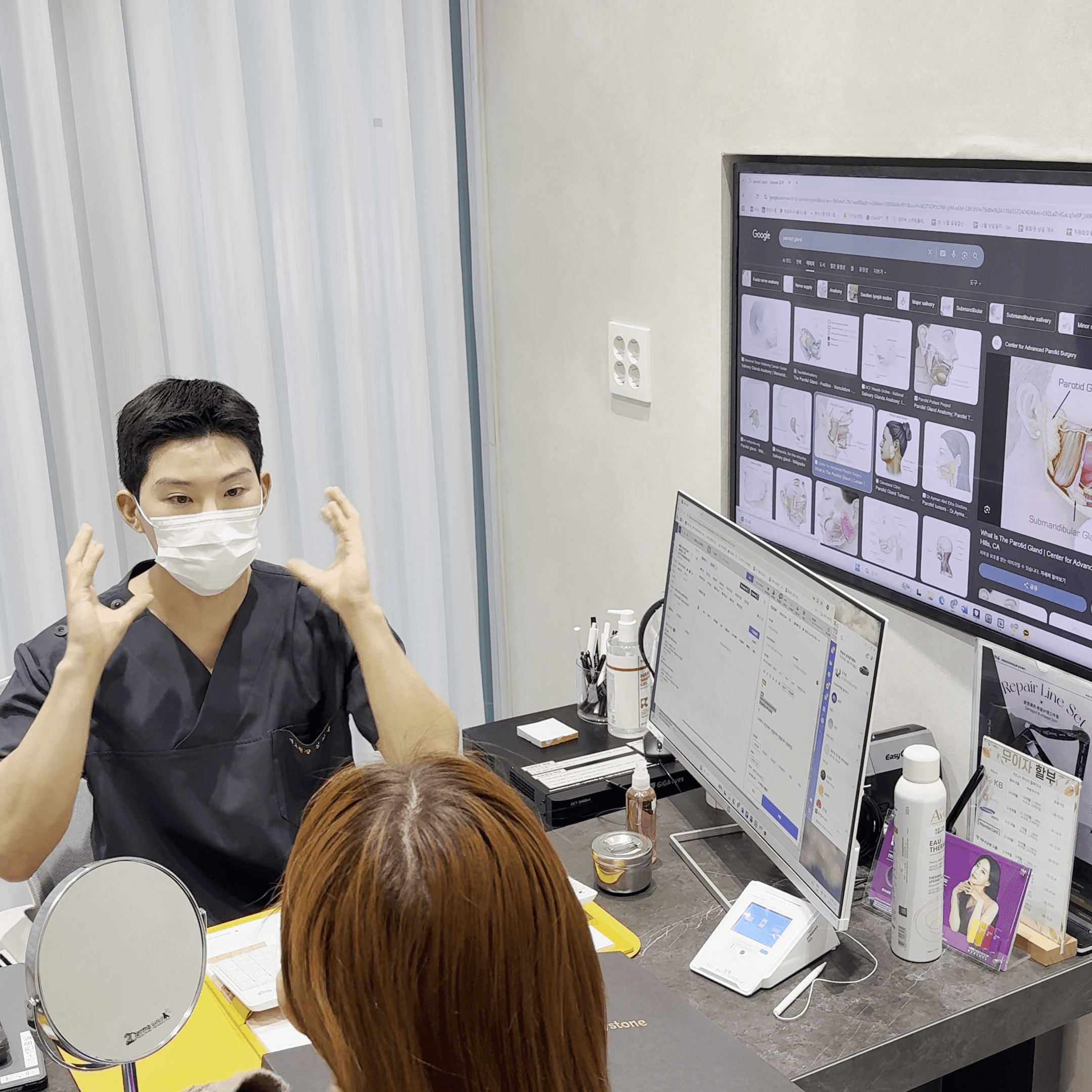
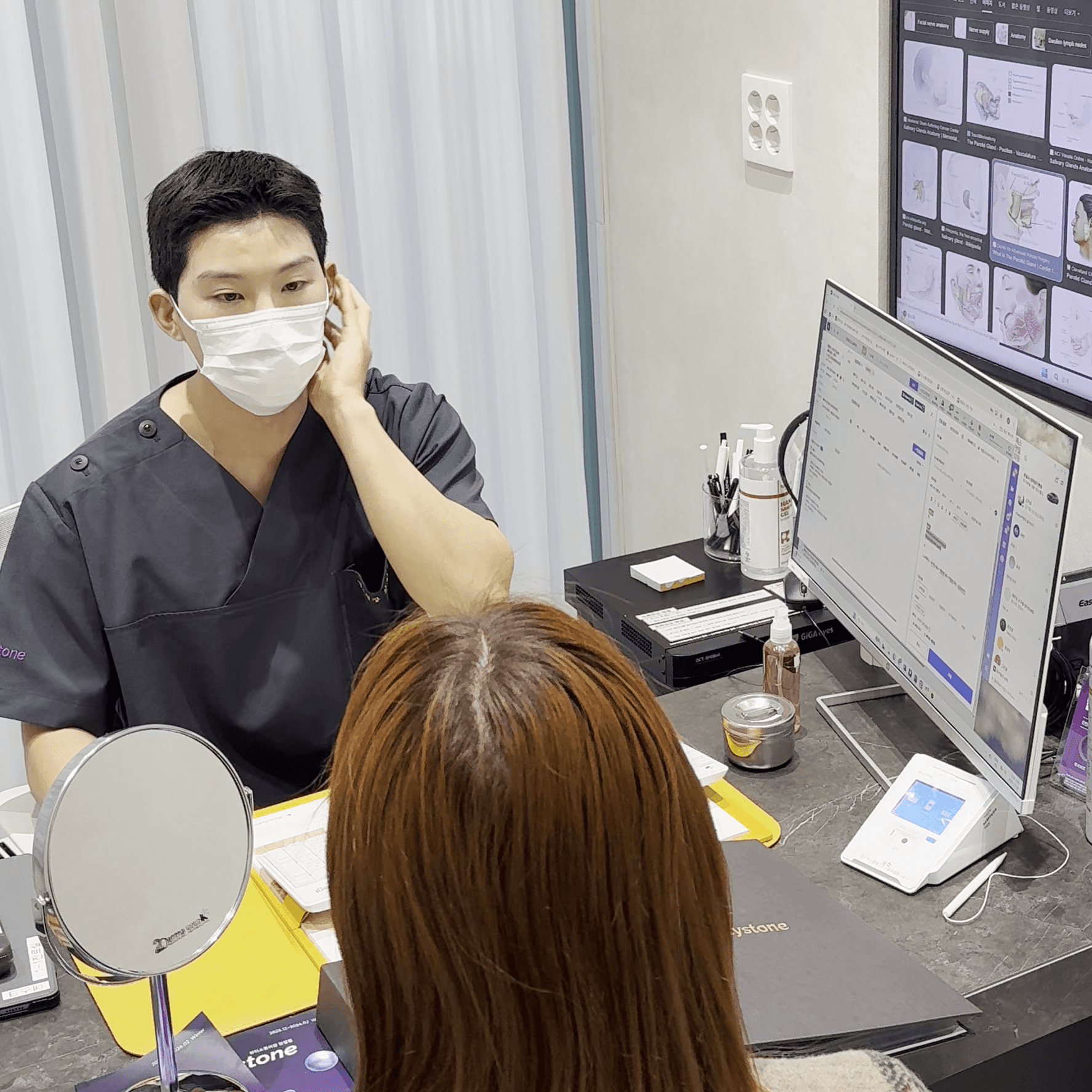
In the clinic, I ask patients to clench their teeth firmly.


Then I check whether the masseter muscle pops out — and whether the bulge remains even when relaxed.


If there's still significant volume when relaxed, the parotid gland is likely involved.


Quite a few patients have enlargement in both structures.


In those cases, Botox is split between the masseter and the parotid gland.


Injecting into the parotid is technically more demanding.


The facial nerve runs through this area,


so precise control of injection depth and placement is critical.


A misplaced injection can cause temporary facial muscle weakness.


This is why an anatomically experienced physician is essential.


To be honest,


parotid Botox is more technically challenging than it gets credit for —


and many patients are still only receiving masseter Botox as a result.


Dr. Wi Young-jin's Clinical Notes:


I often see patients who've had jaw Botox over 10 times elsewhere with little to no results.


On examination, parotid gland enlargement turns out to be the culprit in many of these cases.


In my experience, these patients respond far better to a combined approach — masseter plus parotid — than masseter Botox alone.


One thing I always make clear upfront: parotid injections are in close proximity to branches of the facial nerve.


No matter how good the product is, incorrect placement can lead to complications rather than results.


I always discuss this with patients beforehand.


What changes when using Xeomin

Xeomin (incobotulinumtoxinA) is one of the botulinum toxin products available.


It's a purified toxin with complexing proteins removed —


which means there may be a lower risk of antibody formation with long-term use.


(Research is still ongoing, so no definitive conclusions yet.)

When using Xeomin for jaw or parotid Botox,


the standard conversion is 1:1 with conventional Botox (onabotulinumtoxinA) —


though dosage adjustments are sometimes made based on individual cases.

That said, it's not a straightforward upgrade.


Xeomin has strict cold-chain storage requirements,


and post-dilution timing must be carefully managed —


inconsistent handling can lead to unpredictable results.


Still, for those planning long-term treatment, it's a very worthwhile option to consider.
Xeomin for Jaw & Parotid Gland: Treatment Comparison

Key Takeaways:First, identify whether your square jaw is caused by the masseter muscle or the parotid gland. Choosing a product like Xeomin comes after that.


Check These Before Your Treatment

Here's the checklist I go through with every patient.

1. Does the area below your cheekbone bulge when you clench your teeth? → Possible masseter hypertrophy
2. Does the area in front of and below your ear protrude even when relaxed? → Possible parotid gland enlargement
3. Had jaw Botox before with little to no results? → Parotid gland should be evaluated
4. Do you grind your teeth (bruxism)? → Likely a contributing cause of masseter hypertrophy
5. Do you experience jaw pain or headaches? → Masseter hypertonicity may also be involved

If you answered yes to #2 or #3,


I'd recommend a consultation that includes parotid gland Botox.

One thing I often see —


booking based on price alone, without a proper consultation,


means many patients don't receive the right combination of treatments for their needs.


We see patients coming from Sinchon and Ewha areas too.


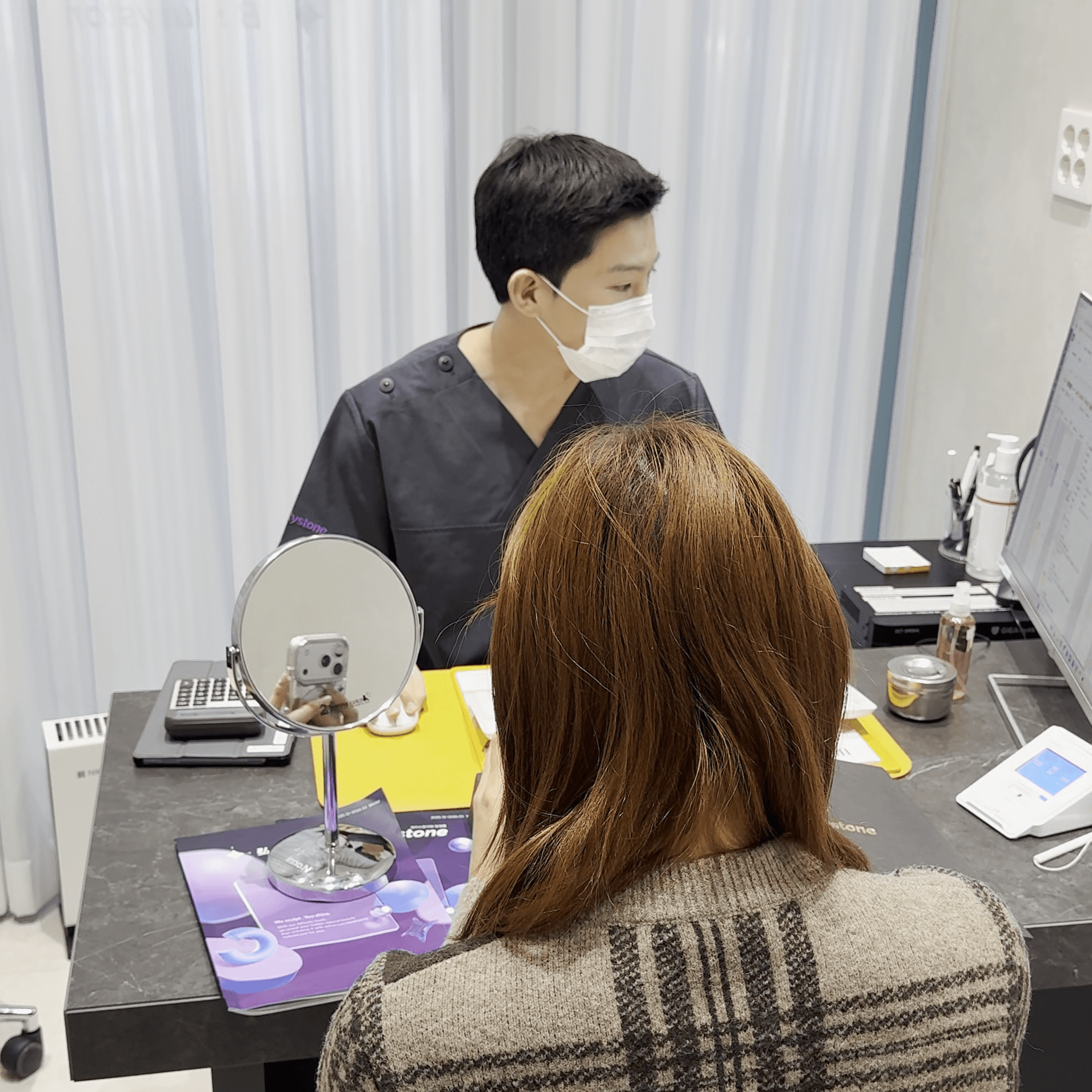
Many say it was their first time getting a proper explanation — after repeating treatments elsewhere without ever identifying the root cause.


Frequently Asked Questions


Q1. Will parotid gland Botox dry out my mouth by reducing saliva?

A. The goal isn't to fully block parotid function — just to reduce its volume. In my experience, significant dry mouth is uncommon. That said, individual responses vary, and excessive dosing can cause temporary dryness, so precise dosing is key.


Q2. It's my first time getting jaw Botox — should I go with Xeomin or regular Botox?

A. For a first treatment, the difference in results is minimal. Xeomin is more commonly considered when there's concern about antibody formation with repeated sessions. First, the priority is finding the right dose and injection points for you.


Q3. When will I see results, and how long do they last?

A. Masseter Botox takes time for the muscle to atrophy — changes are typically visible around 4–8 weeks. Parotid Botox tends to work faster, around 2–4 weeks. In my experience, both areas last roughly 4–6 months. If you grind your teeth heavily, expect a somewhat shorter duration.


This has been Dr. Wi Young-jin.
Feel free to reach out on KakaoTalk anytime with questions.


✦ Related Reading

No botox effect after 10 jaw injections — until parotid gland botox changed everything


More patients are coming in with a solid understanding of their own facial structure these days.


It's not just "I want to slim my face" anymore.

Many now say upfront, "I want to understand what's actually causing my issue."


In that context, more people are asking about both jaw botox and parotid gland botox

— and the questions have been coming in more frequently.


Today's topic: the difference between the two, and which one you actually need.


Q. Are jaw botox and parotid gland botox the same treatment?


A. No. They target completely different structures. I'll explain in detail below.


Q. I have a prominent square jaw — do I need both?


A. It depends on the underlying cause. I'll break down how to tell them apart below.


Q. Can Xeomin produce the same results?


A. Yes, it can. However, dosage conversion and technique differ — I'll cover that separately.

Jaw Botox vs. Parotid Gland Botox: A Comparative Guide


Here's where it gets nuanced — not every square jaw has the same cause.

This is a common misconception:


A wide lower face that looks like a square jaw actually comes from two very different structures.


One is an overdeveloped Masseter (chewing muscle)masseter (chewing muscle).


The other is an enlarged Parotid gland (salivary gland near the ear)parotid gland.


The masseter sits just below the cheekbone, along the outer edge of the jawbone.


It enlarges from teeth grinding or frequently chewing tough foods.


Injecting botox here is what we call jaw botox.

The parotid gland, on the other hand, is a salivary gland located just in front of and below the ear.


When it's naturally large or has become enlarged, it overlaps visually with the masseter —


which is why some people see no results no matter how many jaw botox treatments they get.

I noticed this pattern over time


while treating patients who had received multiple jaw botox sessions elsewhere with no visible change.


That's when I started checking the parotid gland size first.


When these two structures aren't distinguished before treatment,


reducing the masseter alone won't help if the parotid volume remains the same.

Category

Jaw Botox (Masseter)

Parotid Gland Botox

Target Structure

Masseter (muscle)

Parotid gland (salivary gland)

Location

Below cheekbone, outer jawline

In front of/below ear, behind the masseter

Primary Cause

Teeth grinding, overactive chewing

Congenital enlargement, body type

Onset of Effect

4–8 weeks (muscle atrophy)

2–4 weeks (reduced secretion & volume)

Duration

~4–6 months in my experience

~4–6 months in my experience

How to Check

The area that bulges when you clench your teeth

That bulge just in front of and below the ear — even when you're completely relaxed

Masseter vs. Parotid Gland: Anatomy and Location Explained

Here's something important to understand — both can exist at the same time.

It varies case by case, but here's how I typically approach it.


In the clinic, I ask patients to clench their teeth firmly.


Then I check whether the masseter muscle pops out — and whether the bulge remains even when relaxed.


If there's still significant volume when relaxed, the parotid gland is likely involved.


Quite a few patients have enlargement in both structures.


In those cases, Botox is split between the masseter and the parotid gland.


Injecting into the parotid is technically more demanding.


The facial nerve runs through this area,


so precise control of injection depth and placement is critical.


A misplaced injection can cause temporary facial muscle weakness.


This is why an anatomically experienced physician is essential.


To be honest,


parotid Botox is more technically challenging than it gets credit for —


and many patients are still only receiving masseter Botox as a result.


Dr. Wi Young-jin's Clinical Notes:


I often see patients who've had jaw Botox over 10 times elsewhere with little to no results.


On examination, parotid gland enlargement turns out to be the culprit in many of these cases.


In my experience, these patients respond far better to a combined approach — masseter plus parotid — than masseter Botox alone.


One thing I always make clear upfront: parotid injections are in close proximity to branches of the facial nerve.


No matter how good the product is, incorrect placement can lead to complications rather than results.


I always discuss this with patients beforehand.


What changes when using Xeomin

Xeomin (incobotulinumtoxinA) is one of the botulinum toxin products available.


It's a purified toxin with complexing proteins removed —


which means there may be a lower risk of antibody formation with long-term use.


(Research is still ongoing, so no definitive conclusions yet.)

When using Xeomin for jaw or parotid Botox,


the standard conversion is 1:1 with conventional Botox (onabotulinumtoxinA) —


though dosage adjustments are sometimes made based on individual cases.

That said, it's not a straightforward upgrade.


Xeomin has strict cold-chain storage requirements,


and post-dilution timing must be carefully managed —


inconsistent handling can lead to unpredictable results.


Still, for those planning long-term treatment, it's a very worthwhile option to consider.

Xeomin for Jaw & Parotid Gland: Treatment Comparison

Key Takeaways:First, identify whether your square jaw is caused by the masseter muscle or the parotid gland. Choosing a product like Xeomin comes after that.


Check These Before Your Treatment

Here's the checklist I go through with every patient.

1. Does the area below your cheekbone bulge when you clench your teeth? → Possible masseter hypertrophy
2. Does the area in front of and below your ear protrude even when relaxed? → Possible parotid gland enlargement
3. Had jaw Botox before with little to no results? → Parotid gland should be evaluated
4. Do you grind your teeth (bruxism)? → Likely a contributing cause of masseter hypertrophy
5. Do you experience jaw pain or headaches? → Masseter hypertonicity may also be involved

If you answered yes to #2 or #3,


I'd recommend a consultation that includes parotid gland Botox.

One thing I often see —


booking based on price alone, without a proper consultation,


means many patients don't receive the right combination of treatments for their needs.


We see patients coming from Sinchon and Ewha areas too.


Many say it was their first time getting a proper explanation — after repeating treatments elsewhere without ever identifying the root cause.


Frequently Asked Questions


Q1. Will parotid gland Botox dry out my mouth by reducing saliva?

A. The goal isn't to fully block parotid function — just to reduce its volume. In my experience, significant dry mouth is uncommon. That said, individual responses vary, and excessive dosing can cause temporary dryness, so precise dosing is key.


Q2. It's my first time getting jaw Botox — should I go with Xeomin or regular Botox?

A. For a first treatment, the difference in results is minimal. Xeomin is more commonly considered when there's concern about antibody formation with repeated sessions. First, the priority is finding the right dose and injection points for you.


Q3. When will I see results, and how long do they last?

A. Masseter Botox takes time for the muscle to atrophy — changes are typically visible around 4–8 weeks. Parotid Botox tends to work faster, around 2–4 weeks. In my experience, both areas last roughly 4–6 months. If you grind your teeth heavily, expect a somewhat shorter duration.


This has been Dr. Wi Young-jin.
Feel free to reach out on KakaoTalk anytime with questions.


✦ Related Reading

Recommended post

Recommended post

Latest post

Latest post

홍대 레이저제모, '프라이빗'이라는 말의 진짜 의미는?

Hair Removal

홍대 레이저제모, '프라이빗'이라는 말의 진짜 의미는?

홍대 프라이빗 레이저제모를 고민 중이라면, 기계 차이보다 '누가, 어떤 공간에서 진행하는가'가 결과를 바꿉니다.

칼슘 필러 레디어스 vs HA 필러, 내 얼굴 볼륨을 위한 더 나은 선택은?

Lifting

레디어스, 단순히 오래가는 필러? "피부가 스스로 콜라겐을 만들게 합니다"

레디어스가 일반 볼륨 필러와 다른 이유, 콜라겐 유도 원리부터 시술 대상까지 원장이 직접 설명합니다.

레터링 문신 제거, 어렵다고 겁먹지 않아도 됩니다

Hair Removal

피부색 어두우면 제모 못 한다고요? 그 말 절반은 틀렸습니다

피부색이 어두운 분도 레이저 제모가 가능합니다. 파장과 기기 설정에 따라 화상 위험 없이 안전하게 시술받을 수 있는 이유를 설명합니다.

올리지오X, 기존 올리지오랑 뭐가 다른 건가요?

Lifting

올리지오X, 기존 올리지오랑 뭐가 다른 건가요?

올리지오X는 듀얼 모드 에너지로 피부 더 깊고 촘촘하게 자극하는 RF 리프팅 장비입니다. 홍대 피부과 추천을 찾는 분들께 실제 원리와 케이스별 접근법을 안내합니다.

가로 목주름 지우기: 왜 '벨로테로 소프트' 전용 필러여야 할까?

Contouring & Volume

목주름 필러 후 울퉁불퉁? "아무 제품이나 쓰면 안 되는 이유"

목주름 필러 시술 시 결절 없이 자연스러운 결과를 얻으려면 벨로테로소프트 같은 전용 제품 선택이 핵심입니다.

"살 빠졌냐는 말 자주 들어요" 팔자주름 필러가 주는 드라마틱한 변화

Contouring & Volume

팔자주름, 선이 문제가 아닙니다! 필러로 '그늘'을 지워야 하는 이유

팔자주름 필러, 어떤 원리로 어려 보이게 만들까요? 꺼진 부위에 생기는 그늘과 필러 탄성의 관계를 알기 쉽게 설명합니다.